NEW YORK, July 30, 2026, 14:01 EDT — U.S. trading begins
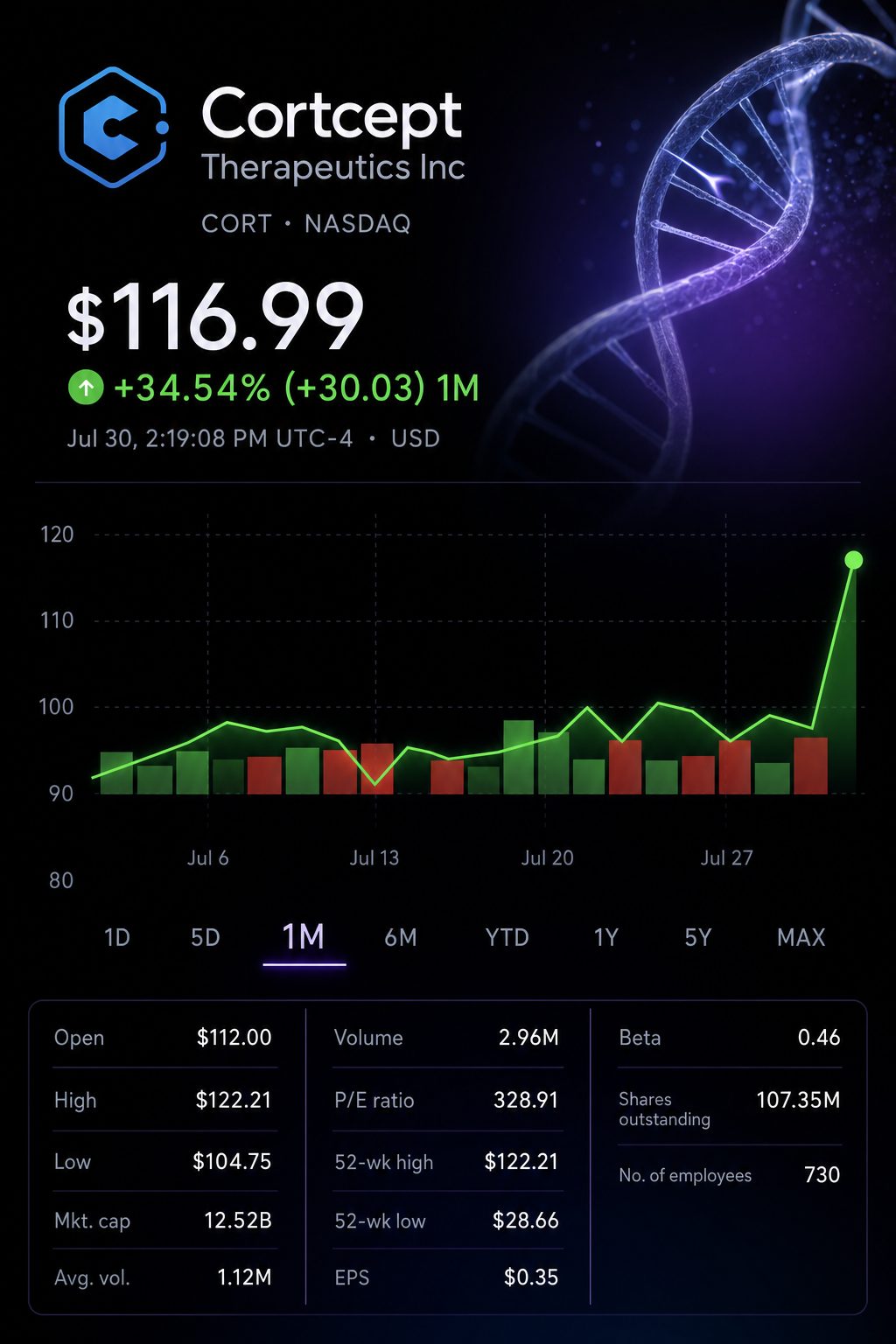
Corcept shares rose 27.4% to $118.41, having reached as high as $122.23 earlier.
Revenue for the second quarter climbed 32% to $256.1 million, with Lifyorli accounting for $47.6 million.
Based on reported data, midpoint guidance calls for $729 million in revenue during the second half.
Shares of Corcept Therapeutics Incorporated NASDAQ:CORT jumped 27.4% to $118.41 as of 13:45 EDT. The company reported a 32% increase in quarterly sales and lifted its full-year guidance.
The updated revenue outlook is between $1.1 billion and $1.2 billion. First-half revenue was reported at $421.0 million.
This raises the bar. From July to December, Corcept requires $729 million.
The bridge shown below reflects an author’s calculation, not official preliminary guidance from the company. It is based on first-half revenue figures that have been reported and the updated full-year range from management.
$ million unless stated
Low case
Midpoint
High case
Full-year forecast
1,100.0
1,150.0
1,200.0
Reported in first half
421.0
421.0
421.0
Second half needed
679.0
729.0
779.0
Q3-Q4 revenue average
339.5
364.5
389.5
Rise from Q2 rate
32.6%
42.3%
52.1%
Quarterly revenue needs to reach an average of $364.5 million at the halfway mark, representing a 42.3% increase from the second-quarter figure.
The advance outpaced gains in biotechnology shares. The iShares Nasdaq Biotechnology ETF (NASDAQ:IBB) slipped 0.4%. Xeris Biopharma Holdings NASDAQ:XERS, which offers the Cushing’s therapy Recorlev, was little changed.
Security
Price at about 13:45 EDT
Day move
Intraday high
Corcept Therapeutics
$118.41
+27.4%
$122.23
iShares Nasdaq Biotechnology ETF
$187.72
-0.4%
$188.55
Xeris Biopharma
$8.38
-0.1%
$8.48
Corcept reported that revenue increased at a marginally higher rate than operating expenses. Net income climbed 22.5%, while diluted earnings increased by 24.1%.
$ million except EPS
Q2 2026
Q2 2025
Change
Revenue
256.1
194.4
+31.7%
Korlym and authorized generic
208.6
194.4
+7.3%
Lifyorli
47.6
—
New
Operating expenses
214.8
167.8
+28.0%
Net income
43.0
35.1
+22.5%
Diluted EPS
$0.36
$0.29
+24.1%
Lifyorli accounted for 18.6% of revenue in its initial quarter on the market. The product contributed 77.1% of the annual dollar growth.
Lifyorli has been started by over 1,300 patients, according to management. The therapy has been prescribed by upwards of 1,000 doctors, indicating substantial initial uptake. However, how long patients continue the treatment is not yet known.
Chief Executive Joseph Belanoff stated that “Demand for Lifyorli has accelerated each month.” Chief Financial Officer Atabak Mokari noted inventory made minimal impact on sales. Distributors held about a week’s worth of supply. Corcept Therapeutics, Incorporated
The Cushing’s franchise showed further improvement. Korlym and its authorized generic grew by 7.3% compared to the previous year. Revenue climbed 26.5% from the first quarter.
Sean Maduck, president of endocrinology at Corcept, stated the rise was unrelated to backlog reduction, noting that the company had finished its specialty-pharmacy shift. He said record levels were instead seen in new patient enrolments.
Cash and investments increased by $29.2 million since March to reach $544.6 million. However, net income for the first half declined to $11.2 million compared to $55.7 million. Spending rose due to launch expenses and investment related to the Cushing’s business.
The upcoming key catalyst will be another FDA ruling regarding relacorilant. The agency is set to make its decision on the Cushing’s submission by December 17, 2026. Additional updates from European regulators and on metabolic-disease developments are anticipated within the year.
Risks: The FDA turned down the previous Cushing’s application in December due to lacking sufficient efficacy data. An amended notification highlighted issues related to liver safety and mentioned earlier regulatory cautions. The updated sales outlook also relies on ongoing momentum in both franchises.
The share reaction reflects expectations beyond a successful rollout. It factors in continued momentum for both businesses since the June quarter. Third-quarter revenue results will serve as the initial gauge.
At 1:40 p.m. ET, CORT was trading at $118.27, up about 27.2%. Shares moved between $105.00 and $122.23 following Wednesday’s $92.95 close. XBI added approximately 1.0%, while IBB slipped around 0.5%. The divergence indicates a move unique to the company, rather than a sector-wide biotech surge. The stock climbed on strong sales and a significant boost to full-year revenue guidance.
How robust were Corcept’s results for the second quarter?
Revenue totaled $256.1 million, a rise of 32% from $194.4 million a year earlier. Diluted EPS stood at $0.36, up from $0.29 in Q2 2025. Net income was $43.0 million, compared to $35.1 million previously. Operating expenses advanced 28% to $214.8 million, reflecting stronger commercial investment. Despite this, operating income advanced 55% to $41.3 million.
How challenging is the updated 2026 revenue projection?
Management lifted its 2026 revenue outlook to $1.1–$1.2 billion. Revenue for the first half came in at $421.1 million, which leaves $678.9–$778.9 million needed for the second half. Achieving that will require quarterly revenue of about $339–$389 million on average. The pace required is 33%–52% higher than second-quarter sales. Meeting these goals relies on quicker Lifyorli uptake and ongoing momentum in Cushing’s.
Is Lifyorli beginning to establish itself as a significant product?
Lifyorli posted $47.6 million in revenue in its first full quarter of commercial sales, accounting for 18.6% of Corcept’s second-quarter revenue. Since gaining approval in March, over 1,300 patients have initiated therapy. In April, NCCN designated the combination as a preferred regimen. The straightforward annualized sales rate stands at roughly $190 million, though analysts caution against extrapolating from the launch quarter.
Is there potential for ongoing growth in the established Cushing’s franchise, even as generics exert pressure?
Revenue from hypercortisolism products reached $208.6 million, an increase of 7.3% from a year earlier. Increased sales volume accounted for 76.1% of the growth in quarterly revenue. Meanwhile, average pricing for the first half declined by 2.1% as the share of authorized generics expanded. Volume gains are compensating for, but not cancelling out, pricing headwinds. Broader uptake of third-party generics continues to pose a significant downside risk.
What timing and regulatory risks exist for relacorilant in Cushing's?
The FDA has established December 17, 2026, as the revised decision deadline. Corcept's resubmission included further analyses of existing data rather than new pivotal trial results. The earlier rejection from the agency cited a lack of sufficient evidence to support a positive benefit-risk profile. The FDA's amended letter also outlined prior concerns involving efficacy and liver safety. Approval is still possible, but regulatory risk remains notably high.
What upcoming pipeline developments have the potential to impact the stock’s movement?
A decision on ovarian cancer in Europe is anticipated in the fourth quarter. Results for BELLA Part A and MONARCH are expected by year-end. BELLA Part A enrolled 95 patients with resistant ovarian cancer. The MONARCH trial enrolled 175 MASH patients. Corcept intends to begin a Phase 3 ALS trial in early 2027. DAZALS did not meet its functional primary endpoint, though exploratory survival improvements were observed.
Does Corcept’s balance sheet provide sufficient support for ongoing growth?
As of June 30, cash and investments stood at $544.6 million. Operating cash flow for the first half was $16.8 million, a decrease from $49.1 million in the prior period. Second-quarter SG&A climbed 51% to $156.9 million. Stock-based compensation totaled $29.9 million for the quarter. Management anticipates existing resources will support operations for more than twelve months. The company maintains a solid balance sheet, though continued commercial investments must deliver quantifiable results.
Following today’s rally, what is a plausible price range to expect over the next twelve months?
Corcept’s market capitalization stood at approximately $14.0 billion with shares at $118.27. After excluding cash and investments, the figure is about $13.5 billion, equating to nearly 11.7 times the $1.15 billion guidance midpoint. New upper-end price targets, posted after earnings, reached $161 and $165. Wolfe Research has maintained a $50 target, citing valuation issues. The consensus target range remains close to $106–$115 as more updates come in. Overall, current twelve-month published targets extend from about $50 to $165.
Shan Ahmed Khan is a senior markets reporter at TS2.tech. His coverage ranges from stocks and technology to economic developments across global markets. He worked in investment research and market analysis before becoming a financial journalist and is a graduate of the Lahore University of Management Sciences (LUMS).