
CoreWeave (NASDAQ:CRWV), Nebius (NASDAQ:NBIS) regain ground amid diverging AI cloud sector cash positions

CoreWeave (NASDAQ:CRWV), Nebius (NASDAQ:NBIS) regain ground amid diverging AI cloud sector cash positions

NEW YORK, July 30, 2026, 10:19 EDT – CoreWeave (CRWV.O) and Nebius (NBIS.O) stocks rose as differences in cash reserves shaped separate directions for AI cloud trading.

  • CoreWeave advanced 20.8%, while Nebius climbed 28.7% during open U.S. trading.
  • As of March 31, both had debt close to 25% of their contracted work.
  • CoreWeave reported a debt-to-cash ratio of 11.2, while Nebius was at 0.9, according to an SEC filing.

CoreWeave advanced to $73.45, as Nebius rose to $190.79 during Thursday morning trading. The gains came after a steep, credit-driven selloff on Wednesday.
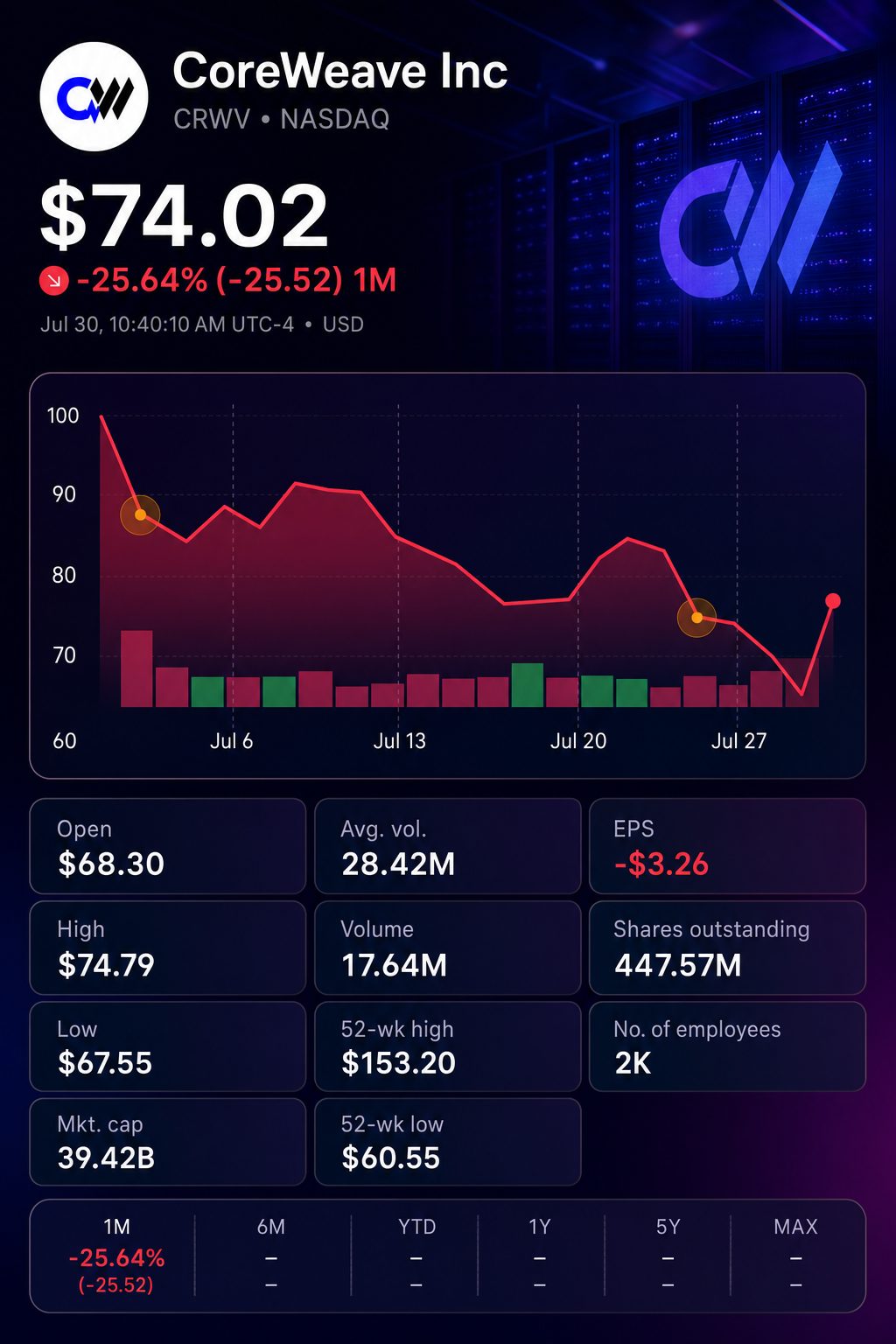
Stock chart for NASDAQ:CRWV

Shares of Microsoft surged 15.3% after reporting a 43% increase in Azure revenue. The company’s cloud outlook for the coming quarter was also above expectations. “Azure is ‘staying right there in the race,’” Aptus Capital’s Dave Wagner told Reuters. Reuters

Thursday market summary

CompanyPriceDaily changeIntraday range
CoreWeave$73.45+20.8%$61.02–$73.80
Nebius$190.79+28.7%$149.00–$195.26
Microsoft$450.21+15.3%$417.00–$451.62

The finance-feed snapshot was captured at 10:19 a.m. EDT. Prices continued to update in real time.

The report reinforced the argument for AI demand, but did not resolve the funding issue.

Regulatory filings reveal the reasons. Debt made up close to 25% of contracted business for both neocloud firms. CoreWeave’s cash reserves were much lower relative to its debt.

Credit-default swaps (CDS) function similarly to insurance for missed debt repayments. The associated report put CoreWeave’s five-year CDS spread close to 855 basis points. The model-based five-year default likelihood stood at roughly 50%. Reuters cautioned that light trading volumes in CDS markets can amplify the impact of relatively minor trades.

CoreWeave’s Q1 results clarify the credit reaction. Interest costs amounted to 25.8% of sales. Spending on capital assets totaled $7.70 billion, which is 3.7 times quarterly revenue.

Cash intensity for Q1 2026

MetricCoreWeaveNebius
Revenue$2.078bn$0.399bn
PP&E and intangible purchases$7.695bn$2.473bn
Purchases/revenue3.7x6.2x
Interest expense$0.536bn$0.064bn
Interest/revenue25.8%16.0%
Operating cash flow$2.984bn$2.258bn
Simple free cash flow-$4.711bn-$0.215bn

Simple free cash flow is calculated by taking operating cash and deducting reported capital expenditures. Nebius’s numbers for the quarter are unaudited.

Nebius required more capital relative to its present sales, but its straightforward cash shortfall was notably less.

The result requires context. Operating cash was bolstered by a $3.20 billion inflow from deferred revenue, largely comprised of customer advance payments. Nebius additionally secured $4.34 billion via convertible note issuance and $2 billion through prefunded warrants.

Funding status for Q1 2026

MetricCoreWeaveNebius
Debt$25.149bn$8.450bn
Cash$2.244bn$9.298bn
Debt/cash11.2x0.9x
Contracted work$99.400bn in backlog$33.585bn RPO
Debt/contracted work25.3%25.2%

CoreWeave reports principal debt, while Nebius includes both current and non-current debt. Ratios use data from company filings.

CoreWeave’s undrawn facilities amounted to $8.83 billion, bringing total liquidity up to $11.09 billion. The company’s debt remained 2.3 times its liquidity. Nebius maintained net cash, while its projected undiscounted leases reached $9.91 billion.

The figures for contracted work are not directly comparable. CoreWeave’s total incorporates projected revenue from its signed contracts, while Nebius provides data for its remaining performance obligations. Of this amount, just 29% was anticipated to be realized within 24 months.

Research is divided on the stock. Danil Sereda, a contributor to Seeking Alpha, maintained a Hold rating, highlighting concerns over debt and declining margins. Meanwhile, Rosenblatt analyst John McPeake set a Street-high price target of $250, which is roughly 240% greater than Thursday’s closing price.

CoreWeave announced a federal AI partnership with Leidos . Chief Operating Officer Sachin Jain stated that federal teams require “secure, scalable platforms to operationalize” AI. The companies did not reveal the value of the contract. Final agreements have yet to be signed. investors.coreweave.com

The upcoming results are set to challenge both narratives. CoreWeave is scheduled to announce on August 11 at 5 p.m. EDT, while Nebius is due to report before the market opens on August 12. Analysts will focus on capex, interest expenses, and backlog conversion for their implications.

Risks: Broader CDS spreads have the potential to lift refinancing expenses. CoreWeave faces $11.72 billion in principal repayments scheduled through 2027. Nebius’s lease commitments may weaken its present cash position.

TS2 TECH • EXTENDED COVERAGE

Further analysis

Why is CRWV stock surging today?

As of 10:01 a.m. ET, CRWV traded at $73.70, up 21.2%. CoreWeave also announced a Leidos collaboration for secure federal AI services. CoreWeave would supply the cloud platform, while Leidos handles mission integration. No contract value or committed revenue was disclosed. The arrangement still needs definitive agreements and depends on federal appropriations. Microsoft-led strength across AI stocks likely amplified the move. investors.coreweave.com

Does today’s rally reverse CRWV’s recent downtrend?

The trend is not repaired. At $73.70, shares remained about 52% below the $153.20 52-week high. They were roughly 22% above the $60.55 52-week low. Volume reached 13.2 million within thirty minutes, nearly half the daily average. That supports the move, although one session cannot confirm a durable reversal. Robinhood

Is CRWV attractively valued after the selloff?

At $73.70, CoreWeave’s equity value was roughly $38.8 billion. That equals about 3.1 times midpoint 2026 revenue guidance. Adding March net debt gives a simple enterprise value near $61 billion. That equals roughly 4.9 times midpoint sales, excluding lease adjustments. Debt makes the equity multiple look cheaper than the whole business. Valuation now depends on backlog conversion and margin recovery.

What must CoreWeave deliver in its next earnings report?

CoreWeave reports second-quarter results on August 11 at 5 p.m. ET. Management guided revenue to $2.45 billion through $2.60 billion. It guided adjusted operating income to $30 million through $90 million. Interest expense should reach $650 million through $730 million. Quarterly capital spending could total $7 billion through $9 billion. A full-year revenue-guidance cut would likely overwhelm today’s partnership news. investors.coreweave.com

Is CoreWeave’s $99.4 billion backlog as strong as it looks?

Backlog reached $99.4 billion on March 31. That equals almost eight times midpoint 2026 revenue guidance. It supports unusually strong demand visibility. However, backlog includes estimated future amounts beyond accounting performance obligations. Revenue still depends on delivering powered capacity and maintaining service availability. Conversion speed matters more than the headline. investors.coreweave.com

Why is profitability still a concern despite strong growth?

First-quarter revenue rose 112% to $2.078 billion. Adjusted EBITDA reached $1.157 billion, with a 56% margin. Yet CoreWeave posted a $144 million operating loss. Net interest expense reached $536 million, helping drive a $740 million net loss. Adjusted operating margin fell to 1% from 17% one year earlier. Revenue growth remains exceptional. Profit quality does not. investors.coreweave.com

Can CoreWeave handle its debt and capital-spending plans?

Debt remains the central balance-sheet risk. Principal debt totaled $25.15 billion at March 31. Cash was $2.24 billion, while total liquidity reached $11.09 billion. Another $6.07 billion of principal was scheduled during 2026. CoreWeave also secured an $8.5 billion delayed-draw facility. Management said available liquidity should cover obligations for one year. That reduces near-term danger, but not refinancing or execution risk. SEC

How serious is CoreWeave’s customer-concentration risk?

CoreWeave generated 65% of first-quarter revenue from its two largest customers. That improved from 72% generated by one customer a year earlier. OpenAI, Microsoft and Meta remain significant relationships. Meta signed a new $21 billion commitment in March. Leidos could broaden the mix, but no federal revenue was guaranteed. Concentration is falling, not disappearing. SEC

What do Wall Street forecasts imply for CRWV stock?

Analyst forecasts remain bullish, but wildly dispersed. Investing.com shows a $138.03 average target and a $36-to-$303 range. At $73.70, that average implies roughly 87% upside. Recent targets include $90 at Barclays and $100 at Mizuho. Truist and Bank of America sit higher at $126 and $140. Targets are not probabilities. The spread reflects exceptional uncertainty. Investing.com

Leokadia Głogulska is a financial and technology journalist at TS2.tech, covering stocks, artificial intelligence, space technology and global market developments. She graduated from Wrocław University of Economics and Business and previously worked in financial analysis before moving into business journalism. Her reporting focuses on helping readers understand the market trends, companies and technologies shaping the global economy.

AI PORTFOLIO

Top Stock Picks

Today’s highest-ranked model selections.

#1 BUY ON PULLBACK

Microsoft

NASDAQ: MSFT 94 / 100
#2 BUY

L3Harris Technologies

NYSE: LHX 90 / 100
#3 BUY

Xylem

NYSE: XYL 89 / 100
#4 BUY IN TRANCHES

Lam Research

NASDAQ: LRCX 87 / 100
#5 BUY ON WEAKNESS

GE HealthCare

NASDAQ: GEHC 84 / 100
View full portfolio
Editorial model selection. Not personalised advice.
Lam Research (NASDAQ:LRCX) shares recover after company projects $8.1 billion, beating forecasts
Previous Story

Lam Research (NASDAQ:LRCX) stock jumps as AI outlook points to 45% incremental margin

VOO Rises After Dip as Chip Sector Concentration Takes Center Stage
Next Story

VOO Rises After Dip as Chip Sector Concentration Takes Center Stage