
New York, June 13, 2026, 18:02 ET
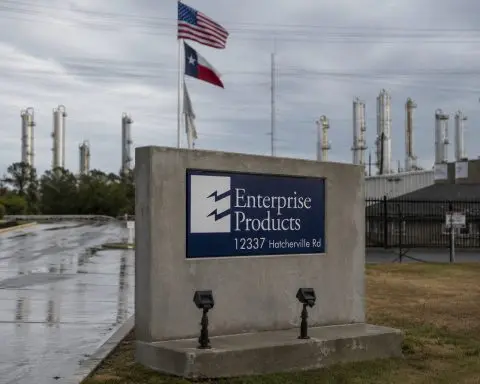
- Enterprise Products Partners ended Friday at $37.25, off 0.08%. The S&P 500 finished higher and some midstream names posted gains.
- The company’s next scheduled catalyst is its appearance at JPMorgan’s energy conference, set for June 23–24.
- The stock trades at fair to slightly attractive levels for income buyers, though leverage, project execution, and sentiment tied to commodities are still big risks.
Enterprise Products Partners L.P. NYSE:EPD finished Friday at $37.25, off 0.08%. Shares stuck to a range of $37.02 to $37.64, per Google Finance. The slip came with big indexes mostly higher—SPDR S&P 500 ETF Trust advanced 0.57%, while the Alerian MLP ETF was down 0.27%. Google EPD also lagged other pipeline stocks. MarketWatch data showed Kinder Morgan up 1.85% and Williams up 1.39%, so investors weren’t buying every pipeline name on the day.
Oil prices dropped hard. Brent settled at $87.33, down 3.37%, and U.S. West Texas Intermediate finished at $84.88. Reuters said traders saw hope for a U.S.-Iran deal as the driver. Reuters For Enterprise, the midstream MLP that moves and stores hydrocarbons, a crude slide isn’t a direct blow like it is for oil producers. But cheaper energy can still hurt sentiment toward the group and spark questions about drilling, throughput and export demand down the line.
Cash-flow strength is still the key bull argument. In April, Enterprise posted Q1 operating income of $1.9 billion, up 8%. Net income for common unitholders came to $1.5 billion, and adjusted EBITDA was $2.7 billion. Operational DCF hit $2.1 billion. That’s the cash-flow metric MLP investors watch to see if payouts are safe—Enterprise said DCF covered distributions by 1.8 times. Enterprise Products Partners L.P. Co-CEO A.J. “Jim” Teague said, “Enterprise began 2026 with a strong start in the first quarter,” highlighting new assets and record system volumes. Enterprise Products Partners L.P.
That operating setup is part of the reason income investors still stick with the units. Google Finance has EPD’s distribution yield at 5.91%, based on a quarterly payout of $0.55. The P/E sits at 13.81, meaning investors are paying that multiple for each dollar of earnings. Google Enterprise also bought back $116 million of its own common units in the first quarter. The company has now used 31% of its $5.0 billion buyback program, giving some more backing to the per-unit price.
The stock isn’t cheap after its rally, according to the bear side. Google Finance lists the average 12-month analyst target at $41.64 from 15 analysts, so about 11.8% upside from $37.25. MarketBeat goes wider, with 17 analysts and a consensus “Hold” call, plus a $39.67 target, or 6.39% upside from their current price. Google Revenue for the first quarter dropped year over year, even though earnings rose. MarketBeat noted the EPS missed forecasts, which flags some near-term risk. MarketBeat
Debt and project execution remain key risks. Enterprise had $34.2 billion in consolidated debt at March 31, with $3.3 billion in liquidity. Its 10-Q flagged exposure to interest-rate and commodity-price risks, saying it uses derivatives for some risk management. Enterprise Products Partners L.P. The company is also building about $5.3 billion in major growth projects, including new Permian processing, NGL infrastructure, and export projects. Investors are focused on whether these will come online as planned and deliver the returns Enterprise expects.
Investors looking for the next clear event have Enterprise’s appearance at the JPMorgan Energy, Power, Renewables & Mining Conference in New York set for June 23–24. Business Wire Markets will watch for anything new on export demand, Permian volumes, capital spending or distribution plans—any of those could move the stock. EPD isn’t tied closely to oil prices, so volumes, fee trends and project returns matter more for funding both ongoing growth and distributions. The newest confirmed data puts EPD at a fair to mildly attractive valuation for income buyers. Yield and coverage look solid. But analyst sentiment is more Hold than Buy, leverage is high, and the stock remains sensitive to the energy cycle. Caution is still warranted.



![UK Stock Market Today 26/08/2026 [UPDATE: 09:01 BST] [Miners Offset Oil Majors as Brent Slides Below $86]](https://ts2.tech/wp-content/uploads/2026/08/UK-market-dashboard-2026-08-26-0901-480x384.jpg "UK Stock Market Today 26/08/2026 [UPDATE: 09:01 BST] [Miners Offset Oil Majors as Brent Slides Below $86]")