
NEW YORK, June 28, 2026, 16:04 EDT
- U.S. equity markets didn’t open Sunday. The NYSE is set to shut again Friday, July 3, for the Independence Day holiday.
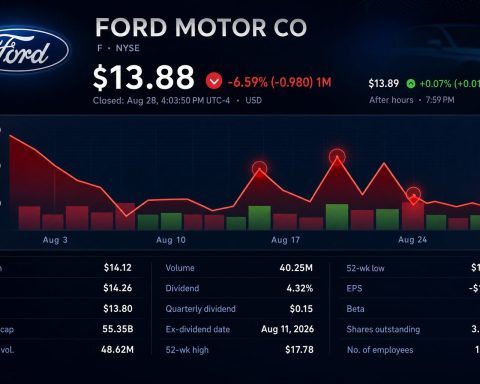
- Ford ended Friday at $14.13, gaining 0.14%. Volume came in at 59.55 million shares.
- Ford ended the week up 0.5% by closing prices. General Motors dropped 1.5%. Stellantis slid 10.4%.
- Ford scored above the industry in J.D. Power, but the automaker logged the most recalls in 2026 with 51.
Ford Motor Company NYSE:F starts a four-day trading week in the U.S. with shares holding close to $14, higher volume, and improvements in new-vehicle quality. NYSE regular hours are 9:30 a.m. to 4 p.m. ET, Monday to Friday. July 3 shows up as a 2026 Independence Day holiday on the exchange calendar, according to TradingHours.com.
Ford finished Friday at $14.13, up 0.14% for the session. That’s a 7 cent gain from its June 18 close of $14.06, right before the Juneteenth break. Trading volume for the five trading days through June 26 came in at about 305 million shares—averaging almost 61 million shares a day, roughly 6% above the 65-day average, according to The Wall Street Journal.
WSJ closing-price data on automakers, together with AP index figures, break down the split:
| Stock/index | Friday close | Friday move | Week change |
|---|---|---|---|
| Ford Motor Company NYSE:F | $14.13 | up 0.14% | added 0.5% for the week |
| General Motors Company NYSE:GM | $78.10 | fell 0.55% | dropped 1.5% this week |
| Stellantis N.V. NYSE:STLA | $5.68 | down 1.05% | slid 10.4% this week |
| S&P 500 | 7,354.02 | edged less than 0.1% lower | lost 2.0% for the week |
| Nasdaq Composite | 25,297.62 | slipped 0.2% | fell 4.6% this week |
For Ford, the key metric wasn’t pricing but the difference between its quality score and recall record. Ford led all mass-market brands in J.D. Power’s 2026 Initial Quality Study, posting 152 problems per 100 vehicles, down from 193 last year. The industry improved too, hitting 175 from 192.
| Metric | Ford | Comparison |
|---|---|---|
| 2026 J.D. Power score | 152 problems per 100 vehicles | Industry average: 175 |
| Improvement from prior year | 41 fewer problems | Industry saw 17 fewer |
| 2026 recalls cited by Reuters | 51 | Stellantis reported 19 |
| Best-in-segment Ford models cited by J.D. Power | F-150, Mustang, Super Duty | — |
Ford CEO Jim Farley said the result is “a culmination of a lot of hard work.” Thomas King, J.D. Power’s president of OEM solutions, said Ford led “mass market brands,” with the F-150, Mustang and Super Duty taking segment wins. Reuters
Ford didn’t see a clear reset on its stock because an old issue still hangs over it. Reuters says Ford had 51 recalls so far this year, more than any automaker. Stellantis had 19. Ford also remains under a consent order with federal safety regulators over slow recalls tied to faulty rearview cameras.
Ford said June 25 that the vehicles rolling out now rank among its best for quality, and warranty costs dropped in 2025 compared to the previous year. The company expects that decline to keep going in 2026. Chief Operating Officer Kumar Galhotra said the theme is “Quality Comes First.” Supply chain chief Liz Door said the target is “zero defects.” Q4 Capital
Investors are watching for earnings to improve. Fixing quality—up by 41 points—might help if it means fewer warranty claims and less trouble for customers. But recall numbers suggest this could take a while as service departments still deal with problems from older models.
Ford held up better than a lot of growth stocks last week, thanks to the broader market action. The S&P 500 dropped 2% and the Nasdaq slid 4.6% as weakness in AI names weighed on the tape. The Dow was up 0.6%.
Another Ford angle shows up on the labor calendar this week. Unifor, the Canadian union, kicked off contract talks with Ford on June 22, picking Ford first, saying the company made the biggest commitments to Canada. Unifor represents about 19,000 workers at Ford, GM and Stellantis. It set a July 10 deadline to cut a deal with Ford, planning to use those terms as a pattern for the other two automakers.
Unifor’s contracts with the Detroit Three end Sept. 20. The union said close to 6,000 workers have already been laid off at the automakers after output changes or stops, bringing wage, job security and production uncertainty back onto Ford’s radar ahead of next earnings.
Related articles: NYSE:F