
DETROIT, July 20, 2026, 15:05 EDT — Ford shares moved lower in early New York trading after the automaker reached a Canadian labor agreement that preserves truck production capacity while limiting the company’s expenses.
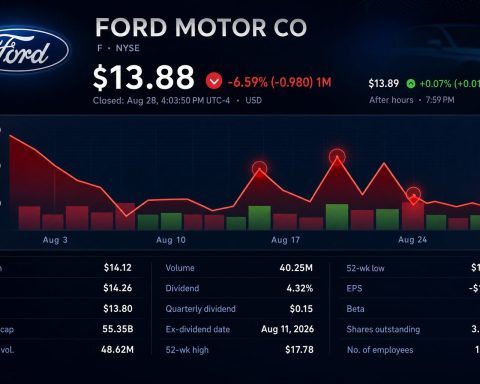
- Ford shares were down 1.5% at $14.02, with approximately 55 minutes left in the session.
- Canadian employees have agreed to yearly pay increases of 3% and $900 million in factory investment.
- An initial calculation indicates that the final-year base-pay rise amounts to approximately 0.34% of Ford’s projected adjusted EBIT midpoint.
Shares of Ford Motor Company NYSE:F slipped 1.5% to $14.02 on Monday afternoon as trading continued in New York. The decline came after a three-year labour deal was ratified in Canada, affecting 5,150 employees.
The deal eliminates a labor uncertainty tied to major truck and engine operations. The revealed base-wage increase also seems modest relative to Ford’s profit foundation.
The deal provides for yearly wage increases of 3%, totaling 9.27% compounded over the term. Top production pay will climb to C$50.20 per hour by the contract’s conclusion.
A provisional illustrative estimate places the annual base-pay hike for the final year at C$45.6 million, based on the assumption that all eligible employees receive the production wage and work 2,080 hours per year.
Using Monday’s exchange rate of C$1.4060, this amounts to approximately US$32.5 million. That figure is about 0.34% of Ford’s adjusted EBIT guidance midpoint of US$9.5 billion. The projection does not include factors such as worker mix, benefits, overtime, bonuses, or cost-of-living adjustments.
There was no apparent labor-deal premium in intraday trading:
| Company | Price at 15:05 EDT | Day change |
|---|---|---|
| Ford Motor Company NYSE:F | $14.02 | down 1.48% |
| General Motors Company NYSE:GM | $75.55 | off 0.68% |
| Stellantis N.V. NYSE:STLA | $5.73 | fell 1.04% |
Ford lagged behind its Detroit peers in the session, indicating that investors continued to prioritize earnings, expenses, and execution over just relief from labor concerns.
Unifor members under the central agreement approved the deal with 74% support. The contract will begin on September 21 and run until September 19, 2029.
The package allocates US$500 million for Windsor facilities and tooling. An additional US$400 million is designated for Super Duty production at the Oakville Assembly Complex.
Ford agreed to safeguards against closures as well as pledges on plant programs. The deal aims for full staffing at Oakville by July 1, 2027. A third shift at the Essex Engine facility is planned for 2029.
John D’Agnolo, Ford bargaining chair, pointed to “a plan to return every laid off member in Oakville to work.” The deal additionally includes productivity bonuses and December bonuses for eligible employees. Unifor
At the start of talks, Ford Canada’s vice president of human resources, Meredith Keenan, stated the company was aiming for “stability for our workforce” as well as lasting competitiveness in manufacturing. The ratification meets the first goal, while implementation at plant level will determine the outcome of the second. Ford From the Road
These safeguarded operations are near Ford’s main profit drivers. In the first quarter, Ford Blue and Ford Pro together posted an adjusted EBIT of $3.63 billion. The overall company adjusted EBIT reached $3.49 billion, as Model e reported a $777 million loss.
Ford projects adjusted EBIT for the full year in the range of $8.5 billion to $10.5 billion and anticipates adjusted free cash flow between $5 billion and $6 billion. The forecast factors in commodity headwinds of more than $2 billion and tariff expenses around $1 billion.
The next challenge arrives soon. Ford will announce second-quarter earnings after markets close on July 28, with a webcast scheduled for 5 p.m. EDT. Investors are expected to focus on truck profit margins, the price of aluminum, and the schedule for Canadian investment.
Risks: Final labor costs may surpass the initial estimate due to factors such as bonuses, pensions, benefits, skilled trades pay and adjustments for cost of living. Production setbacks at Oakville or Windsor could reduce expected capacity gains, and tariffs along with aluminum prices continue to pose significant earnings risks.
Related articles: NYSE:F