
New York, May 21, 2026, 11:00 EDT
- Ford shares pushed higher Thursday morning after a filing revealed the company has a reworked battery-plant financing arrangement with the U.S. Department of Energy.
- The automaker took on a $3.805 billion DOE note linked to the Kentucky battery plant. It also dropped its $6.6 billion capital commitment to BlueOval SK.
- Investors are sizing up Ford’s energy-storage bet as the company faces deep EV losses and a softer market.
Ford Motor shares moved up Thursday after a regulatory filing showed the company wrapped up restructuring its BlueOval SK battery joint venture and picked up a $3.805 billion U.S. Department of Energy loan related to a Kentucky battery factory.
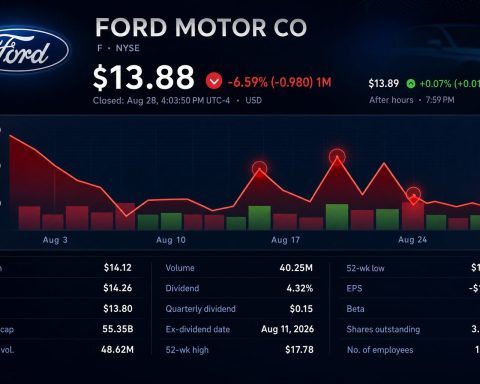
Ford traded up 0.9% at $13.35 as of 10:44 a.m. EDT, a bit below its intraday peak of $13.40. General Motors slipped 0.2%, and Stellantis dropped 5.3%. Ford outperformed both its Detroit rival and Stellantis in a weak session for automakers.
The timing is important as Ford looks to shift its battery focus. The company used to center battery capacity on electric vehicles, but now wants to move into power storage. Battery energy storage systems, or BESS, are big rechargeable units that save electricity for later. Utilities, renewable projects, and data centers often use them.
Ford in a May 20 filing said its membership interest in BlueOval SK was redeemed and its obligation to contribute up to $6.6 billion to the joint venture ended. A Ford subsidiary took stakes in two Kentucky battery plants and took on the $3.805 billion DOE promissory note tied to one of those plants.
Ford’s new loan has a 4.814% annual rate, according to the filing. The automaker will pay just interest every quarter until Jan. 15, 2030, then start paying down the loan with principal and interest until July 15, 2040. Ford must keep at least $4 billion in liquidity, which can be cash or available funds.
Days after EDF power solutions North America and Ford Energy said they had a five-year deal in place for up to 4 GWh a year of Ford Energy DC Block batteries, Ford Energy made the filing. The agreement lets EDF buy up to 20 GWh over the term, with deliveries set to start in 2028.
Lisa Drake, who heads Ford Energy, said the EDF deal pointed to buyers needing “industrial-scale manufacturing discipline.” EDF North America CEO Tristan Grimbert called supply-chain reliability “paramount.” Stock Titan
Ford shares rose 13% last week, Reuters said, as investors took a fresh look at its storage business. Morgan Stanley called out Ford’s licensing deal with CATL on battery tech as a key advantage. The company is putting $2 billion into the business and wants to start delivering to customers by late 2027, according to Reuters.
Broader U.S. stocks slipped. Reuters said the Dow was off 0.05%, the S&P 500 dropped 0.30%, and the Nasdaq lost 0.46% just before 10 a.m. ET. Oil prices moved up while investors watched for more signs of inflation. “Inflation and high oil prices are putting some pressure on stocks today,” Sam Stovall, chief investment strategist at CFRA Research, told Reuters. Reuters
Ford is making more changes. The automaker said global CMO Lisa Materazzo steps down June 1. Dean Stoneley will take over as interim CMO while a permanent replacement is found. CEO Jim Farley said Stoneley adds digital and product-marketing experience to the post.
Ford’s balance sheet is stronger than a year ago, though things aren’t straightforward. The company posted first-quarter revenue of $43.3 billion, net income of $2.5 billion and adjusted EBIT of $3.5 billion. EBIT means operating profit before financing and taxes. Ford boosted its full-year adjusted EBIT outlook to a range of $8.5 billion to $10.5 billion.
Investors are betting now on a business that won’t show volume for some time. Ford said its Model e EV unit posted a $777 million EBIT loss for Q1 and expects Model e losses between $4.0 billion and $4.5 billion in 2026. The EDF storage agreement starts deliveries in 2028, while the DOE loan brings extra long-term liabilities on battery assets. If storage demand, execution, or car pricing falls short, the stock rally could reverse fast.
Ford’s battery strategy is in focus again. Thursday saw just a slight move in the stock. The real question is if Ford can use its battery business for more than just EVs.
Related articles: NYSE:F