
Ford Motor Company stock NYSE:F is back in the spotlight on Friday, December 19, 2025—not because the market suddenly discovered that Ford sells trucks (it did know), but because a fresh U.S. safety recall lands right as investors digest Ford’s dramatic electric-vehicle strategy reset, battery-supply shakeups, and a still-cautious analyst consensus on where F shares go next.
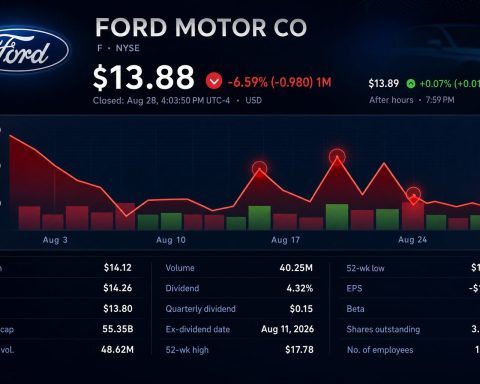
In the latest available quote on Friday, Ford shares hovered around the low-$13 range, close to the top of the past year’s trading band (52-week range roughly $8.44 to $13.99, per widely followed market data).
Below is what matters most for Ford stock today—what’s new, what’s changing, what analysts are forecasting, and the catalysts (and risks) that could move F meaningfully into 2026.
Ford stock price context: Why the low-$13 level matters right now
Ford’s stock has been strong over the past year, with data providers showing roughly a mid-30% change over that period and a 52-week high near $14.
That “$13-and-change” zone is psychologically important for traders because it sits near recent highs—meaning good news can push a breakout, but bad headlines can trigger profit-taking fast. On Friday’s data, the day’s range was roughly $13.25 to $13.47, with an opening price around $13.38. Investing.com
Today’s top Ford stock news: Recall of 272,645 vehicles
The immediate headline driver on Dec. 19 is a recall covering 272,645 vehicles in the U.S. tied to a loss of park function that could allow a vehicle to roll away, raising crash risk, according to the U.S. National Highway Traffic Safety Administration (NHTSA) as reported by Reuters.
Which vehicles are included (per NHTSA/Reuters):
- Certain 2022–2026 F-150 Lightning (battery-electric)
- Certain 2024–2026 Mustang Mach‑E (battery-electric)
- Certain 2025–2026 Maverick Reuters
What’s the issue:
- The integrated park module may fail to lock into the park position when the driver shifts into park.
What’s the fix (and why investors care):
- Ford plans a software update, delivered over-the-air or via dealers, at no cost to owners.
From a stock perspective, software-based remedies can sometimes be less financially painful than hardware-heavy recalls—but recall headlines still matter because they can:
- Pressure near-term costs (warranty, dealer support, customer handling)
- Add reputational drag (quality concerns can hit demand and pricing power)
- Distract management during a strategic pivot
The bigger storyline behind Ford stock: The $19.5 billion EV “reset”
This recall lands in the same week as Ford’s most market-moving announcement of December: a sweeping pullback from large EV plans, paired with a massive charge.
Reuters reported Ford will take a $19.5 billion writedown and is killing several EV models, describing it as a major example of the industry’s retreat from earlier EV ambitions amid weaker demand and policy shifts.
What Ford said it’s changing
According to Reuters, Ford’s plan includes:
- Replacing the fully electric F‑150 Lightning with a new extended-range electric model that uses a gas-powered engine to recharge the battery
- Scrapping a next-generation electric truck (code name T3)
- Scrapping planned electric commercial vans Reuters
Ford also said it will pivot harder into gas and hybrid models and expects its global mix of hybrids, extended-range EVs, and pure EVs to reach 50% by 2030, up from 17%.
What’s inside the $19.5B charge (and the “cash vs. accounting” distinction)
The same Reuters coverage breaks down the writedown roughly as:
- About $8.5B related to canceling planned EV models
- Around $6B tied to dissolving a battery JV with SK On
- About $5B in “program-related expenses” Reuters+1
Crucially for investors who care about cash flow (not just accounting fireworks), Reuters also reported that only about $5.5B of the total charges are expected to impact cash, incurred next year and into 2027.
Guidance moved higher—despite the writedown
Ford also raised its 2025 guidance for adjusted EBIT to about $7 billion, up from its previous $6.0B to $6.5B range.
That combination—huge EV writedown plus higher near-term profit guidance—helps explain why Ford stock hasn’t traded like a company in freefall. Investors are trying to price Ford as a business that’s choosing margin protection over EV market share.
How deep were Ford’s EV losses?
AP reported Ford has lost $13 billion on EVs since 2023 and expects the $19.5B hit largely in the fourth quarter tied to the EV business shift.
Reuters similarly emphasized that Ford (like many legacy automakers) has been losing billions in its EV operations and that battery costs have been a major factor.
This matters for Ford stock because the market is effectively asking one brutal question:
Is Ford’s “EV retreat” a disciplined capital reallocation… or a delayed admission that the original EV roadmap was economically shaky?
Different investors will answer that differently. The stock will, too.
Battery strategy whiplash: The canceled $6.5B LG Energy Solution deal
On Dec. 17, Reuters reported LG Energy Solution said Ford terminated an EV battery-supply deal worth about 9.6 trillion won (about $6.5 billion) that was originally set to supply batteries in Europe starting in 2026 and 2027.
Reuters linked the termination to Ford’s decision to halt production of some EV models amid policy changes and shifting EV demand outlook.
This is a meaningful “second-order” factor for Ford stock:
- It could reduce future committed spending (good for cash discipline)
- But it also introduces uncertainty about long-range EV supply planning (bad for investors who want stable execution)
Europe: Ford teams with Renault to build cheaper EVs
Even as Ford backs away from certain large EV bets, it hasn’t abandoned EVs outright—especially in Europe, where smaller vehicles and different economics can matter.
Reuters reported that Renault and Ford will jointly develop small, cheaper EVs for Europe, with the first of two planned small EVs expected in showrooms in 2028, produced at a Renault plant in northern France.
The two companies will also jointly develop Renault- and Ford-branded vans for Europe, aiming to cut costs and compete better—particularly against lower-cost Chinese rivals.
For Ford stock, this reads like a classic “asset-light EV” move: partner where you’re weak, save capital, and try to stay relevant in regions where EV policy and competition are intense.
Supply chain headline that could sneak up on investors: rare-earth licenses
Another December development that matters more than it sounds like it should: rare earths.
Reuters reported that Chinese rare-earth magnet suppliers to Ford were included in the first batch of new streamlined export licenses, designed to boost shipments and reduce shortages of components critical for the auto supply chain.
Supply chain stability rarely makes a stock spike on its own—but instability can absolutely kneecap production and margins. Investors tend to price this as “quietly bullish insurance” when things improve.
Ford dividend: income appeal still supports the bull case
Ford’s dividend remains a big part of the “value-and-income” pitch for F shares.
In its Q3 2025 earnings press release, Ford stated it declared a fourth-quarter regular dividend of 15 cents per share, payable Dec. 1 to shareholders of record as of Nov. 7.
Dividend-focused investors often treat Ford stock like a “hybrid security”: part cyclical auto, part income vehicle. That can support the share price in flat markets—but it also raises the standard for cash-flow execution, especially during expensive strategic transitions.
Wall Street forecasts for Ford stock: “Neutral,” with targets clustered in the low-to-mid teens
Analyst sentiment on Ford remains cautious.
A widely followed consensus snapshot shows:
- Overall consensus: Neutral
- 3 Buy, 17 Hold, 1 Sell (poll of the past 3 months)
- Average 12-month price target: ~$12.89 (about -3% downside versus the referenced price at the time)
- High estimate around $16, low estimate around $9.8 Investing.com
Recent notable analyst actions (examples from the same consensus feed)
The same data compilation lists recent actions such as:
- UBS: Hold, $12.50, maintained Dec. 16, 2025
- Morgan Stanley: Hold, $14.00, maintained Dec. 8, 2025 Investing.com
The takeaway: analysts are not pricing Ford like a moonshot. They’re pricing it like a large legacy automaker trying to protect profits while reworking an EV plan—i.e., a story where execution matters more than hype.
What investors are really watching next
Here are the catalysts that could plausibly move Ford stock more than day-to-day market noise over the next several quarters:
1) Recall execution and quality metrics
Today’s recall is software-fixable, which helps. But the market will watch whether quality headlines fade—or pile up.
2) How quickly Ford converts the EV reset into improved cash performance
Ford’s EV writedown is massive, but Reuters reported only a portion is expected to be cash-impacting over time. Investors will look for that cash curve to match management’s narrative.
3) Profit durability in trucks, commercial, and hybrids
Both Reuters and AP framed Ford’s pivot as a move toward segments with clearer profitability and customer demand (trucks, vans, hybrids, Ford Pro focus).
4) Battery and partnership credibility
Terminating a major battery supply deal (LGES) while partnering with Renault in Europe sends a mixed—but not necessarily negative—signal: Ford is trying to be more capital-efficient, but it needs partnerships to actually land products on schedule.
5) Policy and demand realities
Both Reuters and AP tied Ford’s EV strategy shift to policy changes and EV demand softness. Whether that environment persists—or re-accelerates—will heavily influence what “Ford stock forecast” looks like by mid-2026. Reuters+1
Bottom line for Ford stock on Dec. 19, 2025
Ford stock today sits at the intersection of two forces:
- Short-term headline risk (like the recall) that can jolt sentiment
- Medium-term strategic repricing as investors decide whether Ford’s $19.5B EV reset is smart discipline or costly backtracking
Right now, the market is treating Ford as a pragmatic, dividend-paying industrial that’s trying to win on margins and execution—while analysts, on balance, remain “Neutral” and keep targets in a relatively tight band around the current price. Reuters+1
Related articles: NYSE:F