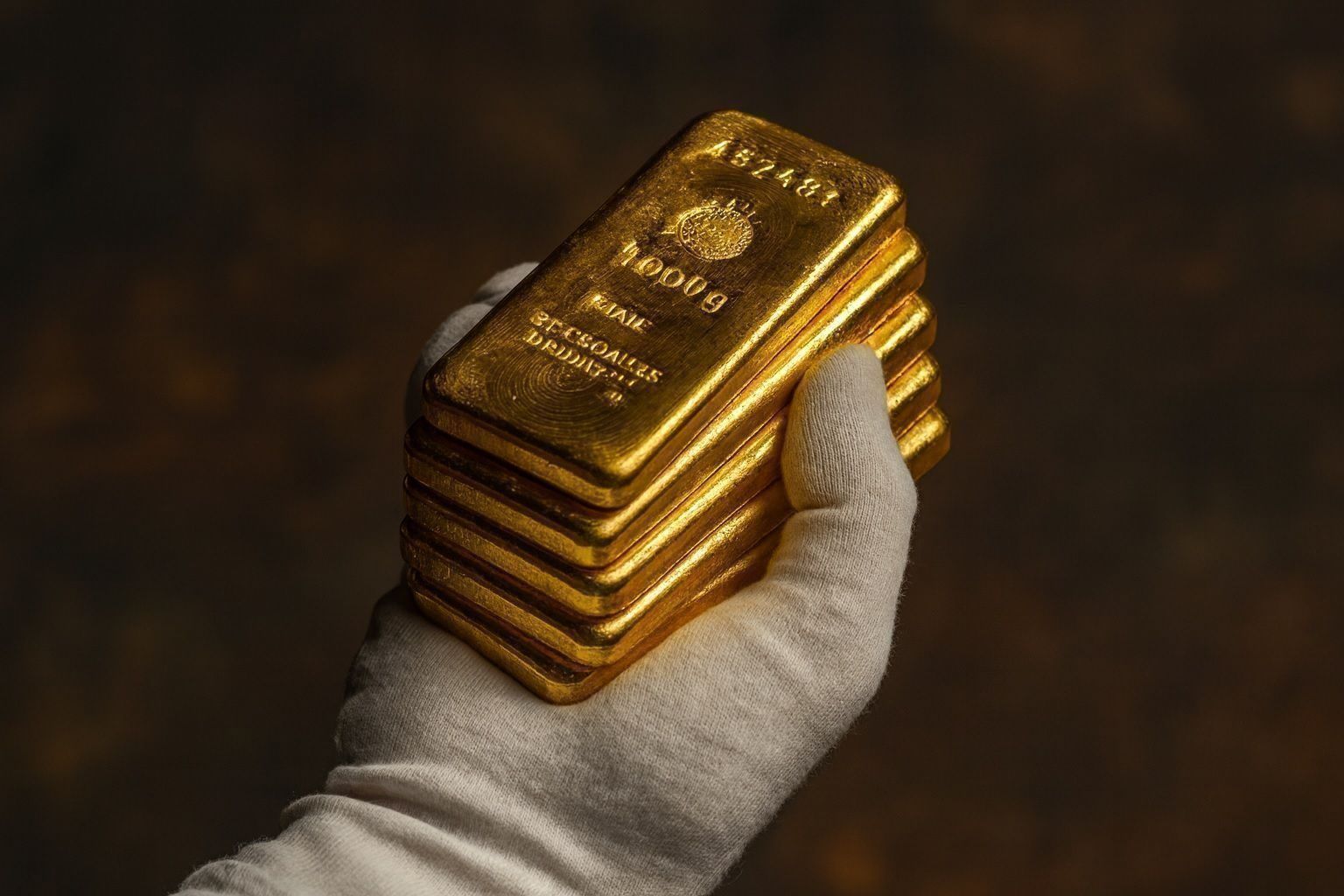
Gold prices closed the week of December 8–14, 2025 on a firm footing near the $4,300 per ounce area, as traders digested the U.S. Federal Reserve’s year-end rate cut, a softer U.S. dollar, and a renewed tug-of-war between safe-haven demand and “too-far-too-fast” valuation concerns.
Across the same week, a sharp surge in silver (including fresh record highs) repeatedly spilled into broader precious-metals sentiment—helping keep gold bid even as physical demand in key Asian markets cooled under the weight of record local prices. Reuters+2Reuters+2
Below is a detailed, publication-ready roundup of the key gold price moves, headline drivers, and the most-circulated forecasts and analyst views published from December 8 through December 14.
Gold price action this week: from Fed “wait-and-see” to a late-week push above $4,290
Monday, Dec. 8: Gold was choppy as markets braced for the Fed’s final meeting of the year. Reuters reported spot gold at $4,189.49/oz in afternoon U.S. trading, with investors focused on the upcoming decision and Chair Jerome Powell’s guidance; traders were pricing a high probability of a December cut. Reuters
Tuesday, Dec. 9: Optimism about a cut helped lift bullion. Reuters cited spot gold at $4,211.77/oz, while silver blasted through $60/oz—a move that strengthened the broader precious-metals complex. Reuters
Wednesday, Dec. 10 (Fed decision day): Gold rose after the Fed cut rates, even as policymakers signaled caution about the road ahead. Reuters put spot gold at $4,236.57/oz after the decision, noting the market’s focus on uncertainty about next year’s policy path. Reuters
Thursday, Dec. 11: The post-cut rally broadened. Reuters reported spot gold at $4,280.08/oz, the highest in more than a month, aided by a weaker dollar and accelerating momentum across precious metals. Reuters
Friday, Dec. 12: Gold pushed higher even as profit-taking hit silver. Reuters reported spot gold at $4,293.43/oz and U.S. gold futures settling higher, as investors weighed the Fed’s messaging against still-bullish market pricing for 2026 cuts. Reuters
By the weekend (Dec. 13–14), the market narrative centered on consolidation near $4,300 and what the next U.S. data releases might do to yields and the dollar—two of gold’s most consistent short-term drivers.
The biggest driver: the Fed cut rates, but signaled a potential pause
The defining catalyst of the week was the Federal Reserve’s quarter-point rate cut—and the fact that it came with a notably divided policy debate.
Reuters reported that the Fed reduced the policy rate by 25 basis points to the 3.50%–3.75% range, and new projections showed a median expectation of only one additional quarter-point cut in 2026—a path more restrained than what many traders had been pricing. Reuters
That “cut now, slow later” message mattered for gold for two reasons:
- Lower rates reduce the opportunity cost of holding non-yielding gold (a classic supportive factor).
- But a slower easing path can lift real yields and stabilize the dollar, limiting upside if inflation stays sticky.
This tension showed up repeatedly in the week’s price action: gold climbed on the cut itself, then continued higher as the dollar softened—yet remained sensitive to any sign the Fed might pause longer than markets expect. Reuters+2Reuters+2
Why silver mattered so much: it helped “pull gold up”
Even though the headline is gold, silver’s breakout was one of the week’s most important cross-currents.
On Dec. 9, Reuters highlighted silver hitting the $60/oz milestone amid tight supply and strong industrial-demand expectations. Reuters
On Dec. 11, Reuters reported silver printing fresh records (above $64/oz intraday) and quoted analysts arguing that silver’s momentum was lifting gold, platinum, and palladium alongside it. Reuters
By Friday, silver pulled back sharply on profit-taking, but gold held up—an important clue that bullion demand wasn’t only a sympathy trade. Reuters
Physical demand reality check: India and China cooled as prices hit extremes
A key theme in December gold coverage was the widening gap between paper/financial demand and on-the-ground physical buying.
Reuters reported that in India—entering peak wedding-season demand—dealers were forced to offer discounts as wide as $34/oz versus official domestic prices, while local benchmarks hit a record ₹132,776 per 10 grams. Jewellers cited weaker footfall as buyers balked at the rally. Reuters
In China, Reuters described muted demand and a wider range of discounts/premiums amid volatile pricing and a recent VAT-related policy change that increased costs for jewellers. Reuters
For investors, this matters because extreme local pricing can limit one traditional stabilizer for gold: bargain-hunting in major consumer markets. It doesn’t necessarily stop rallies driven by macro and flows—but it can make pullbacks sharper when leveraged positioning unwinds.
The “double bubble” debate: BIS warns of bubble conditions in gold and equities
Alongside the Fed, the other headline that shaped gold sentiment this week came from the Bank for International Settlements (BIS).
In a Dec. 8 analysis, the BIS said statistical measures suggested both the S&P 500 and gold had entered “explosive” territory, noting it’s the only time in at least the last 50 years that both assets appeared to do so simultaneously. The BIS also emphasized an important caveat: bubble-detection tools may flag risk, but do not reliably predict when a reversal will occur. Bank for International Settlements
Crucially for gold, the BIS highlighted evidence that retail investor exuberance spilled into gold, including gold ETF prices trading at a premium to net asset value (NAV)—a sign of strong buying pressure and limited arbitrage effectiveness. Bank for International Settlements+1
Bloomberg coverage carried by SWI swissinfo.ch sharpened the point, quoting BIS official Hyun Song Shin saying gold had deviated from its historic safe-haven pattern by rising alongside other risk assets, becoming “much more of a speculative asset” in the recent surge. SWI swissinfo.ch
The takeaway for readers: the bull case and the bubble-risk case can coexist. Gold can still climb on rates, geopolitics, and central-bank demand—while becoming more vulnerable to abrupt drawdowns if sentiment turns and “crowded trades” unwind.
ETF and fund flows: capital kept coming into gold-linked products
While physical buying in Asia cooled, fund flow data pointed to continued financial demand.
Reuters reported that gold and precious-metals commodity funds saw net inflows of $1.9 billion for a fifth consecutive week (data for the week ending Dec. 10), a sign that institutional and retail allocations to the theme remained active into the Fed decision. Reuters
This helps explain why gold could remain elevated even as jewelry and bar demand in some regions softened: macro-driven investors were still adding exposure, and flows can overwhelm physical trends in the short run.
Gold price forecasts and analyst calls published this week: $4,213 to $5,000+ scenarios
The Dec. 8–14 news cycle featured unusually wide—but mostly bullish—forecast ranges, with many analysts emphasizing that 2025’s rally may cool but not necessarily reverse.
1) TD Securities: 2026 average around $4,213
On Dec. 12, Reuters quoted TD Securities’ Bart Melek saying their average annual forecast for gold in 2026 is $4,213/oz. Reuters
2) ING: 2026 average around $4,325
ING’s Dec. 8 outlook argued the bull run has “further to go,” citing continued central-bank buying, ongoing geopolitical risks, expanding ETF holdings, and expectations of additional Fed cuts—projecting average prices of $4,325/oz in 2026 while warning that a broad market sell-off could trigger forced gold selling. ING Think
3) Goldman Sachs: $4,900 by end-2026, with “upside risk” if U.S. ownership rises
A Goldman-linked note highlighted by Business Insider argued that U.S. gold ownership remains low, with gold ETFs only 0.17% of private U.S. financial portfolios—implying that even modest allocation shifts could move prices meaningfully. The piece cited Goldman’s forecast for gold to reach $4,900 by end-2026, while warning of “significant upside risk” if private-sector buying broadens beyond central banks. markets.businessinsider.com
4) “$5,000 is in reach” talk returns
Even tactical market commentary turned ambitious. Reuters quoted Zaner Metals strategist Peter Grant on Dec. 8 saying fundamentals remain strong and central-bank buying continues, adding that a move toward $5,000/oz in Q1 2026 is within reach. Reuters
5) World Gold Council: base case range-bound, but “surprise” scenarios remain
The World Gold Council (WGC) has stressed that gold’s 2025 surge was driven by a blend of geopolitical/economic uncertainty and dollar dynamics, and said 2026 could be rangebound if current macro conditions persist, while still leaving room for stronger gains under deeper risk scenarios—or declines if growth accelerates and the dollar strengthens. World Gold Council+1
A Dec. 9 Euronews roundup echoed this framework, describing a baseline of roughly -5% to +5% for 2026 under “macro consensus,” with stronger upside in recession-risk scenarios and downside risk if reflation pushes yields and the dollar higher. euronews
Technical outlook into the new week: key levels, breakout risks, and the next macro catalyst
Technical analysts framed the market as “bullish but vulnerable to volatility” after the run toward $4,300.
- FXStreet wrote that gold was sitting at seven-week highs and appeared poised to regain $4,300 and beyond, while warning that a modest U.S. dollar rebound could create short-term friction. FXStreet
- FXEmpire’s Dec. 14 weekly outlook emphasized breakout risk as major macro releases approach. FXEmpire
The next “make-or-break” event: U.S. jobs data (Dec. 16)
Reuters noted the market is watching the next major U.S. labor update, with nonfarm payrolls due Dec. 16, as traders calibrate how quickly the Fed might (or might not) ease further. Reuters+1
Why it matters for gold:
- A softer jobs read can pull yields and the dollar down, typically supporting gold.
- A stronger report can revive the “hawkish pause” narrative, pressuring gold via higher real yields and a firmer dollar.
Bottom line: gold’s uptrend remains intact—but December’s rally now faces tougher tests
From Dec. 8 to Dec. 14, gold’s story wasn’t just “rates down, gold up.” It was a more complex mix:
- Supportive: Fed rate cut, softer dollar, persistent central-bank demand narrative, and steady inflows into gold-linked funds. Reuters+2Reuters+2
- Complicating: BIS bubble warnings, retail-driven exuberance signals, and softer physical demand in India and China at record local prices. Bank for International Settlements+2Reuter…
- Amplifying: Silver’s record surge boosted sentiment across precious metals—helping gold grind higher even when some traditional demand channels cooled. Reuters+2Reuters+2
For Google News/Discover readers, the key forward-looking question is straightforward: Can gold keep climbing if the Fed really delivers only one cut in 2026, as its projections suggest—while markets still price more? Reuters+1
The answer will likely hinge on the same trio that defined this week: U.S. data (especially jobs and inflation), the dollar and real yields, and whether flows stay positive even as “bubble talk” grows louder. Bank for International Settlements+2Reuter…