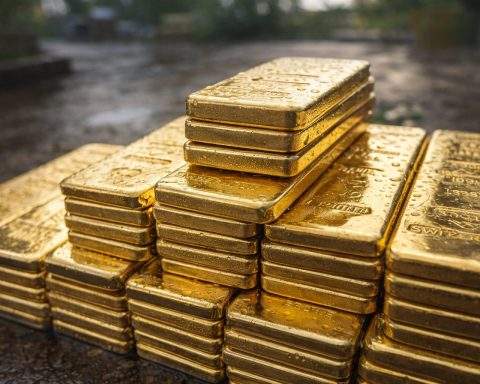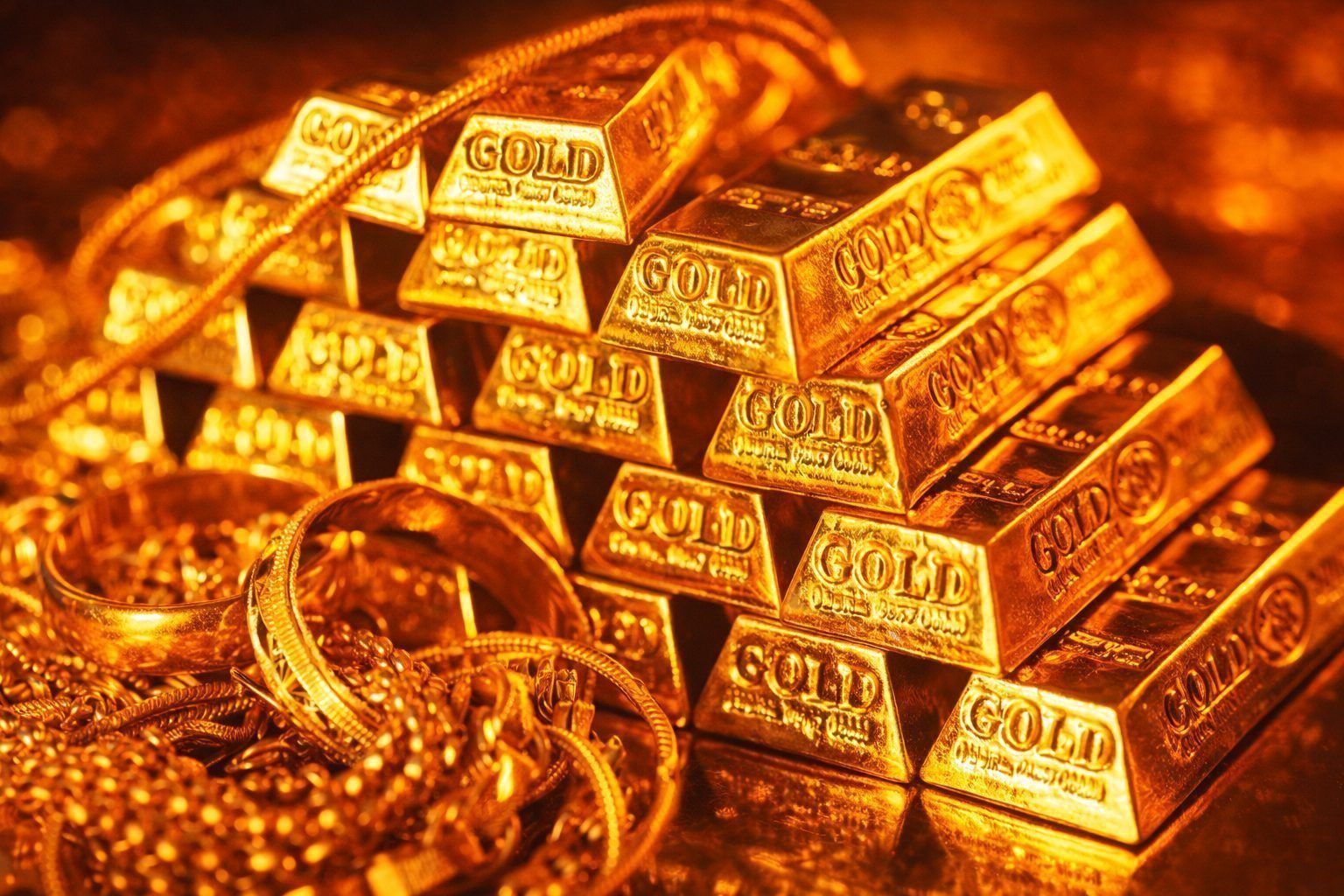

Gold’s 2025 run has turned into a full-blown stampede—capped by a late-December surge that pushed bullion to fresh all-time highs and pulled the rest of the precious-metals complex along for the ride.
On December 26, spot gold hit record territory above $4,500 an ounce, while silver vaulted beyond $77—milestones that underscore just how unusual this year has been for metals markets. Reuters reported spot gold around $4,531 after an intraday record near $4,550, with silver jumping to the $77 handle amid thin year-end liquidity and rising safe-haven demand.
This is no longer just a “crisis hedge” story. Analysts and market data increasingly point to a mix of structural forces—central-bank buying, revived ETF demand, and shifting views on the U.S. dollar and interest rates—helping to keep the bid under gold even as prices climb to levels few predicted a year ago. World Gold Council+2World Gold Council+2
A record-setting year for gold—by both price and positioning
Gold didn’t simply grind higher in 2025; it repeatedly reset the ceiling.
Business Insider noted that gold pushed through $4,500 during the year and is up more than 70% year-to-date—its strongest annual performance since 1979—supported by a weaker dollar, policy uncertainty, and sustained central-bank demand.
World Gold Council (WGC) data helps explain why this rally has looked different from many past spikes. In Q3 2025 alone, total gold demand (including OTC) rose to 1,313 tonnes, the highest quarterly total in WGC’s series, while the value of demand jumped to a record $146 billion. Massive ETF buying (about 222 tonnes in Q3) and strong bar-and-coin investment were key drivers, even as jewelry volumes fell under the weight of record prices.
Put simply: the market wasn’t just watching gold rise—it was actively allocating into it.
What’s pushing gold higher: rates, the dollar, geopolitics, and “debasement trade” psychology
Several catalysts have converged at once:
1) The interest-rate path is becoming friendlier to non-yielding assets
Gold tends to benefit when investors expect lower real yields or a shift toward easier monetary policy, because holding bullion carries no coupon.
Reuters reported that markets were anticipating two U.S. rate cuts in 2026, with the first potentially around mid-year, and highlighted how expectations of Fed easing have been a tailwind for precious metals into year-end.
Business Insider similarly emphasized that gold often performs best when real yields fall, lowering the opportunity cost of holding a non-yielding asset.
2) The dollar’s softness is amplifying the move
A weaker dollar generally makes gold cheaper for non-U.S. buyers and can reinforce the perception that “hard assets” offer protection in a world of expanding debt burdens.
Investopedia described a weakening-dollar backdrop as part of what it called the “debasement trade,” tying investor demand for metals to concerns about rising government debt and currency purchasing power. Investopedia
Reuters also noted the dollar index was on track for a weekly decline during the latest metals surge—supportive for dollar-priced gold. Reuters
3) Geopolitical risk is keeping safe-haven demand elevated
Safe-haven positioning is back in force, and not only among retail investors. Reuters pointed to heightened geopolitical tensions as a key reason gold and silver extended their record runs into late December.
4) A shift in how investors “use” gold
One of the most important developments in 2025 isn’t simply the price—it’s how many investors have come to treat gold as a portfolio anchor rather than a tactical hedge.
As Reuters put it in an October deep dive on ETF inflows, investors wary of “sky-high stock market valuations” and uncertain policy/geopolitics have used gold as a refuge, with analysts describing a “barbell” approach that pairs exposure to high-flying growth themes with defensive gold allocations. Reuters
Gold ETFs are back—after years in the wilderness
If there’s one data point that keeps showing up behind the headlines, it’s the resurgence of gold ETFs.
World Gold Council’s monthly ETF report for November 2025 showed six consecutive months of inflows, with physically backed gold ETFs adding $5.2 billion in November alone. WGC reported total gold ETF assets under management at $530 billion (a month-end peak), with holdings rising to 3,932 tonnes, the highest month-end level on record.
That ETF revival matters because it reflects large-scale, liquid allocation—often from institutions—rather than only incremental retail buying.
WGC’s own Q3 2025 commentary echoed the same trend: investors “piled into physically backed gold ETFs” for a third consecutive quarter, adding 222 tonnes in Q3, with year-to-date ETF additions totaling 619 tonnes (about $64 billion) as of that release. World Gold Council
And Reuters’ October reporting quantified the scale of the pivot:
- SPDR Gold Shares (GLD) inflows reached $35 billion as of end-September (surpassing the prior full-year record set in 2020).
- Global gold ETF inflows hit $64 billion year-to-date, including a record $17.3 billion in September alone.
Those are “regime change” numbers—especially after the prior period of multi-year outflows.
Did gold ETFs permanently change the gold market?
This is where 2025’s rally starts to connect to a longer-term debate: has financial innovation structurally lifted gold prices?
Fortune pointed to Duke University research suggesting the introduction of gold ETFs may have permanently pushed up gold prices by making the metal dramatically easier to buy and hold for investors.
Duke’s Fuqua School of Business has made a similar argument in its own research framing. Professor Campbell Harvey describes the launch of gold ETFs in 2005 as a major change in the structure of gold investment: before ETFs, the practical challenges and costs of secure storage made gold exposure harder to scale. ETFs, by contrast, allow investors to gain exposure without storing physical bullion themselves—something Harvey says increased gold demand after 2005 and may help explain the persistent rise in prices.
A more recent working-paper perspective from Harvey and Claude B. Erb (“Understanding Gold,” posted to SSRN in late 2025) explicitly lists gold “financialization” and de-dollarization pressures among the reasons gold prices are elevated. The authors also argue that historically, when gold hits all-time highs, subsequent multi-year returns have often been low or negative—an important caution for late-cycle buyers. SSRN
That tension—structural demand vs. historically lower forward returns after peaks—is one reason the 2026 outlook remains so contested, even among bulls.
Central banks remain a cornerstone of demand—and they’re signaling more to come
If ETF flows are the market’s “fast money,” central-bank demand is often the slow-moving force that can reshape the floor.
WGC reported that central banks added 1,045 tonnes to global gold reserves in 2024—marking the third consecutive year above 1,000 tonnes and extending central banks’ net-buying streak to 15 straight years. Poland led 2024 purchases with 90 tonnes, while a broad range of emerging-market central banks remained active.
And the official sector’s appetite hasn’t been purely backward-looking. WGC’s 2025 Central Bank Gold Reserves Survey found that 95% of surveyed central banks expect global official gold reserves to increase over the next 12 months, and 73% foresee moderate or significantly lower U.S. dollar holdings in global reserves over the next five years—alongside higher shares for gold and other currencies.
Meanwhile, WGC’s Q3 2025 report recorded 220 tonnes of net central-bank buying in the quarter and highlighted that even with record prices, official demand stayed elevated.
For gold bulls, the message is straightforward: central-bank buying isn’t a one-quarter phenomenon—it’s increasingly a strategic posture.
The year-end “buying frenzy” spread beyond gold—silver and platinum hit their own records
Gold may be the headline act, but 2025 has been a broader precious-metals story.
Australian Financial Review reported a year-end buying frenzy that sent gold and silver (and other precious metals) to fresh records into late December.
Reuters provided the clearest snapshot of the late-December surge: on December 26, silver breached $77 for the first time, up roughly 167% year-to-date, while gold and platinum also marked record highs. Reuters cited Peter Grant, vice president and senior metals strategist at Zaner Metals, pointing to expectations of Fed easing, a weak dollar, and geopolitics—while also noting the additional volatility that can come with thin year-end conditions.
Business Insider, writing two days earlier, also highlighted that gold’s surge has contributed to record highs across other precious metals, noting silver’s enormous year-to-date gains (with prices then around the low-$70s) and platinum’s own record-setting move.
In other words: what started as a gold rally evolved into a metals complex repricing—powered by both macro hedging demand and (in silver’s case) industrial-use narratives.
Gold price forecast for 2026: “room to run,” but not a straight line
So where does gold go next—after a year that already looks historic?
Business Insider reported that analysts see the drivers of gold’s rally as structural rather than purely reactive. Farah Mourad, a market analyst at IG, argued that gold “doesn’t need a crisis” to rise if the macro backdrop remains defined by elevated debt, policy uncertainty, and a diminished aura of dollar dominance. The report noted that “major banks” expect gold to trade in the $4,500–$4,700 range next year, with potential upside toward $5,000 if conditions persist. Business Insider
Business Insider also cited Ewa Manthey, commodities strategist at ING, forecasting more record highs in 2026, and highlighted Goldman Sachs’ call for gold to reach $4,900 by December 2026.
Reuters added another notable marker: Grant said $5,000 could be reached in the first half of next year—a statement that captures how aggressively some strategists are now framing the upside case.
ING’s own research has leaned bullish as well, noting record demand metrics in 2025 and arguing that ETF holdings are nearing prior peaks—suggesting the “investment channel” could remain supportive. ING Think
What could cool the rally?
Even many bulls acknowledge gold rarely moves in a straight line.
Business Insider flagged the main risks: a stronger-than-expected rebound in the U.S. dollar or a sustained shift back to risk-on sentiment could slow gold’s advance. Business Insider
And Duke’s Campbell Harvey has repeatedly cautioned that gold can be extremely volatile—“about as volatile as the S&P 500,” in his words—while emphasizing that historically, when gold sits at all-time highs, expected long-run returns have often been low. Duke People
Harvey and Erb’s SSRN work also stresses this historical pattern, even while acknowledging that financialization and de-dollarization may be changing the demand landscape. SSRN
What this means for investors after gold’s historic 2025 run
Gold’s 2025 breakout has forced a reassessment across portfolios—especially for investors who previously treated bullion as an “insurance asset” they could ignore until a crisis.
A few takeaways emerge from the year’s reporting and research:
- ETF flows are a real-time sentiment gauge. The return of sustained inflows—and record AUM and holdings—suggests gold has re-entered mainstream asset allocation conversations, not just tactical hedging.
- Central banks appear to be building a structural bid. WGC data and surveys show continued accumulation and an institutional desire to diversify away from the dollar over time.
- Volatility is part of the package. Even supportive strategists warn about pullbacks and the outsized price swings that can occur when positioning gets crowded or liquidity thins—especially around year-end.
For readers tracking the story into 2026, the key variables to watch are simple but powerful: the direction of U.S. rates and real yields, the dollar’s trend, the pace of ETF inflows, and whether central-bank buying remains resilient at these higher price levels.
Related articles: Precious Metals