
BEIJING, August 24, 2026, 12:20 CST
- Tesla required to fix door-release alerts on 2,975,910 vehicles in China.
- The size of the impacted fleet is 1.81 times greater than Tesla’s projected global deliveries for 2025.
- An additional recall affecting 2,740,642 vehicles for driver-monitoring can be addressed via an over-the-air update.
- Tesla stock gained 5.1% on Friday, with revenue from China accounting for 16.6% of the firm’s second-quarter total.
Tesla, Inc. NASDAQ:TSLA has been ordered to carry out its biggest recall in China, as authorities require action on almost 3 million vehicles due to concerns that emergency door releases may be difficult to locate. The recall, involving 2,975,910 units, will start on September 25.
The scale surpasses Tesla’s output in a single recent year. The door-release count is 1.81 times Tesla’s total of 1.64 million consumer vehicles delivered globally in 2025. That comparison does not assess expense but highlights the service demand supporting the trend tesla china vehicle recall — Tesla’s China recalls affect millions of vehicles. This may impact China demand near-term and draw further regulatory attention on safety issues.
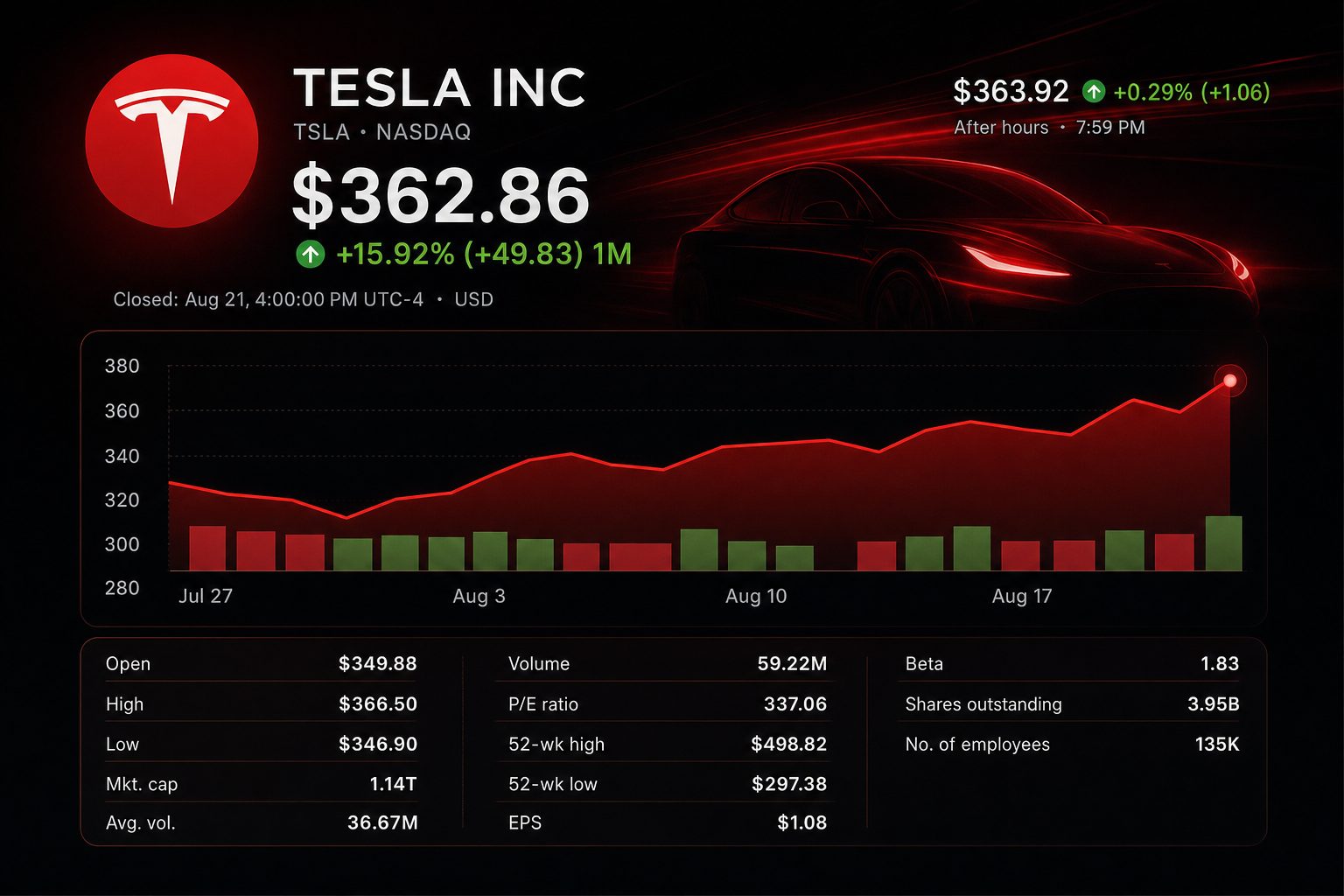
The news was not received by investors as an instant earnings surprise. Shares of Tesla ended Friday at $362.86, rising 5.1% on the day and gaining 6.0% for the week. Nasdaq markets were shut for the weekend when this was published.
| Tesla China program | Vehicles | Remedy | Start |
|---|---|---|---|
| Emergency door mechanism | 2,975,910 | Apply warning decals and update post-crash window controls | Sept. 25, 2026 |
| Monitoring driver attention | 2,740,642 | OTA update to activate cabin camera tracking | Immediate |
The door campaign includes a physical aspect. Vehicle owners might require labels to indicate manual releases within the car. Tesla is additionally set to revise window software, enabling windows to lower following a crash to enhance another exit option if low-voltage power is lost.
A separate recall affects 2.74 million Model 3 and Model Y vehicles manufactured in China. Tesla plans to introduce cabin-camera gaze monitoring alongside steering-wheel torque checks. This fix involves only software and will be deployed over-the-air.
| Door-release recall composition | Vehicles | Share |
|---|---|---|
| Model Y made in China | 1,956,713 | 65.8% |
| Model 3 produced in China | 973,156 | 32.7% |
| Model 3 imported | 35,590 | 1.2% |
| Model X imported | 8,328 | 0.3% |
| Model S imported | 2,123 | 0.1% |
Tesla is not the only company affected. Xiaomi Corporation (HKEX:1810) is recalling 390,435 SU7 cars, and Zhejiang Leapmotor Technology Co., Ltd. (HKEX:9863) is recalling 371,200 vehicles in this round. XPeng Inc. NYSE:XPEV will recall 264,842 vehicles. The common issue involves manual releases that are difficult to distinguish from adjacent trim.
China’s measures extend past simple labeling. Fresh national regulations for newly approved models come into force on January 1, 2027, mandating a mechanical release and discontinuing the use of fully electronic concealed handles. Models already approved are granted until January 2029 to comply.
| Investor context | Latest measure | Comparison |
|---|---|---|
| TSLA Friday close | $362.86 | Gained 5.1% on the day; climbed 6.0% in the week |
| China revenue, Q2 2026 | $4.675bn | Represents 16.6% of total revenue |
| Warranty cost incurred, Q2 | $504m | Higher than $398m for the same period last year |
| Accrued warranty reserve | $8.963bn | Increased from $7.512bn in the prior year |
| Door-recall fleet | 2.976m | Equal to 1.81 times 2025 global deliveries |
China continues to be a significant market for Tesla but does not account for the majority of its revenue. The country contributed $4.675 billion, representing 16.6% of Tesla’s $28.236 billion in revenue for the second quarter. For the first half, China revenue totaled $8.859 billion, reflecting a 2.9% increase compared to the previous year.
Warranty accounts provide a clear boundary but do not reflect an estimate of recall costs. Tesla recorded $504 million in warranty expenses during the second quarter, with reserves totaling $8.963 billion as of June 30. The company has not revealed the expenses related to the China remedies.
Analysts are split. A three-month poll on Investing.com lists 22 buy ratings, 19 holds, and five sells. The average price target from 39 analysts is $390.09, which is just 7.5% higher than Friday’s closing price.
| Analyst view | Count or value | Reading |
|---|---|---|
| Buy ratings | 22 | 48% out of 46 analysts |
| Hold ratings | 19 | 41% out of 46 analysts |
| Sell ratings | 5 | 11% out of 46 analysts |
| Consensus price target | $390.09 | 7.5% higher than $362.86 |
| Price target span | $125–$600 | Analysts divided on valuation |
Risks: Direct expenses could remain moderate if software and labels address the bulk of cases. Greater risks would stem from weaker demand in China, extensive redesign needs, or related measures in other regions. An increase in warranty outlays would make that strain apparent.
Monday’s U.S. session will indicate if investors continue to distinguish the recall from upcoming earnings. Critical operational indicators include owner completion rates following September 25, the possibility of expansion outside China, and when Tesla will next report on warranty costs.
Related articles: NASDAQ:TSLA

![US Stock Market Today 08/24/2026 [UPDATE: 01:05 EDT] [Nasdaq Futures Slip as Overnight Chip Weakness Holds]](https://ts2.tech/wp-content/uploads/2026/08/US-market-dashboard-2026-08-24-0102-480x384.jpg "US Stock Market Today 08/24/2026 [UPDATE: 01:05 EDT] [Nasdaq Futures Slip as Overnight Chip Weakness Holds]")