
Sunnyvale, California, May 27, 2026, 14:03 (PDT)
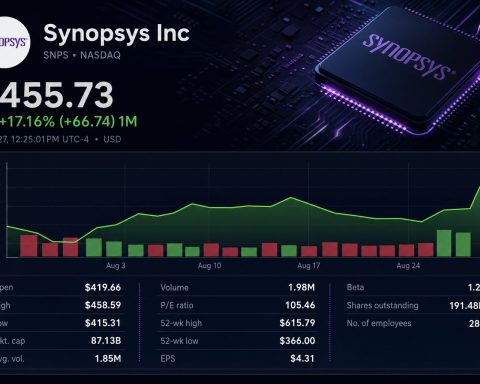
Synopsys raised its annual revenue and profit forecast on Wednesday after fiscal second-quarter sales topped expectations, but its shares fell in late trading as investors looked harder at a soft chip-IP business and the costs of absorbing Ansys. The company reported adjusted earnings of $3.35 a share on revenue of $2.28 billion, above analyst estimates of $3.15 and $2.25 billion, while SNPS dropped more than 2% after hours, Investors Business Daily reported.
The result matters because Synopsys sits near the center of the AI hardware buildout. Its electronic design automation, or EDA, software helps engineers design and verify chips, a market getting more complex as Nvidia, cloud providers and chipmakers race to build AI processors and systems. Reuters said Synopsys lifted its fiscal 2026 revenue forecast to $9.63 billion-$9.71 billion from $9.56 billion-$9.66 billion, citing steady demand tied to AI chip design.
The quarter also lands with pressure building inside the boardroom. Synopsys said separately that Jesse Cohn, a managing partner at activist investor Elliott Investment Management, will join its board on June 1, expanding the board to 11 members. Cohn said Synopsys is “essential to the global chip industry,” language that points to both the opportunity and the scrutiny now on management. Synopsys Investor Relations
Revenue for the quarter ended April 30 rose to $2.276 billion from $1.604 billion a year earlier. GAAP earnings, the standard accounting measure, fell to 9 cents a share from $2.24, while adjusted, or non-GAAP, earnings were $3.35 a share; non-GAAP figures strip out items such as acquisition amortization, stock pay and restructuring costs.
Synopsys now expects fiscal 2026 adjusted earnings of $14.72 to $14.80 a share, up from $14.38 to $14.46. For the current quarter, the company forecast revenue of $2.41 billion to $2.46 billion, compared with analysts’ average estimate of $2.41 billion, according to LSEG data cited by Reuters.
Chief Executive Sassine Ghazi said AI is driving more semiconductor demand and chip complexity. CFO Shelagh Glaser said the company’s focus on execution and cost discipline “sets us up for a strong second half,” as Synopsys lifts targets for revenue, operating margin, earnings and free cash flow. Synopsys News Releases
The mix was not clean. Design Automation revenue jumped to $1.82 billion from $1.12 billion and accounted for 80% of quarterly sales, helped by the broader move into systems and simulation software. Design IP, the business that licenses pre-built chip-design blocks, fell to $454.2 million from $482.0 million; its adjusted operating margin narrowed to 24.4% from 31.2%.
That is the rub for investors. A 24/7 Wall St. column published Tuesday argued that Synopsys risked being valued like a high-growth AI winner while parts of the business looked more like mature software licensing, with Design IP a weak spot and Cadence Design Systems the closest EDA rival.
Cadence gives the read-through. It raised its own annual revenue forecast last month on demand for AI chip-design tools, showing the industry tailwind is real, but it also means Synopsys has little room to blame the market if margins or IP sales lag.
Ansys remains the other test. Synopsys said fiscal 2026 revenue includes $2.96 billion of expected Ansys revenue, including a $60 million accounting impact tied to channel partners, while the outlook also reflects the drag from planned and completed divestitures. The company plans a Sept. 30 Investor Day to lay out longer-term targets.
But the downside is clear enough. Synopsys’ targets assume no further changes to export controls or U.S. Entity List restrictions, and the company listed trade rules, tariffs, Ansys integration and semiconductor industry growth among factors that could shift results. If Design IP keeps weakening, Ansys synergies come in slowly or China-related restrictions tighten again, the raised forecast may not be enough to quiet investors.
Related articles: NASDAQ:SNPS