
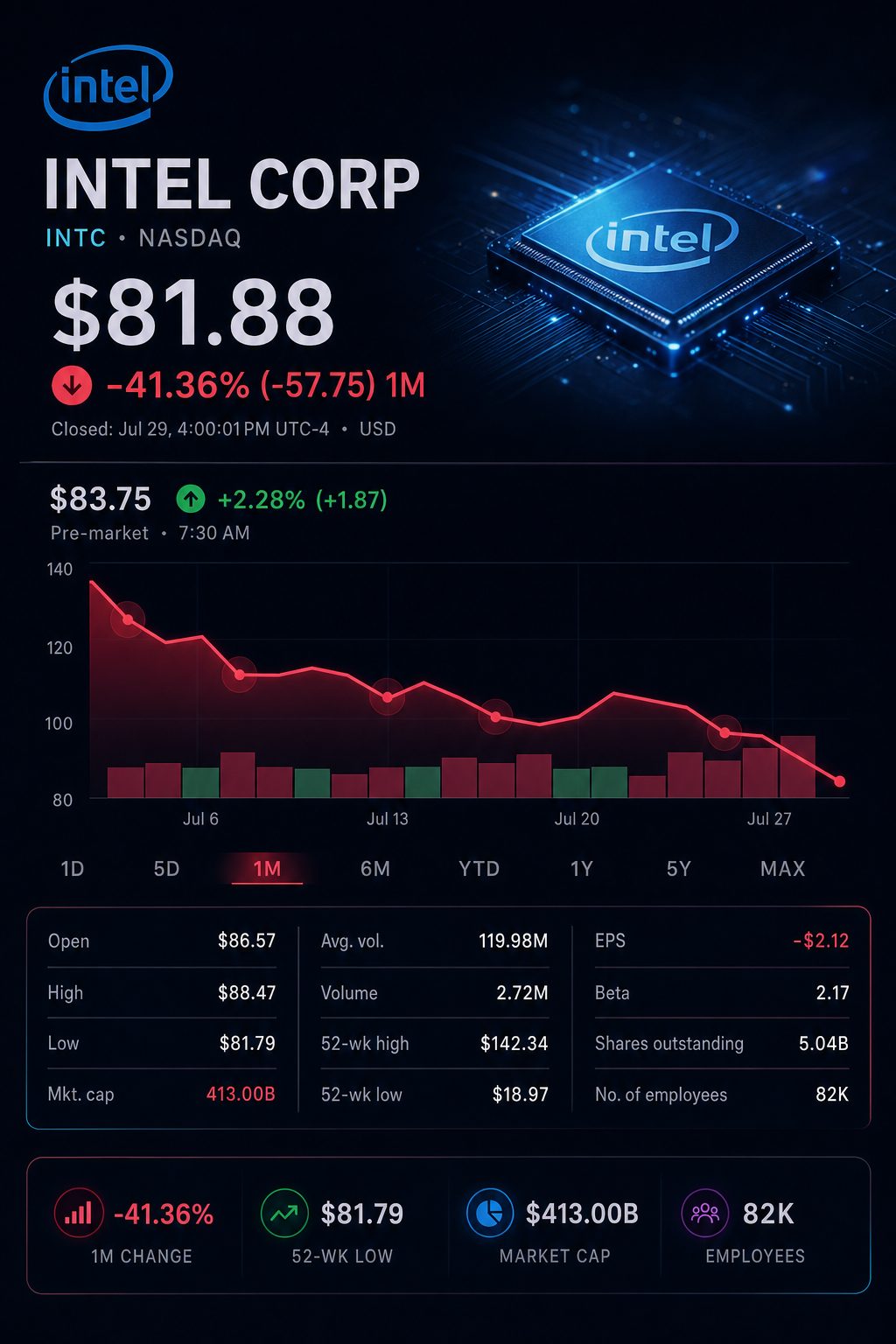
NEW YORK, July 30, 2026, 07:02 EDT – Shares of Intel NASDAQ:INTC were little changed around $82 on Thursday as persistent losses from its foundry business continued to weigh on gains fueled by AI demand.
- Intel was at $82.29 in premarket activity, rising 0.5%. The stock slid 5.12% on Wednesday.
- The stock is down 22.4% over six consecutive sessions, but it is still up 121.9% in 2026.
- Intel Foundry reported a quarterly loss amounting to 43% of Intel Products’ operating profit.
Intel stock rose slightly in premarket trading on Thursday. The uptick was limited. As of 7:02 a.m. EDT, U.S. markets had yet to open.
The figures indicate that demand is likely not the primary issue. Intel surpassed expectations for the second quarter and issued guidance ahead of consensus forecasts. The tougher question remains whether earnings from its products can support its manufacturing growth.
Semiconductor shares were broadly under pressure at the close on Wednesday. Intel’s decline, however, outpaced that of the overall market.
| Security | Wednesday close | Day change |
|---|---|---|
| Intel Corporation NASDAQ:INTC | $81.88 | -5.12% |
| Advanced Micro Devices NASDAQ:AMD | $429.56 | -5.60% |
| Nvidia Corporation NASDAQ:NVDA | $190.01 | -3.36% |
| Taiwan Semiconductor Manufacturing NYSE:TSM | $374.67 | -4.52% |
| S&P 500 | 7,316.15 | -1.52% |
The extended comparison highlights further weakness. Intel lagged the S&P 500 by close to 20 percentage points over its recent six-day losing streak. Despite this decline, shares are still among the top performers for 2026.
| Period ending July 29 | Intel | S&P 500 | Intel versus S&P 500 |
|---|---|---|---|
| One day | -5.1% | -1.5% | -3.6 points |
| Six days | -22.4% | -2.6% | -19.8 points |
| 21 days | -37.8% | -1.7% | -36.1 points |
| Year so far | +121.9% | +6.9% | +115.0 points |
The earnings report exceeded forecasts, with revenue, adjusted earnings, and gross margin all surpassing estimates. Early guidance for the third quarter also topped predictions.
| Metric | Intel result or outlook | Consensus estimate | Variance |
|---|---|---|---|
| Q2 revenue | $16.13 billion | $14.42 billion | +11.8% |
| Q2 adjusted EPS | $0.42 | $0.21 | +100.0% |
| Q2 adjusted gross margin | 41.8% | 38.8% | +3.0 points |
| Q3 revenue midpoint | $16.30 billion | $15.10 billion | +7.9% |
| Q3 adjusted EPS | $0.38 | $0.27 | +40.7% |
*Initial management projections. Intel forecast revenue in a range of $15.8 billion to $16.8 billion. Final outcomes could vary.
The GAAP net loss of $11.03 billion reflects a $12.53 billion mark-to-market expense related to escrowed shares. Adjusted net income totaled $2.20 billion.
Segment economics illustrate market caution. Revenue rose most quickly in Data Center and AI. Foundry also saw higher sales, though the unit continued to post significant losses.
| Q2 segment | Revenue | Year-on-year change | Operating income/(loss) | Operating margin |
|---|---|---|---|---|
| Client Computing and Physical AI | $8.88 billion | +12.8% | $2.34 billion | 26.4% |
| Data Center and AI | $6.26 billion | +59.0% | $2.47 billion | 39.5% |
| Intel Foundry† | $5.77 billion | +30.5% | $(2.09) billion | -36.2% |
†Foundry revenue accounts for internal sales. Intel reported total intersegment eliminations of $5.48 billion.
The foundry segment reported a loss equivalent to 43.4% of Intel Products’ $4.82 billion in operating profit. This loss shrank by 34% compared to a year earlier. Meanwhile, Data Center and AI operating income almost multiplied by four. The contrast is still pronounced.
Intel increased its projected 2026 capital expenditures to $20 billion, up from $18 billion. The company expects a significant rise in spending again the following year. Adjusted free cash flow, as defined by Intel, registered at negative $8.42 billion, compared to negative $1.05 billion a year ago. This figure included a net partner outflow of $12.22 billion.
At the end of the quarter, cash and short-term investments amounted to $29.73 billion, while combined short- and long-term debt was approximately $50.54 billion. Chief Financial Officer David Zinsner stated that a share sale has not been authorized, but did not exclude the possibility.
Synopsys NASDAQ:SNPS announced on July 27 that it has certified updated design flows and intellectual property for Intel’s 14A process, enhancing overall design readiness. The company’s statement did not mention any new wafer customers.
Chief Executive Lip-Bu Tan stated he is “increasingly confident” in the competitiveness of 14A. Shay Boloor at Futurum Group noted that additional revaluation hinges on improved “foundry economics” and more wins with external customers. Reuters
Risks: Intel faces the challenge of achieving strong 14A manufacturing yields, attracting external orders, and managing its funding requirements. Continued chip sector selloffs, export limits or supply disruptions may mask progress in operations.
For investors, the focus now shifts to cash conversion. Even another revenue beat may fall short. Intel has to demonstrate reduced foundry losses, solidify external orders and show more consistent spending.
Related articles: NASDAQ:INTC