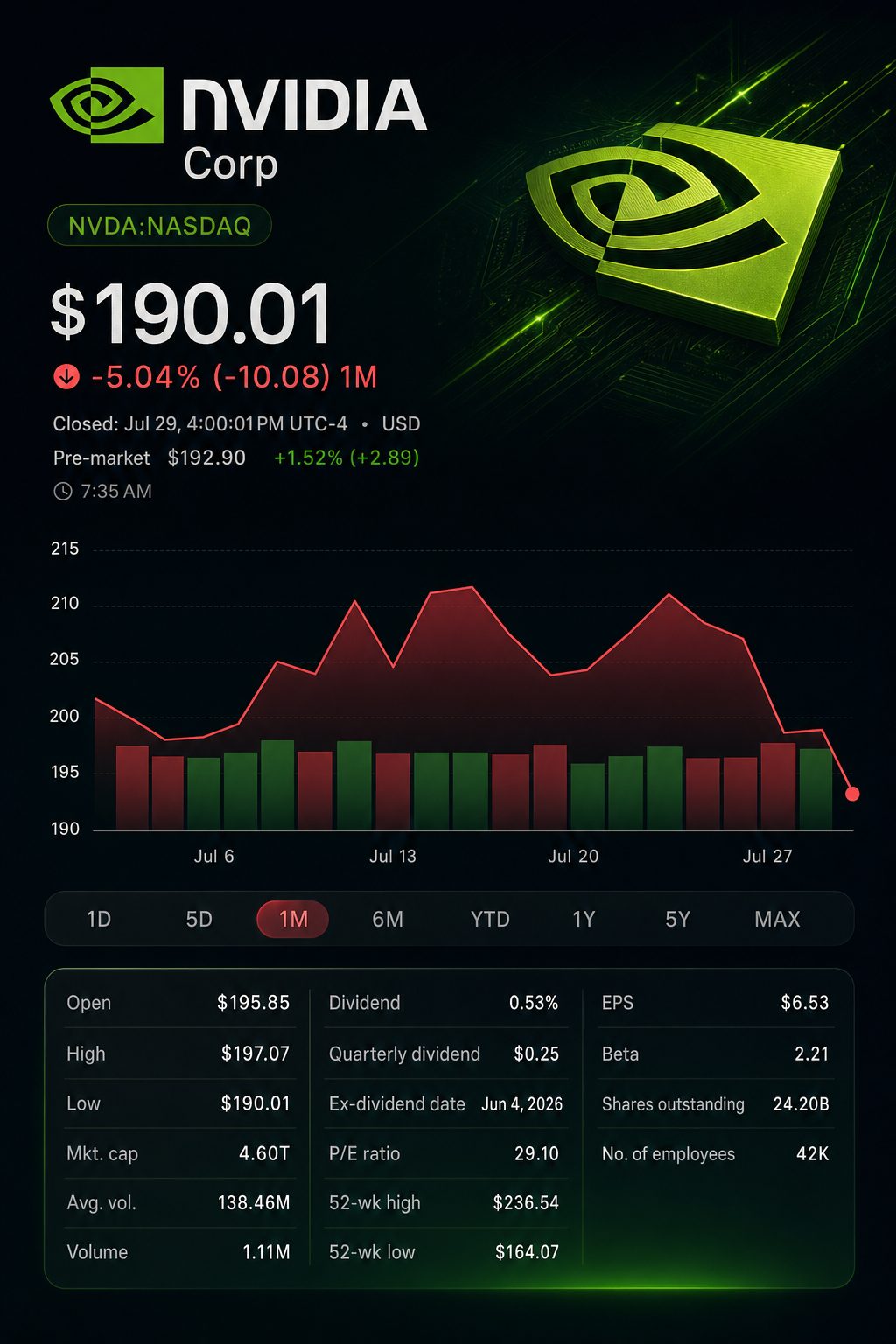
NVIDIA shares were at $192.61 as of 6:51 a.m. EDT, rising 1.37% in premarket trading, following a 3.55% drop on Wednesday.
Microsoft NASDAQ:MSFT surged 9.35% in premarket trading. Meta Platforms NASDAQ:META dropped 9.24% following their earnings.
Amazon.com NASDAQ:AMZN is set to report on Thursday. Advanced Micro Devices NASDAQ:AMD will release results on Aug. 4.
NVIDIA stock gained ahead of Thursday’s market open, recovering some ground after Wednesday’s decline. U.S. cash markets stayed shut, but premarket trading was underway.
Microsoft and Meta delivered the most pronounced messages. While each invested significantly in infrastructure, Microsoft alone maintained robust free cash flow. Investors responded by sending the companies’ shares in different directions.
NVIDIA rose above the chip index on Wednesday, despite its nearly 9% fall over five days. The gap suggests a broader sector revaluation rather than an isolated company impact.
How Meta and Microsoft financed their most recent quarters
$ billions
Revenue
Operating cash flow
Reported capex
Free cash flow
Capex / operating cash flow
Microsoft
90.000
55.400
41.000
19.600
74.0%
Meta
60.801
31.862
31.080
0.784
97.5%
Total
150.801
87.262
72.080
20.384
82.6%
Figures are based on corporate filings. Capex calculations encompass finance leases as disclosed. Variations in accounting practices mean the comparison serves as an indicator rather than a precise match.
Capital expenditures accounted for 82.6% of the total operating cash flow for the companies. Microsoft was responsible for 96% of the combined free cash flow, highlighting the gap for investors.
“Around two thirds of capital expenditures went to short-lived assets,” said Microsoft CFO Amy Hood, naming CPUs and GPUs as primary examples. Azure revenue increased by 43% as demand still outstripped capacity. Microsoft
Meta’s capital expenditures reached $31.08 billion, coming close to its operating cash flow. Free cash flow dropped to $784 million. CEO Mark Zuckerberg stated, “AI is accelerating our core business today.” The premarket slide showed investors were still uncertain about when returns could be expected. Meta Investor
AI supply chain cash conversion
Company and period
Revenue, $bn
Free cash flow, $bn
FCF margin
NVIDIA, Q1 FY2027
81.615
48.554
59.5%
Microsoft, Q4 FY2026
90.000
19.600
21.8%
Meta, Q2 2026
60.801
0.784
1.3%
Margins are calculated. Definitions for free cash flow and reporting periods vary.
NVIDIA continues to display robust cash generation, reporting a free-cash-flow margin of 59.5% in its most recent quarter. The company posted a 74.9% GAAP gross margin, and Data Center revenue surged 92% to $75.2 billion.
NVIDIA forecast second-quarter revenue at $91 billion, with a 2% margin of error. The initial guidance excludes any China data-center compute sales.
Buyer capital expenditures do not serve as a direct indicator of NVIDIA’s revenue. Microsoft is widening its adoption of Maia chips and intends to roll out AMD Helios processors as well as NVIDIA Vera Rubin platforms.
Upcoming investor reviews
Date and time
Event
Main NVIDIA read-through
July 30, 5:00 p.m. ET
Amazon Q2 earnings call
AWS expansion, infrastructure expenditure and available capacity
Aug. 4, after market close
AMD Q2 financial results
Demand for accelerators, pricing environment and development plans
Company calendar events.
Amazon’s results will show if Microsoft’s strong cash generation also appears among other cloud providers. AMD’s earnings will directly gauge demand for accelerators and competitive pricing dynamics.
Risks are evident. Purchases from cloud customers may decrease if AI yields fall short of expectations. Custom chips and AMD might draw a greater share of future budgets, and China is still not included in NVIDIA’s present revenue projections.
AI demand is holding steady for NVIDIA shareholders. The question now is whether buyers can support that demand without impacting their cash flow. Amazon will offer further insight Thursday evening.
What is NVIDIA’s current stock price, and what factors are weighing on it?
NVIDIA finished Wednesday, July 29, at $190.01, marking a drop of around 3.6%. The stock has fallen approximately 9% since July 23. Despite the decline, market capitalization remained close to $4.63 trillion, with a 28.9 trailing P/E ratio. The downturn on Wednesday followed weaker demand for chip stocks, a rise in oil prices, and increasing Treasury yields. Snapshot confirmation occurred before trading began on Thursday.
What does NVIDIA need to show in its earnings report in August?
The following report is due August 26 and will detail fiscal second-quarter performance. Management forecasted revenue at $91 billion, with a tolerance of plus or minus 2%, setting a range between approximately $89.2 billion and $92.8 billion. The midpoint signals sequential growth of 11.5% and almost 95% growth year-over-year. Gross margin is expected to reach about 75%, with no revenue from China compute included in the outlook.
How solid were the most recent operating figures?
First-quarter revenue was $81.6 billion, an increase of 85% versus the prior year. Data Center revenue climbed to $75.2 billion, up 92% year on year. Non-GAAP earnings per share reached $1.87, up 140%. Gross margin remained steady at 75% even amid rapid Blackwell systems rollout. GAAP profit reflected approximately $15.9 billion in investment gains.
Can ongoing investments from major technology firms continue to drive NVIDIA’s growth momentum?
Spending by existing customers continues to drive demand, but investment returns are coming under increasing evaluation. Microsoft posted quarterly expenditures of $41 billion, with Azure revenue climbing by 43%. Meta projects 2026 capital expenditures between $130 billion and $145 billion. Google, in a separate update, raised its 2026 forecast to a range of $195 billion–$205 billion. Still, UBS forecasts a significant slowdown in hyperscaler spending growth beyond 2026.
To what extent does China remain significant for the forecast?
China is still the main uncertainty. NVIDIA recorded no Hopper Data Center product shipments to China in the latest quarter, after reporting $4.6 billion in comparable shipments the previous year. New licenses for the H200 have not contributed any revenue, and demand from China remains unpredictable. As a result, the existing $91 billion guidance includes zero revenue from China compute sales.
Is reliance on a few customers emerging as a significant risk factor?
Yes, but such concentration also indicates substantial orders placed by large infrastructure clients. Three individual customers made up 21%, 17%, and 16% of revenue for the quarter. Combined, they accounted for 54% of overall sales. Roughly half of Data Center revenue for the period came from hyperscalers. A single customer's postponed deployment has the potential to significantly affect quarterly revenue.
Will Blackwell and Rubin help NVIDIA maintain its technological advantage?
Blackwell accounted for the majority of system deliveries in the most recent quarter. NVIDIA anticipates Rubin shipments in the second half of fiscal 2027. A planned Korean facility with two gigawatts capacity will feature Rubin chips and HBM4 memory. The site’s initial phase is scheduled to begin operations during 2027. There is ongoing execution risk as complicated deployments can impact both yields and delivery schedules. Custom accelerators and competing GPUs continue to challenge pricing over extended timeframes.
Do NVIDIA’s investments pose a risk of circular financing?
NVIDIA's balance sheet remains robust. In the most recent quarter, the company produced $50.3 billion in operating cash flow. NVIDIA repurchased $20.2 billion in shares and secured an $80 billion buyback authorization. Investments in private companies and infrastructure funds totaled $18.6 billion. According to filings, some beneficiaries may eventually acquire or utilize NVIDIA systems indirectly. Expected obligations for future research data-center leases totaled $32.4 billion. Discussions regarding reported financing guarantees are ongoing, so the ultimate level of exposure is still undetermined.
What do valuation and analyst projections suggest starting at $190?
NVIDIA shares changed hands at $190.01, representing a trailing earnings multiple of about 28.9. This valuation appears moderate given recent expansion, though expectations are high. FactSet’s median twelve-month price target stands at $300, indicating an estimated 58% gain. Consensus targets from other sources cluster between $303 and $314. The lowest target identified is around $180, pointing to potential downside risk. These projections rely on ongoing growth, margin levels of 75%, and continued customer demand.
Michał Rogucki is a senior markets reporter at TS2.tech. His coverage ranges from stocks and technology to economic developments affecting global markets. He graduated from Humboldt University of Berlin and worked in investment research and market analysis before becoming a financial journalist.