
Meta Shares Fall 9% as AI Investment Uses 98% of Operating Cash

Meta Shares Fall 9% as AI Investment Uses 98% of Operating Cash

NEW YORK, July 30, 2026, 07:00 EDT – Meta’s stock declined 9% as the company reported that artificial intelligence development had absorbed 98% of its operating cash flow.

  • Meta stock was set at $533.49, a decline of 8.9%, ahead of Thursday’s Nasdaq opening.
  • Revenue increased by 28% in the second quarter, while free cash flow dropped 91% to $784 million.
  • Meta allocated 97.5% of its operating cash flow to capital expenditures and lease obligations. The company did not buy back any shares in the quarter.

Shares of Meta Platforms, Inc. slipped 8.9% in premarket trade on Thursday, quoted at $533.49 after finishing Wednesday at $585.61. The Nasdaq had yet to open for regular trading.
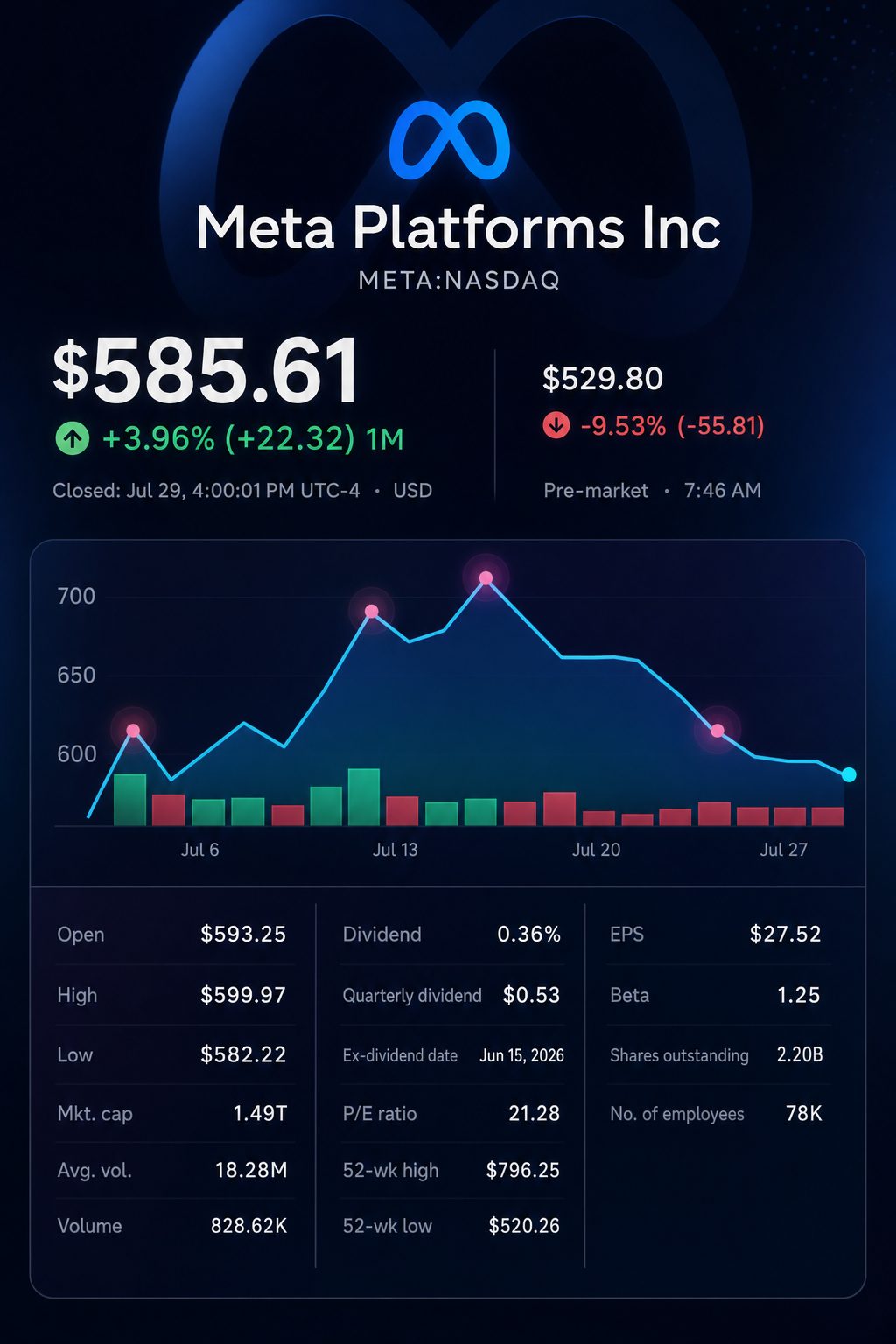
Stock chart for NASDAQ:META

The selloff was driven by concerns over cash flows rather than a drop in advertising demand. Meta generated $31.86 billion in operating cash during the second quarter, while capital expenditures and finance-lease payments totaled $31.08 billion.

That expenditure took up 97.5% of the operating cash flow, based on figures from the company. Free cash flow represented only 1.3% of revenue, compared with an 18.0% margin a year before.

This is significant as advertising accounted for 97.6% of Meta’s revenue. The company’s spending matches that of cloud platforms, yet it does not have a proven cloud business.

Q2 measure20262025Change
Revenue$60.80 bln$47.52 bln+28.0%
Advertising revenue$59.36 bln$46.56 bln+27.5%
Costs and expenses$42.03 bln$27.08 bln+55.2%
Operating income$18.78 bln$20.44 bln-8.2%
Operating margin31%43%-12 points
Operating cash flow$31.86 bln$25.56 bln+24.7%
Capex and lease principal$31.08 bln$17.01 bln+82.7%
Free cash flow$0.78 bln$8.55 bln-90.8%
Share repurchases$0$10.17 bln-100%
Net debt issuance$24.91 bln$0Not meaningful

Expenses increased at nearly double the pace of revenue. This total included $2.40 billion in legal-related charges and $1.18 billion in severance costs. Chief Financial Officer Susan Li noted that operating income would have climbed 9% if these costs were excluded. Reported operating income declined 8%.

The core advertising business stayed robust, with ad impressions up 14% and average pricing climbing 12%. The number of daily active users on Meta’s apps grew by 3%, reaching 3.60 billion.

Revenue surpassed the initial FactSet consensus by $581 million, but earnings fell short by $1.01 per share. Meta’s midpoint revenue guidance for the third quarter likewise came in around $640 million below the preliminary consensus.

Result or outlookMeta figurePreliminary consensusDifference
Q2 revenue$60.80 bln$60.22 blnUp 1.0%
Q2 diluted EPS$6.18$7.19Down 14.0%
Q3 revenue$61–$64 bln$63.14 blnMidpoint off by 1.0%

Meta increased the lower bound of its 2026 capital expenditure outlook, moving the range to $130 billion–$145 billion. The midpoint is up 10% from January and sits roughly 90% higher than Meta’s 2025 capital spend.

The change in capital allocation is evident. Meta posted $24.91 billion in net debt for the quarter. It made no share buybacks, after repurchasing $10.17 billion in the prior year.

Microsoft Corp. stands out for comparison. The company generated $19.6 billion in free cash flow last quarter, even with significant infrastructure investment. Azure revenue increased by 43%, directly enabling the monetisation of that added capacity.

Alphabet Inc. represents the opposite end of the spectrum. In the June quarter, its capital expenditures were higher than its operating cash flow, resulting in negative free cash flow of $5.86 billion.

Latest June quarterOperating cash flowCash purchases of property and equipmentCash investment/OCFReported free cash flow
Meta$31.86 bln$30.12 bln94.5%$0.78 bln
Microsoft$55.40 bln$35.80 bln64.6%$19.60 bln
Alphabet$39.07 bln$44.92 bln115.0%-$5.86 bln

Meta’s stated free cash flow subtracts $962 million in finance-lease principal. Company definitions may vary.

“Meta is spending like a hyperscaler without a hyperscaler’s business model,” said eToro analyst Josh Gilbert. The key distinction is that Microsoft and Alphabet are able to offer computing power via their mature cloud services. Reuters

Chief Executive Mark Zuckerberg stated that “AI is accelerating our core business today.” He additionally described developments in personal agents, enterprise services and potential compute sales. However, investors were given limited concrete revenue targets for those areas. SEC

Another challenge arises from potential legal risks. Meta has cautioned that upcoming youth-focused court cases could result in significant losses. Four states in the U.S. are pursuing $1.4 trillion in damages, citing alleged negative effects on young users. Meta denies these claims.

The criteria for investors have shifted. Growth in advertising is now insufficient by itself. Meta is required to improve cash conversion and demonstrate that its infrastructure is capable of producing income from sources other than advertising.

TS2 TECH • EXTENDED COVERAGE

Further analysis

What is causing Meta’s shares to drop ahead of Thursday’s U.S. market opening?

Meta shares finished Wednesday at $585.61, falling to $533.49 in premarket trading by 7:00 a.m. ET Thursday, down 8.90%. While revenue surpassed forecasts, investors were disappointed by EPS, outlook, profit margins, and cash flow. Markets also turned attention to the company’s planned 2026 capital expenditures of $130–$145 billion. The Wall Street Journal

Is the selloff primarily related to Meta, or is it contributing to the broader decline in the index?

Wednesday saw significant declines across markets, yet that alone does not account for Thursday’s earnings gap. The S&P 500 was down 1.52%, and the Nasdaq Composite slipped 1.74%. Meta shares ended 1.31% lower, dropping a further 8.90% before the Thursday session began. The trend suggests that company-specific issues around earnings and expenditures were the main drivers. The Wall Street Journal

How did the second-quarter results compare to analysts’ forecasts on Wall Street?

Revenue for the second quarter rose 28% year-over-year to $60.80 billion, surpassing the FactSet consensus of $60.22 billion by about $581 million. Earnings per share came in at $6.18, below both the expected $7.19 and last year’s $7.14. Costs jumped 55%, lowering operating margin from 43% to 31%. Legal and severance-related expenses reached $3.58 billion. PR Newswire

Does Meta’s advertising platform remain robust?

Advertising revenue climbed 27% compared to a year earlier, hitting $59.36 billion. Ad impressions were up 14%, and the average price per ad rose 12%. Family daily active people totaled 3.60 billion, marking a 3% increase year over year. Roughly 97.6% of Meta’s quarterly revenue still came from advertising. The company’s main revenue driver remains robust, but dependence on advertising remains notably high. PR Newswire

What does the outlook for the third quarter suggest about revenue growth?

Meta forecast third-quarter revenue between $61 billion and $64 billion. The midpoint of $62.5 billion indicates annual growth of about 22%. Analyst consensus from FactSet was around $63.14 billion, which is a bit higher than Meta’s midpoint. Currency headwinds are expected to cut yearly growth by close to one percentage point. Growth is still robust, though it has slowed from 28%, making the deceleration evident. PR Newswire

What is the extent of the pressure on free cash flow?

Operating cash flow for the second quarter totaled $31.86 billion. Capital expenditures accounted for $31.08 billion, resulting in free cash flow of just $784 million. This marks a 91% drop from $8.55 billion in the same quarter last year. Capital spending for the full year is now projected between $130–$145 billion. This pressure is now the main valuation risk. PR Newswire

Is Meta able to support AI investments without impacting shareholder returns?

Meta reported $90.26 billion in cash and marketable securities as of the end of the quarter. Long-term debt climbed to $83.66 billion, compared to $58.74 billion in December. The company raised $24.91 billion in debt over the first half of 2026. It did not conduct any share buybacks, after repurchasing $22.92 billion in the first half of the previous year. Funding options are still present, but returns to shareholders have already been reduced. PR Newswire

Do Reality Labs and AI services deliver satisfactory returns?

Reality Labs reported $431 million in revenue and booked an operating loss of $4.62 billion. This operational shortfall was over ten times the revenue generated in the segment. Meta noted that third-party buyers were willing to pay premiums for its limited computing resources. Despite this, executives stopped short of providing concrete revenue goals for enterprise AI products. As a result, the potential returns remain uncertain and are challenging to assess. PR Newswire

Does the decline make the stock appealing in terms of valuation?

Meta shares are valued at $533.49, reflecting a price-to-earnings ratio of 20.1 times the company’s reported trailing earnings. The stock’s 52-week low stands at $520.26, about 2.5% beneath current levels. The next significant recovery point sits at the Wednesday close of $585.61. After results, one analyst lowered a price target from $850 to $700. For now, the key reference range is $520–$586, while analyst forecasts are still being revised. The Wall Street Journal

What is the scale of the legal and regulatory risk?

Meta incurred $2.40 billion in legal expenses in the second quarter, which prompted the company to raise its full-year cost forecast to a range of $165–$169 billion. Management highlighted that youth-related litigation may result in significant losses. The total financial impact remains unquantified. As a result, legal developments could outweigh typical quarterly estimate revisions. PR Newswire

Michał Rogucki is a senior markets reporter at TS2.tech, specializing in stocks, technology and macroeconomic developments. A graduate of Humboldt University of Berlin, he previously worked in investment research and market analysis before transitioning to financial journalism. He covers the trends and events that matter most to investors worldwide.

AI PORTFOLIO

Top Stock Picks

Today’s highest-ranked model selections.

#1 BUY ON PULLBACK

Microsoft

NASDAQ: MSFT 94 / 100
#2 BUY

L3Harris Technologies

NYSE: LHX 90 / 100
#3 BUY

Xylem

NYSE: XYL 89 / 100
#4 BUY IN TRANCHES

Lam Research

NASDAQ: LRCX 87 / 100
#5 BUY ON WEAKNESS

GE HealthCare

NASDAQ: GEHC 84 / 100
View full portfolio
Editorial model selection. Not personalised advice.
NVIDIA Corporation (NASDAQ:NVDA) recovers amid AI investors’ cash-flow scrutiny
Previous Story

NVIDIA Corporation (NASDAQ:NVDA) recovers amid AI investors’ cash-flow scrutiny

Vertiv Climbs 6% After Tumultuous 18% Swing; 50x Earnings Level In Sight
Next Story

Vertiv Shares Recover After Upgraded Forecast Sets $326 Million H2 Challenge