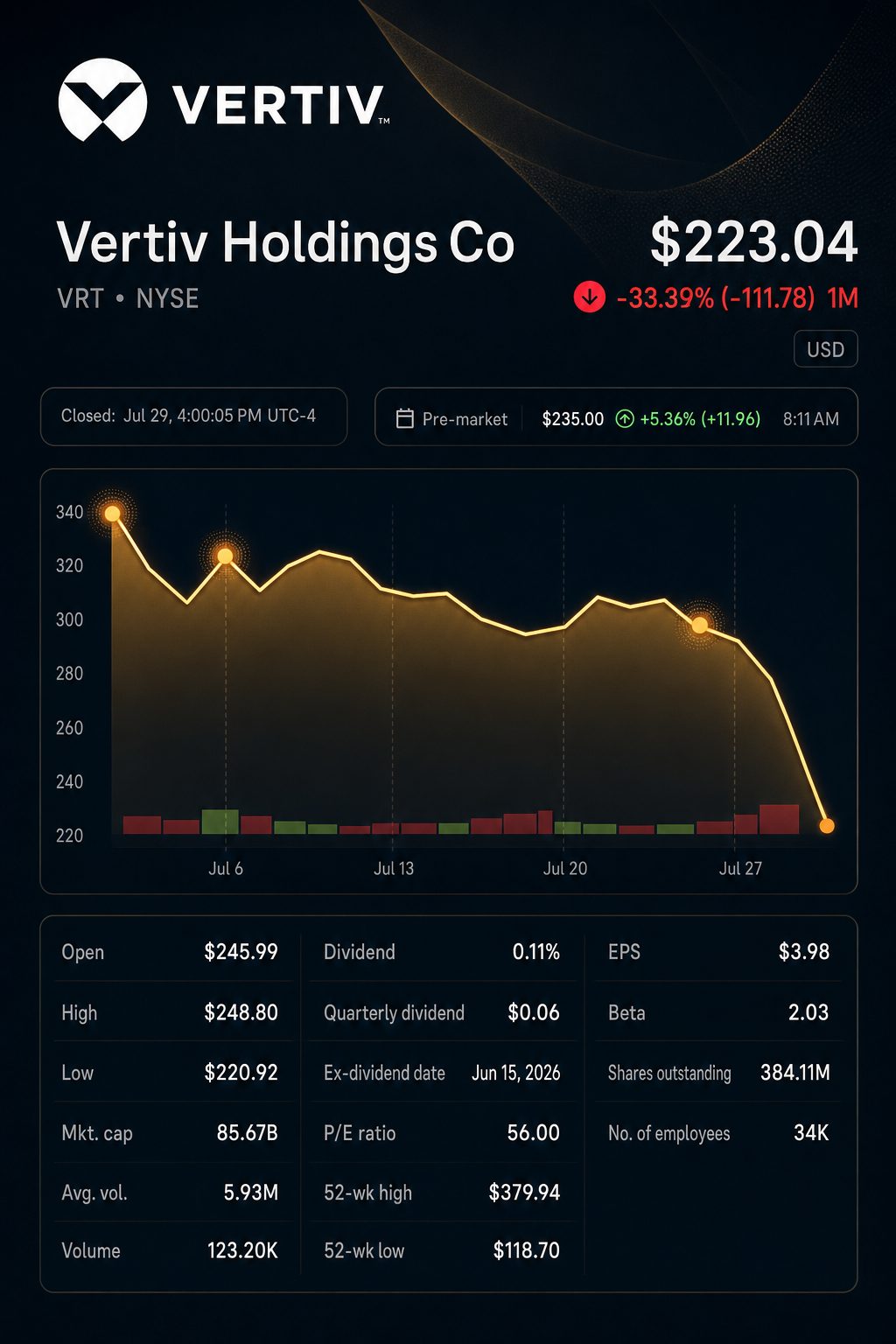
Vertiv rose 4.9% to $234 in premarket trading after falling 17.3% on Wednesday.
Revenue for the second quarter fell short of expectations by 3.2%, while adjusted EPS exceeded estimates by 6.4%.
Initial analysis indicates the increased forecast requires an additional $326 million in sales for the second half.
Vertiv Holdings Co NYSE:VRT shares were up 4.9% at $234 in premarket trading on Thursday. The U.S. regular session was yet to begin. Shares finished Wednesday at $223.04, marking a 17.3% decline.
The recovery has not eliminated the key worry among investors. Vertiv is still required to generate approximately $8.08 billion in sales during the second half in order to meet its guidance midpoint.
Initial estimates indicate the requirement climbed by approximately $326 million. Vertiv’s second-quarter sales came in nearly $76 million under its internal midpoint target. The full-year sales outlook, however, was raised by $250 million.
This moves the discussion from demand toward conversion. Major, multi-phase data center developments need to advance through supply chains as planned.
The remainder of the quarter saw improved performance. Adjusted operating profit increased by 51% and free cash flow climbed to more than three times its previous level.
Vertiv CEO Giordano Albertazzi told CNBC the disruption was “a temporary issue.” In the company statement, Albertazzi said AI and general compute demand “continues to intensify.” Google
Melius Research analyst Scott Davis pointed to the “timing shifts” discussed on the call. Vertiv attributed these shifts to short-term supply chain issues and staggered project execution. Barron’s
2026 metric
Previous midpoint
New midpoint
Increase
Net sales
$13.75 billion
$14.00 billion
$250 million
Adjusted EPS
$6.35
$6.70
$0.35
Adjusted operating profit
$3.20 billion
$3.325 billion
$125 million
Adjusted free cash flow
$2.20 billion
$2.50 billion
$300 million
Midpoints are indicated. Earlier operating-profit and free-cash-flow numbers come from Vertiv’s reported guidance raises.
The increased outlook signals confidence, but it also reduces flexibility if another conversion delay occurs.
Guidance for third-quarter sales is set at a $3.75 billion midpoint, reflecting a 40% rise. The midpoint for the fourth quarter stands at $4.325 billion, up 50%. Vertiv additionally aims for a 25.8% adjusted margin in the fourth quarter.
Preliminary second-half sales bridge
Previous implied plan
Current implied plan
Change
Needed second-half revenue
$7.75 billion
$8.08 billion
+$326 million
Increase over second-half 2025
39.5%
45.4%
+5.9 points
Portion of annual sales
56.4%
57.7%
+1.3 points
Figures are based on official quarterly sales, company-provided midpoint guidance, and the previous second-quarter midpoint.
The decline was notably steeper than that of the broader market. The S&P 500 slipped 1.5% on Wednesday. Shares of Eaton Corporation NYSE:ETN slid 6.3%, while GE Vernova NYSE:GEV was down 4.6%.
The gap indicates doubt directed at the company. Vertiv reported results following a 66% rise in 2026 through Tuesday.
Based on preliminary figures, Vertiv’s closing price on Wednesday was 33.3 times the company’s updated 2026 adjusted EPS midpoint. The premarket quote on Thursday pushed that multiple close to 35 times.
Vertiv’s margins and cash holdings offer a cushion. The company closed the quarter with net cash and $5.6 billion in available liquidity. It lifted its free cash flow midpoint projection to $2.5 billion.
The upcoming test is simple: Vertiv needs to turn its backlog and pipeline into third-quarter sales while maintaining its margin.
Key risks continue to center on supply-chain bottlenecks, the sequencing of projects, tariffs, and a sales strategy weighted toward later periods. Another delay in timing could bring renewed pressure on valuation, despite resilient demand.
VRT ended trading on July 29 at $223.04, falling 17.26% in one day, a steeper drop than the S&P 500’s 1.52% loss. As of 7:55 a.m. EDT, shares in premarket action traded at $233.92, up 4.88%. Trading volume on Wednesday hit 21.3 million shares, about 3.5 times the usual level. The closing price stayed nearly 41% under the 52-week high of $379.94 set in May.
What caused VRT shares to drop even after surpassing earnings forecasts?
Adjusted earnings per share were $1.52, surpassing the consensus expectation of $1.42 by about 7%. Revenue came in at $3.274 billion, falling short of the $3.38 billion forecast by approximately $106 million, or 3.1%. Management attributed the shortfall to short-term supply-chain bottlenecks and more complex, phased projects. Investors prioritized concerns over timing risks above profitability.
What was the strength of the underlying second-quarter results?
Sales increased by 24.1%, with organic revenue up 17.8% compared to a year earlier. Adjusted operating profit rose 51% to $738.4 million for the quarter. The adjusted operating margin widened by 410 basis points to 22.6%. Operating cash flow stood at $1.10 billion, while adjusted free cash flow was $925.3 million. Vertiv ended the quarter holding $5.6 billion in liquidity and net cash.
What are the implications of Vertiv increasing its 2026 guidance?
Vertiv now estimates full-year sales at $13.8 billion to $14.2 billion, with the midpoint projecting approximately 37% reported growth and 31% organic growth. The company expects adjusted EPS between $6.65 and $6.75, suggesting around 60% growth at the midpoint. Adjusted operating margin is forecast in the 23.3% to 24.3% range for the year. Free cash flow is targeted between $2.4 billion and $2.6 billion. Vertiv increased its sales midpoint by $250 million and its EPS midpoint by about $0.35.
How challenging is the revenue increase expected in the second half?
Revenue for the first half reached $5.924 billion, representing an increase of 26.7% compared with the previous year. Achieving the $14.0 billion midpoint target would need $8.076 billion in revenue in the second half, accounting for 58% of annual sales, and marking a 36% rise over first-half revenue. Vertiv’s guidance for third-quarter revenue is about $3.75 billion, implying around $4.326 billion must be generated in the fourth quarter. The company will need to boost execution considerably to meet these targets.
Is demand and order backlog remaining robust?
Management reports that sales pipelines are improving, which underpins higher projected full-year revenue. Vertiv noted ongoing strong demand alongside continued global capacity growth. The most recent official backlog is listed at $15.0 billion as of December 31, 2025, representing a 109% increase from the prior year. There was no updated backlog figure provided in the Q2 release and presentation. Demand remains robust, although the current backlog total has yet to be disclosed.
Following the 17% drop, is VRT now trading at a low price?
Vertiv shares continue to trade at a premium by standard valuation metrics. At the close on Wednesday, VRT was valued at about 33 times the company's $6.70 EPS midpoint. The $233.92 premarket price lifts that ratio closer to 35 times. Its trailing price-to-earnings multiple is still near 50. Management projects about 60% adjusted EPS growth for 2026, but a further revenue miss may put pressure on that high multiple.
How are analysts adjusting their outlook following the earnings surprise?
FactSet reports 22 Buy, four Overweight, six Hold, and one Underweight recommendations. Despite a steep decline Wednesday, the consensus rating is Overweight. The mean price target stands at $352.03, indicating about 58% upside from Wednesday’s finish. Targets, however, are rapidly being lowered. KeyBanc reduced its target to $325, Goldman Sachs set its new target at $301, while Citi trimmed its target to $358 and Evercore raised its target to $375. These swift adjustments may mean the present $352 average no longer reflects current sentiment.
What figures will influence the next significant movement?
Vertiv forecasts third-quarter sales in a range of $3.65 billion to $3.85 billion, with adjusted EPS guidance set between $1.77 and $1.83. The company targets an adjusted operating margin of 24.0% to 25.0% for Q3. Investors seek confirmation that deferred second-quarter revenue will materialise in the latter half. Robust sales results and consistent margins may help restore market confidence. Continued revenue timing issues could pressure the company’s upgraded annual outlook.
Marcin Frąckiewicz is the founder and CEO of TS2 Space, a satellite communications company working with customers worldwide. His experience spans satellite communications, telecommunications and technology ventures. He graduated from the Warsaw School of Economics (SGH) and writes about space technology, artificial intelligence, stocks and the technology companies and industries he follows. Follow Marcin Frąckiewicz on Google News, Facebook or LinkedIn.