
- Third confirmed interstellar visitor. Discovered July 1, 2025 by the ATLAS survey, 3I/ATLAS is only the third known object from beyond our Solar System (after 1I/ʻOumuamua and 2I/Borisov) ts2.tech. Its orbit is highly hyperbolic (eccentricity ≈6.14) and it’s moving at ~58 km/s, confirming it’s unbound to the Sun ts2.tech.
- Safe trajectory. The comet will never come closer than about 1.8 AU (270 million km) to Earth ts2.tech. It reaches perihelion on Oct. 29–30, 2025 at ~1.4 AU from the Sun ts2.tech (between Earth and Mars) and then heads back out, crossing Jupiter’s orbit by March 2026 ts2.tech ts2.tech. NASA and ESA emphasize this path is “benign” – 3I/ATLAS poses no danger to Earth ts2.tech ts2.tech.
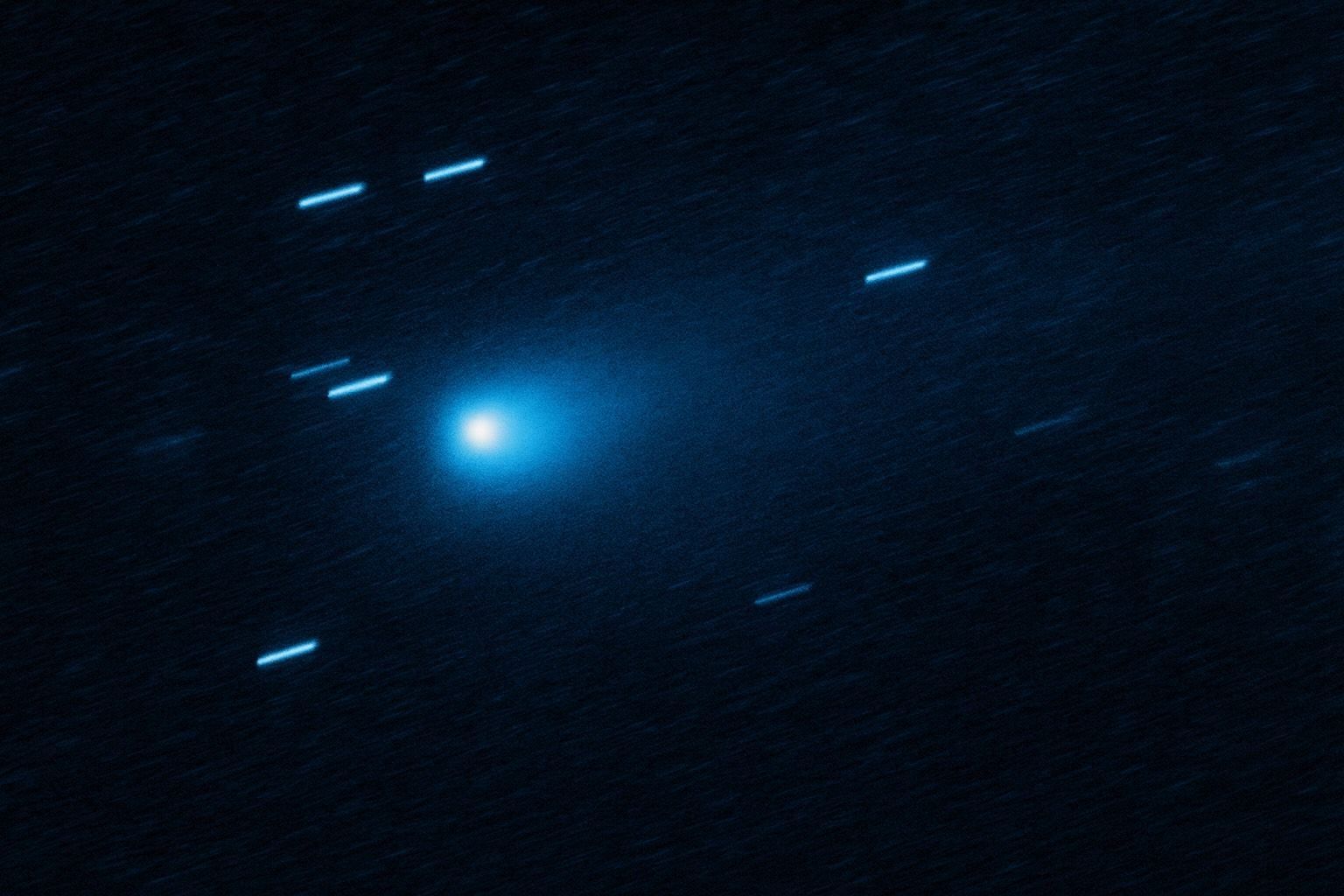
- Active comet. Early Hubble images (July 2025) show a teardrop-shaped coma and tail, indicating 3I/ATLAS is outgassing volatiles while still beyond Jupiter ts2.tech. Its solid nucleus is modest – Hubble constrains it to between ~0.44 and 5.6 km across ts2.tech – but it is already highly active, shedding dust at rates of tens of kilograms per second ts2.tech.
- Ancient, carbon-rich composition. Infrared spectra (by JWST on Aug. 6) reveal a coma extremely rich in CO₂ and water ice Nasa. The CO₂/H₂O ratio is extraordinarily high (~8:1) Nasa ts2.tech – one of the highest ever seen in a comet – suggesting 3I/ATLAS formed in a carbon-rich environment. Scientists estimate it could be over 7 billion years old, possibly predating our Sun ts2.tech ts2.tech.
- Sunward jet observed. A new ground-based image (Aug. 2 composite) shows a dramatic jet of gas and dust blasting from the comet toward the Sun Space Livescience. The fan-shaped jet (visible as a purple streak in the inset) extends ~6,200 miles (10,000 km) from the surface Space Livescience. Astrophysicist Miquel Serra-Ricart notes this is normal comet behavior: “Jets are pointing to [the] sunward direction and [the] comet’s tail [points] in the anti-solar direction” Livescience. The jet is composed mainly of CO₂ and dust, akin to jets seen in other comets.
- Major observing campaign. 3I/ATLAS has been monitored by a fleet of telescopes. ESA’s Mars Express and ExoMars orbiters imaged it during its Oct. 3 flyby of Mars (at ~30 million km) Esa ts2.tech – a “very challenging observation” since the comet was “10,000 to 100,000 times fainter” than typical targets Esa. NASA’s Hubble and James Webb Space Telescopes, ground observatories, and even Mars rovers have tracked it ts2.tech ts2.tech. In November 2025 ESA’s JUICE probe will observe the comet post-perihelion Esa ts2.tech. Remarkably, two other spacecraft – ESA’s Hera and NASA’s Europa Clipper (already en route to other missions) – will pass through the comet’s long tail in late Oct/early Nov, potentially sampling ions from the interstellar visitor Livescience.
- No surprise, no threat, no aliens. 3I/ATLAS is behaving like a normal comet from another star. ESA scientist Dr. Michael Küppers stresses it “looks like a comet and it behaves like a comet” ts2.tech. NASA and ESA have publicly debunked sensational claims, noting the comet “poses no danger” and offers a “rare opportunity to study an interstellar visitor” ts2.tech ts2.tech. Early outgassing and a faint glow led to social-media buzz (even a misattributed Michio Kaku quote), but researchers attribute the activity to solar heating of ices ts2.tech. (Indeed, Northeastern astrophysicist Jacqueline McCleary points out that studying 3I/ATLAS’s composition “gives us a window into conditions in another solar system” ts2.tech – no alien technology needed.)
In recent weeks astronomers have been fascinated by the interstellar comet 3I/ATLAS as it rushes through the inner Solar System. First spotted by the ATLAS telescope (Chile) on July 1 ts2.tech, it turned out to be moving so fast on a hyperbolic path that it could only have come from outside our solar neighborhood. Follow-up orbits confirm it is on a one-way trip, never to return ts2.tech. Importantly, orbital calculations show its minimum distance from Earth is about 1.8 AU (far beyond Mars) ts2.tech, so it will not collide with us. In fact, the comet’s closest brush with any planet was on Oct. 3, 2025, when it passed ~30 million km from Mars. On that date ESA’s ExoMars Trace Gas Orbiter and Mars Express imaged 3I/ATLAS – despite its extreme faintness – giving the first close-up pictures of an interstellar comet Esa Esa.
Ground-based telescopes have also captured 3I/ATLAS’s activity. New images released in mid-October show the nucleus surrounded by a large, fan-shaped coma, with a narrow jet of ice and dust erupting on the Sun-facing side Space Livescience. As Space.com reports, “an interstellar comet is dramatically jetting off ice and dust into space” in the direction of the Sun Space. The jet (highlighted in purple by astronomers) extends roughly 10,000 km from the surface Space. Co-author Serra-Ricart (Light Bridges observatory) explains, “This is the usual. … Jets are pointing to [the] sunward direction and [the] comet’s tail [points] in the anti-solar direction” Livescience. In other words, solar heating creates localized geysers on the comet’s surface – completely normal behavior.
NASA observations have probed the comet’s composition. In August 2025 the James Webb Space Telescope peered at 3I/ATLAS and found an unusual abundance of carbon dioxide. Spectra detected solid H₂O ice and gas-phase H₂O, CO₂, and CO Nasa. The CO₂-to-H₂O ratio is among the highest seen in any comet Nasa, indicating a very carbon-rich interior. This chemical signature hints that 3I/ATLAS formed in a CO₂-ice-rich region of a distant star’s disk and may have been heavily heated (“baked”) over eons Nasa ts2.tech. Combined with trajectory analysis, scientists now suspect 3I/ATLAS could be billions of years old, even exceeding 7–10 billion years ts2.tech ts2.tech – making it an ancient “time capsule” from the early Milky Way.
Despite its exotic origin, experts stress 3I/ATLAS is not a mystery alien probe. Doomsday rumors and alien speculations have swirled online, but reputable astronomers have firmly shut them down. As noted in TechStock² (ts2.tech), viral posts prompted NASA and ESA statements clarifying that the comet “poses no danger” and instead offers an unprecedented research opportunity ts2.tech ts2.tech. Avi Loeb (Harvard) has even floated an engineered-probe theory, but the majority of scientists disagree. ESA’s Michael Küppers flatly states the evidence: 3I/ATLAS “looks like a comet and it behaves like a comet” ts2.tech, showing no signs of technology. In fact, this visitor is fueling a worldwide campaign to learn about other planetary systems. “Studying the composition of this comet gives us a window into conditions in another solar system,” says Jacqueline McCleary of Northeastern University ts2.tech.
Looking ahead, astronomers will have a rare chance to monitor how 3I/ATLAS changes after its Sun encounter. It will quietly go behind the Sun in late October (solar conjunction), briefly invisible to Earth. But by mid-November it should reappear from solar glare, offering a view of its post-perihelion glow and possibly a longer tail. ESA’s Jupiter-orbiting JUICE probe will photograph it then, and even NASA’s Europa Clipper and ESA’s Hera (destined for other missions) will sail through its faint tail in late Oct/early Nov Livescience. In the meantime, the focus remains on careful science. As ESA’s ExoMars chief Colin Wilson remarked, it’s “extra exciting” to have Mars orbiters and other spacecraft turning to study an unexpected visitor like 3I/ATLAS Esa. Far from a threat, this icy interstellar wanderer is a boon – the first of its kind that we can study in detail, teaching us about distant worlds beyond our Sun’s reach Esa ts2.tech.
Sources: Recent observations and analyses of Comet 3I/ATLAS by NASA, ESA, and independent astronomers are summarized at NASA’s Science site and in news reports Nasa ts2.tech. Technical details come from mission releases and scientific articles Esa ts2.tech. Experts’ quotes are taken from ESA and Live Science interviews Esa Livescience. Note that sensational internet claims (e.g. alien conspiracy memes) have been debunked by these official sources ts2.tech ts2.tech.