
Key facts (updated Nov 5, 2025):
- New color shift: Space-based photometry indicates 3I/ATLAS appeared “distinctly bluer than the Sun” near perihelion—a third apparent color change after earlier red and green phases. This likely means gas emission dominated the visible light. (Preprint; not yet peer‑reviewed.) arXiv
- Rapid brightening near the Sun: Analyses of STEREO‑A, SOHO/LASCO and NOAA GOES‑19 CCOR‑1 imagery show an unusually steep brightening trend, roughly scaling as r^‑7.5 ± 1.0 with decreasing solar distance.
- Reappearance from behind the Sun: First post‑perihelion optical images were reported Oct. 31–Nov. 2 by astronomer Qicheng Zhang using the 4.3‑m Lowell Discovery Telescope and a small backyard telescope. “It won’t look very impressive, it’s just a smudge,” he said, but it will get easier to see in coming days. Live Science
- Perihelion timing: JPL’s latest orbit solution places perihelion at 2025‑10‑29 ~11:35 UTC (Oct 29–30 depending on time zone).
- Measured non‑gravitational forces: The current JPL Small‑Body Database solution includes A1 ≈ 1.1×10⁻⁶ au/d² (radial) and A2 ≈ 3.7×10⁻⁷ au/d² (transverse)—the tiny “rocket” pushes expected from cometary outgassing. Solution producer: Davide Farnocchia (JPL); solution date Nov 4. 3I/ATLAS
- Chemistry from JWST: Webb’s NIRSpec data (Aug 6) show a CO₂‑dominated coma with CO₂/H₂O ≈ 7–8—among the highest ratios measured in any comet—plus detections of CO, H₂O, water ice and dust.
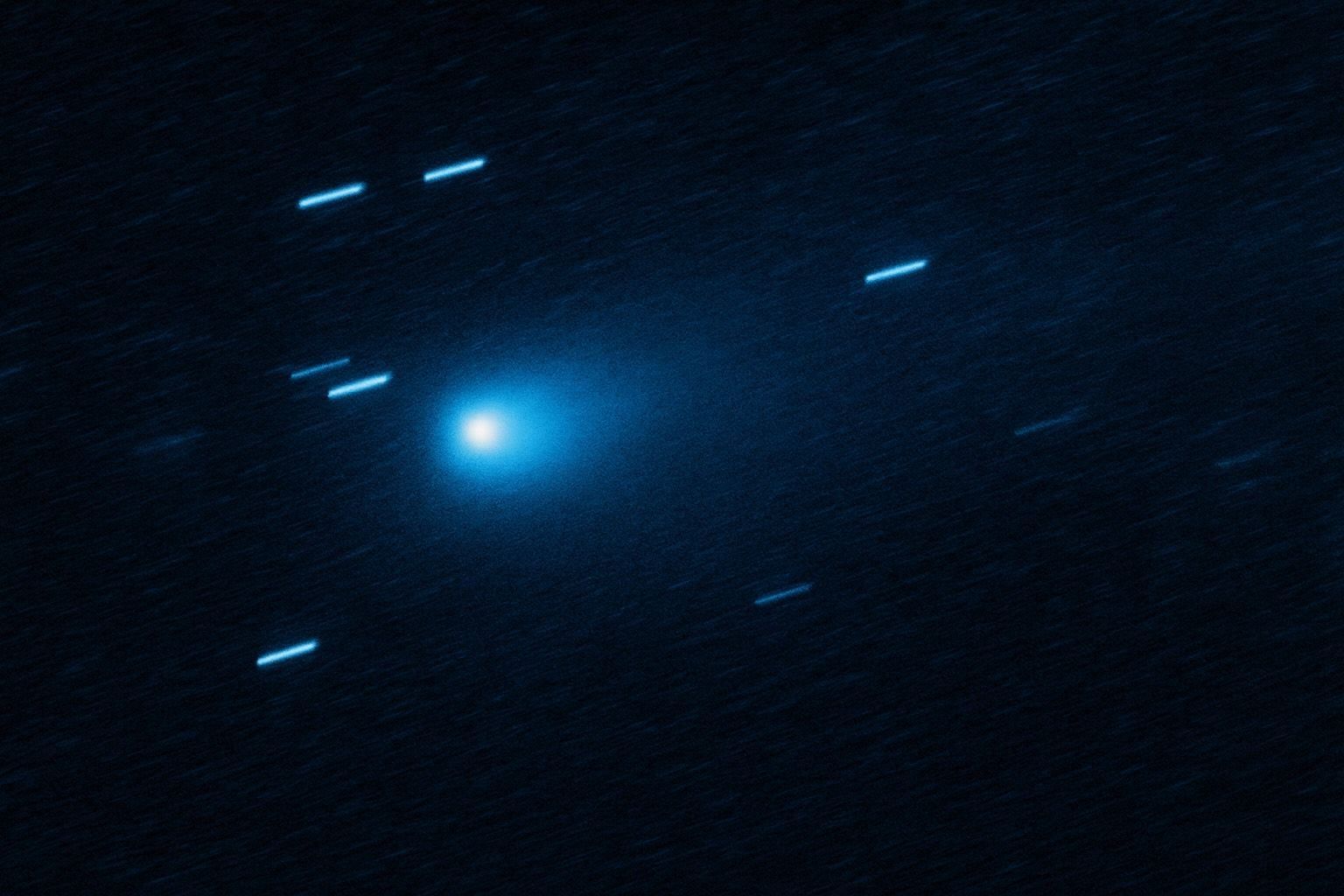
- Hubble size estimate: HST imaging (July 21) constrains the solid nucleus to ≲ 3.5 miles (≲ 5.6 km) across—and “behaves like a comet.” Stsci
- Mars flyby data controversy:Avi Loeb publicly asked NASA to release MRO/HiRISE images taken Oct 2–3 during the object’s close pass by Mars; as of Nov 4 coverage, the images had not been posted publicly.
- SETI Institute update (Nov 3): Researchers emphasize perihelion passed, brightening was confirmed by solar observatories, and community (Unistellar) photometry shows activity changes; “Each one of these discoveries is a rehearsal” for the next interstellar visitor. SETI Institute
The story so far: what changed in the last few days
While 3I/ATLAS was hidden in the Sun’s glare in late October, it slipped into the fields of view of several solar‑monitoring cameras: STEREO‑A (SECCHI), SOHO/LASCO C3 and NOAA’s GOES‑19 CCOR‑1 coronagraph. A new analysis by Qicheng Zhang (Lowell Observatory) and Karl Battams (U.S. Naval Research Lab) reports an extra‑steep brightening as perihelion approached (scaling approximately as r^‑7.5), and color photometry showing the comet was bluer than the Sun, signaling that glowing gas (not just dust) dominated the visible output near perihelion. This is precisely the regime where sublimating volatiles can surge. (Technical note: the paper is a preprint.
As 3I/ATLAS emerged from conjunction, Zhang snapped the first optical, post‑perihelion images Oct. 31–Nov. 2 and noted it’s already within reach of small telescopes under good skies: “It won’t look very impressive, it’s just a smudge,” but it should become easier to track as solar elongation increases. Live Science
Live Science also flagged a third apparent color change: early red (dust‑dominated) in July, a fleeting green coma in September (C₂/CN emissions), and now a blue tint near perihelion, consistent with gas such as CO or NH₃ dominating. Again, this blue claim currently rests on spacecraft color photometry and awaits broader confirmation from ground‑based follow‑ups.
Did 3I/ATLAS really “accelerate” on its own?
Short answer: We do see non‑gravitational forces, and those are exactly what active comets do when jets of gas act like tiny thrusters.
JPL’s post‑perihelion orbit solution (updated Nov 4) explicitly includes non‑gravitational parameters: A1 (radial) ≈ 1.1×10⁻⁶ au/d² and A2 (transverse) ≈ 3.7×10⁻⁷ au/d². Those terms are routine in comet orbit fits and reflect outgassing asymmetries; the solution lists Davide Farnocchia (JPL) as producer and uses 659 observations through Nov 4. These values describe very small accelerations compared with solar gravity.
Some commentary online has speculated about artificial propulsion. It’s important context that Hubble’s team concluded 3I/ATLAS “behaves like a comet,” and the Webb spectrum shows a volatile‑rich coma with water, CO, and abundant CO₂—the classic fingerprints of natural cometary activity. Stsci
Why turning “blue” matters
Most comets look reddish in broadband visible light because sunlight scattered by dust reddens the spectrum. A blue tilt implies that gas emissions (which have strong bands in the blue/near‑blue) are contributing a large fraction of the light. Zhang & Battams’ spacecraft photometry hints that’s exactly what happened near perihelion; they explicitly describe the comet as “distinctly bluer than the Sun.” arXiv
This dovetails with JWST results months earlier: at r = 3.32 au inbound, Webb/NIRSpec found a CO₂‑dominated coma and an unusually high CO₂/H₂O mixing ratio (~7–8), suggesting either an intrinsically CO₂‑rich nucleus or conditions that suppress water sublimation (e.g., evaporative cooling by CO₂, or a thermally insulating crust). The Webb paper calls the ratio “among the highest ever observed in a comet.” NASA Technical Reports Server
What Hubble and Webb already told us about the object
- Size & behavior: Hubble’s July 21 image shows a teardrop dust cocoon and implies a nucleus ≤ 3.5 miles (≤ 5.6 km). The release sums it up plainly: “3I/ATLAS behaves like a comet.” Stsci
- Chemistry: JWST sees CO₂, CO, H₂O, water ice and dust. The preprint team also discusses how galactic cosmic rays over billions of years may have altered the outer layers—possibly explaining today’s volatile behavior and color evolution. (Coverage: Live Science.
The Mars flyby and the call for data release
As 3I/ATLAS passed ~0.2 au from Mars in early October, ESA’s ExoMars TGO and Mars Express targeted the comet, and NASA’s MRO/HiRISE also imaged it. Avi Loeb has publicly urged NASA to release the HiRISE frames, arguing they would be scientifically valuable for understanding mass‑loss geometry during closest approach; media coverage on Nov 4 noted the images had not yet appeared on public servers. (NASA has not issued a detailed public statement at the time of writing.
Orbit, timeline and what to watch next
- Perihelion:Oct 29, 2025 ~11:35 UTC (JPL SBDB). Hyperbolic orbit; it will not return.
- Reappearance for observers: Already re‑imaged Oct 31–Nov 2; visibility improves through mid‑November as elongation increases. Early reports suggest mag ~10–11 class—telescope territory—subject to change as post‑perihelion behavior settles.
- Closest to Earth: ~Dec 19, 2025 (~1.8 au)—still a faint telescopic object for most amateurs.
- Spacecraft monitoring: Expect continued analyses from STEREO, SOHO, GOES‑19, and follow‑ups by Hubble and JWST as geometry improves. SETI Institute highlights how coordinated pro‑am networks (e.g., Unistellar) can track brightness changes and potential outbursts or fragmentation.
Interpreting the “anti‑tail” chatter
Images earlier in the apparition showed sunward features. Sunward plumes (or “anti‑tails”) can arise naturally from projection effects and dust dynamics—they are not unique to 3I/ATLAS, and similar features are seen in some solar‑system comets. That said, geometry near perihelion changed rapidly, and the dominant tail flipped to the anti‑solar direction—as expected when radiation pressure takes over. (Context coverage; explanatory takes vary.) Space
Expert quotes you can trust (short and in context)
- Hubble team (Aug 7): “3I/ATLAS behaves like a comet.” Stsci
- Zhang & Battams (Oct 28 preprint): The comet was “distinctly bluer than the Sun” near perihelion. arXiv
- Qicheng Zhang (Nov 3): “It won’t look very impressive, it’s just a smudge” as it reappears—but improving by the day. Live Science
- SETI Institute’s Franck Marchis (Nov 3): “Each one of these discoveries is a rehearsal” for the next interstellar visitor. SETI Institute
What we know vs. what we don’t
Well supported now
- It’s an active comet from another star system (Hubble morphology; JWST spectrum).
- It brightened unusually fast near perihelion and looked blue in spacecraft color photometry—consistent with gas‑dominated emission. (Awaiting independent confirmation from ground-based color photometry.
- Non‑gravitational terms (A1/A2) are present in JPL’s orbit, as expected for an active comet.
Open questions
- Will the blue tint persist now that it’s back in darker skies, and what exact molecules dominate the spectrum? (Targeted spectroscopy will tell.
- How will activity evolve after perihelion—plateau, fade, or further outbursts? (Even Zhang & Battams caution outcomes are uncertain.
- What do the Mars‑spacecraft images reveal about coma structure? (Awaiting full public release.
Related background (for a general audience)
- What makes an interstellar comet special? Unlike long‑period comets from our Oort Cloud, ISOs arrive with hyperbolic speeds and exotic chemistries that encode conditions in other planetary systems. 3I/ATLAS’s high CO₂/H₂O and possible cosmic‑ray‑processed crust are examples of how different such bodies can be.
- Why comets “accelerate”: As sunlight warms surface ices, jets of gas and entrained dust shoot off. Conservation of momentum gives the nucleus a tiny push. Orbit fitters model this with parameters like A1 and A2; their presence is expected—not evidence of engines. 3I/ATLAS
Sources & further reading (high‑quality, recent)
- Live Science (Nov 3): First post‑perihelion optical detections; observing guidance from Q. Zhang.
- Live Science (Nov 4): Report on a third apparent color change (blue) and what that might mean.
- Zhang & Battams preprint (Oct 28): Spacecraft photometry; rapid brightening; “bluer than the Sun.” arXiv
- JPL SBDB (solution dated Nov 4; via API): Perihelion epoch; non‑gravitational parameters; producer D. Farnocchia.
- JWST team paper (Sept 23 final / Aug 25 preprint): CO₂‑dominated coma; CO₂/H₂O among the highest measured.
- Hubble/STScI release (Aug 7): Nucleus size; “behaves like a comet.” Stsci
- SETI Institute update (Nov 3): Perihelion recap and next steps; Unistellar citizen‑science.
- ESA Mars missions (Oct 7): TGO and Mars Express observed 3I/ATLAS near the Mars flyby.
- NASA overview: Timeline and assets observing 3I/ATLAS.
A note on claims of “alien tech”
Multiple reputable lines of evidence—from Hubble morphology, Webb chemistry, and JPL’s standard non‑gravitational fit—point to a natural, volatile‑rich comet. Speculative hypotheses can be tested against data; the Mars imaging (when released) and post‑perihelion spectroscopy will be especially instructive. For now, the weight of evidence supports an active comet behaving—if dramatically—like a comet.
If you’d like, I can tailor a short observer’s cheat sheet for your location (best dates, times, and where to look) based on the latest ephemerides.
Related articles: Space