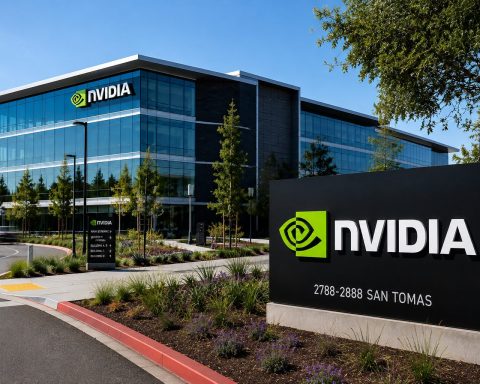
Nvidia shares slipped 0.48% to $196.07 in premarket trading.
The company’s market value dropped by an estimated $238 billion over two sessions, according to an initial assessment.
Meta Platforms, Inc. NASDAQ:META and Microsoft Corporation NASDAQ:MSFT are both scheduled to release their reports later Wednesday.
Nvidia slipped further ahead of the opening bell on Wednesday, as the ongoing valuation adjustment continued. The main Nasdaq session was shut, but premarket activity was in progress.
The absolute value is more significant than the percentage change. Nvidia’s drop in market value over two sessions was roughly 4.7 times its most recent quarterly operating cash flow.
Investors are questioning the sustainability of capital spending on artificial intelligence. Demand for chips is currently robust.
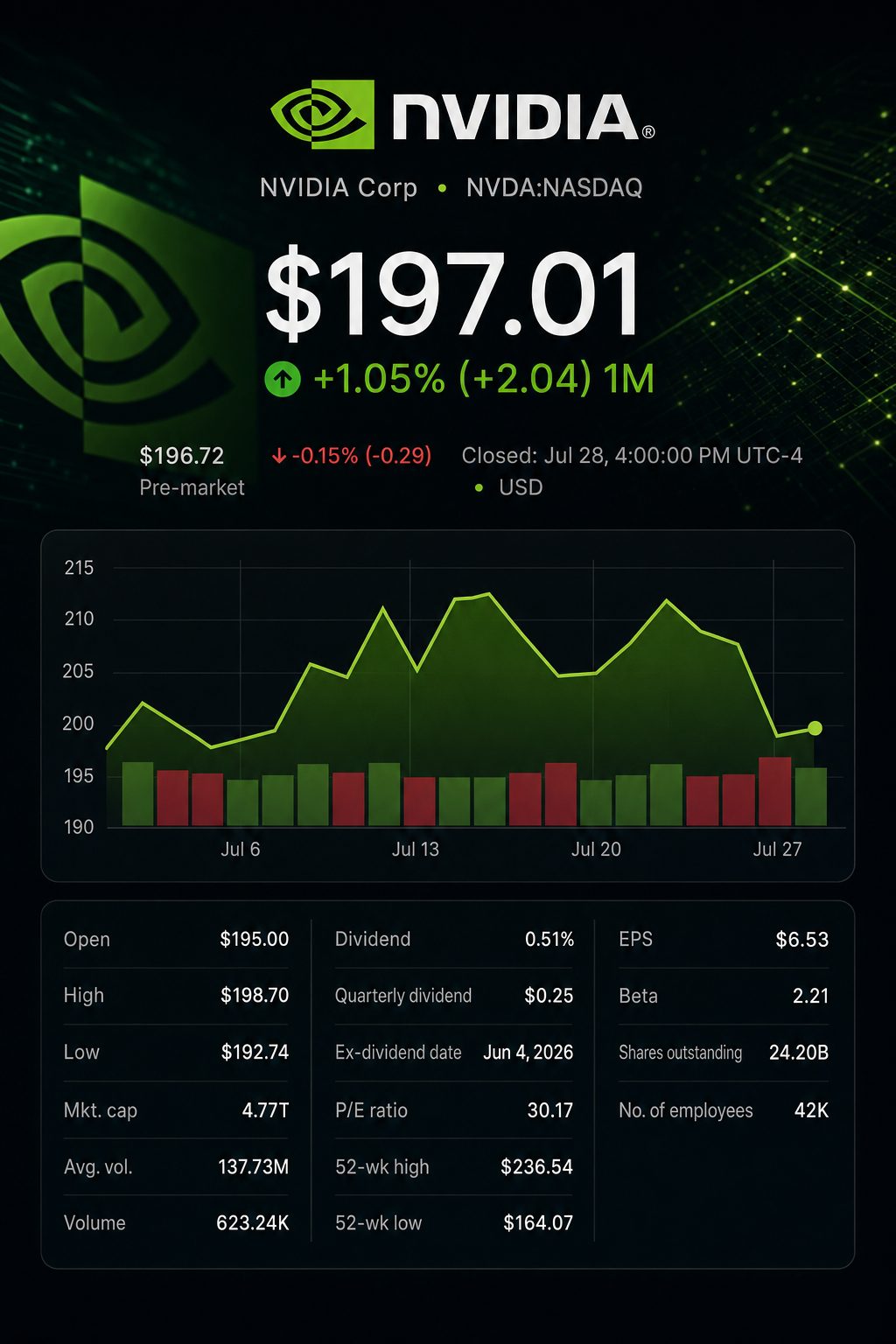
Nvidia ended Tuesday’s session at $197.01, up 0.25%. This small rebound came after a 4.99% drop on Monday. Shares remained 4.75% under Friday’s close of $206.84.
Based on Nvidia’s 24.2 billion outstanding shares, an initial estimate places the company’s market value drop between Monday and Tuesday at about $237.9 billion.
Nvidia investor measure
Amount
Comparison
Preliminary two-day decline in market value
$237.9 billion
4.7 times Q1 operating cash flow
Operating cash flow for Q1
$50.3 billion
61.7% of the revenue for the quarter
Data Center revenue in Q1
$75.2 billion
Constitutes 92.1% of total revenue
Market capitalization as of Tuesday
$4.77 trillion
30.17 times trailing earnings
The calculation does not factor in Wednesday’s premarket drop. It also presumes the reported share count stayed largely unchanged.
Nvidia’s earnings structure highlights its vulnerability. Data Center generated $75.2 billion in revenue during the first quarter, out of an overall $81.6 billion in total sales.
Supplier data indicates robust demand might not be enough for investors. Shares in SK hynix Inc. KRX:000660 dropped 9.6% on Wednesday after the company’s record quarterly profit came in below forecasts.
“Being strong is no longer sufficient in the current AI market,” stated Gary Tan, portfolio manager at Allspring Global Investments. Reuters
The operational outlook stayed strong. SK hynix President Song Hyun-jong stated, “Major customers are still requesting more memory supply.” Reuters
Nvidia has projected ongoing expansion in its own outlook, anticipating second-quarter revenue to reach $91 billion, with a possible variance of 2%. This projection does not include any data centre compute sales to China.
Chief Executive Jensen Huang stated that the pace of AI-factory construction was “accelerating at extraordinary speed.” First-quarter revenue increased by 85% compared with the same period a year ago. NVIDIA Investor Relations
Investors are seeking evidence from Nvidia’s biggest clients as market pressure mounts. Microsoft and Meta are set to report their results later on Wednesday, while Amazon.com, Inc. NASDAQ:AMZN will announce its figures on Thursday.
Investors are set to monitor cloud expansion, expenditure, and cash generation. Revenue-supported investment could underpin Nvidia’s high valuation. Continued weakness in cash flow would heighten worries over AI profitability.
Nvidia is not the only company under pressure. The PHLX Semiconductor Index (INDEXNASDAQ:SOX) dropped 4.5% on Tuesday and remained roughly 25% under its record closing high reached on June 22.
Nvidia maintained a market value of $4.77 trillion on Tuesday. The company’s trailing price-to-earnings ratio was recorded at 30.17. Anticipation continues to run high.
Risks: Nvidia’s outlook does not factor in China data-centre compute revenue. Export restrictions continue to pose a direct risk to earnings. Infrastructure projects may also face delays if rates rise or customer cash flow declines.
The upcoming indicator will be customer economics rather than chip benchmarks. Wednesday’s results need to demonstrate that AI capacity is generating revenue.
What is the current trading level of NVIDIA shares, and what factors are influencing this week’s price swings?
NVIDIA ended Tuesday, July 28, at $197.01, up approximately 0.3%. Its market capitalization stayed close to $4.8 trillion, just under Apple’s. The stock had fallen about 5% on Monday following news of an OpenAI fundraising proposal. The wider selloff in chips also pointed to competition from China and concerns over AI-related returns.
How robust were NVIDIA’s most recently disclosed fundamentals?
NVIDIA posted fiscal first-quarter 2027 revenue of $81.6 billion, up 85% compared with the same period last year. Revenue grew 20% over the previous quarter. Data Center revenue totaled $75.2 billion, accounting for about 92% of total revenue. Non-GAAP earnings per share were $1.87, rising 140% from a year earlier.
What revenue threshold does NVIDIA need to surpass in its August earnings release?
NVIDIA is set to release its fiscal second-quarter results on August 26 at 2 p.m. Pacific. The company’s guidance points to revenue of $91.0 billion, with a possible variance of plus or minus 2%, corresponding to a range of approximately $89.2 billion to $92.8 billion. Analyst consensus presently sits near $91.8 billion, sitting just above the midpoint. Year-on-year growth at the midpoint would be close to 95%.
Is NVIDIA able to keep gross margins close to 75%?
The company reported a 75.0% non-GAAP gross margin for the first quarter. For the second quarter, management expects a gross margin of 75.0%, plus or minus 50 basis points. Non-GAAP operating expenses are projected to be approximately $8.3 billion. A margin below 74.5% would fall outside the provided guidance range.
What level of opportunity or risk does China present?
NVIDIA’s $91 billion forecast does not include Data Center compute sales to China. Any approved shipments could offer upside, though the timing is unclear. Reuters earlier said stricter controls excluded more than half of previous Asian customers. Reuters has not confirmed this, and NVIDIA did not respond to a request for comment.
What makes hyperscaler earnings particularly significant this week?
This week’s packed earnings schedule includes reports from Microsoft, Meta and Amazon. The level of their capital expenditures has a direct effect on demand for NVIDIA’s networking and systems. Capex projections for the five largest hyperscalers have climbed to about $730 billion for the current year, up from approximately $485 billion in January. A reduction in spending would put NVIDIA’s short-term demand projections at risk.
Does the reported OpenAI financing plan signal optimism or raise concerns?
Reuters reported that NVIDIA was in talks regarding about $250 billion in financing guarantees. The potential Ohio initiative may exceed $500 billion in total cost. NVIDIA was also said to be negotiating as much as $350 billion in chip purchase agreements. While that could ensure sustained demand, it raises issues around circular financing and customer credit. Reuters was unable to independently confirm the information, and neither company provided a statement.
Is there still potential for disappointment given NVIDIA’s current valuation?
NVIDIA’s share price of $197.01 equates to roughly 30 times its trailing earnings, with earnings per share standing at about $6.57. The company reported an 85% jump in revenue for its most recent quarter. However, with a market capitalization of $4.8 trillion, there is little tolerance for operational setbacks.
What level of backing can buybacks and dividends offer?
NVIDIA bought back 108 million shares worth $20.2 billion during the last quarter. The company subsequently increased its repurchase authorization by $80 billion. Including previously available capacity, NVIDIA’s remaining authorization stood at about $118.5 billion. At $197.01 per share, this accounts for nearly 2.5% of shares outstanding. The quarterly dividend of $0.25 delivers an annualized yield of around 0.5%. Share repurchase authorizations are voluntary, so the actual buyback amount could be much less.
Mateusz Kaczmarek is a financial and technology journalist at TS2.tech. His coverage ranges from stocks and artificial intelligence to semiconductors and developments across global markets. He graduated from the Poznań University of Economics and Business and worked in financial analysis before becoming a business journalist. Follow Mateusz Kaczmarek on Google News.
Surprising starts and permits data can impact homebuilders, mortgage-sensitive stocks, Treasury yields, and the dollar if results deviate significantly from consensus estimates.
#02
Home Depot Q2
The results and outlook provide key insights into housing turnover, renovation demand, professional customer activity, and U.S. discretionary spending.
#03
09:15 ET industrial production
A robust or disappointing factory or utilities report can shift expectations for economic growth, cyclical stocks, bond yields, and the Federal Reserve’s policy direction.