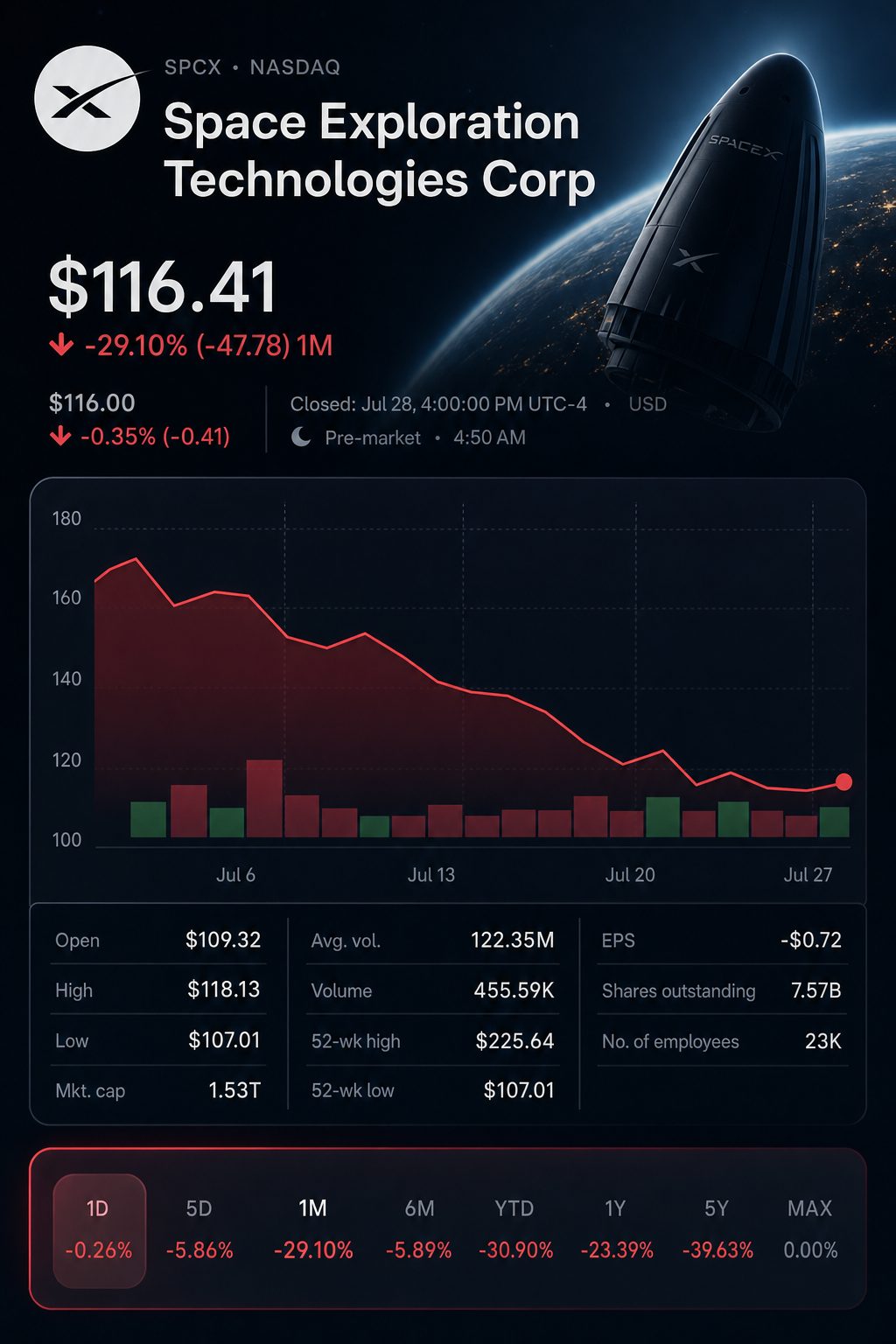
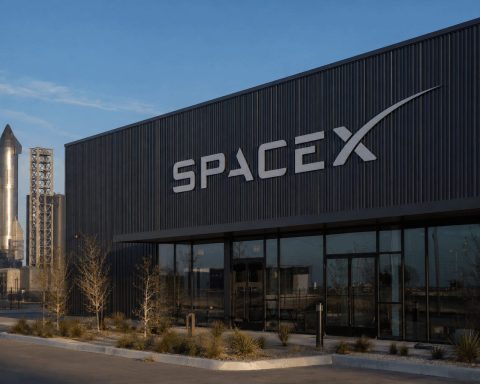
SpaceX slipped 1.3% to $114.90 before the market opened, after posting a 2.6% rise in the previous session on Tuesday.
An initial estimate puts the company’s valuation at 81.9 times its 2025 sales.
The FCC filing includes as many as one million satellites. Results for the second quarter are scheduled for release on August 4.
SpaceX NASDAQ:SPCX fell ahead of Wednesday’s market open after renewed environmental attention on its orbital artificial-intelligence project. NBC News, in a report on Tuesday, pointed to scientists raising issues about pollution from spacecraft re-entry. Nasdaq trading starts at 9:30 a.m. EDT.
The focus is significant as SpaceX retains a market capitalization of $1.53 trillion. Relative to projected 2025 revenue of $18.67 billion, this market value represents 81.9 times the company’s sales. This figure is a preliminary estimate based on Tuesday’s closing price.
This type of multiple puts more emphasis on future expansion. A delay in regulation would primarily lessen the value investors attribute to orbital computing. Starlink’s current connectivity revenue would not be directly affected.
SpaceX ended Tuesday at $116.41, representing a 13.8% drop from its $135 IPO price and a 22.4% decline from its initial $150 trade. The stock also fell 5.8% across the five most recent sessions ending Tuesday. These figures are preliminary.
Filings from SpaceX highlight the significance of timing. Connectivity is already bringing in operating profit, while AI continues to demand substantial capital investment.
Segment
Q1 2026 revenue
Q1 operating result
Result as a share of revenue
2025 capital spending
Connectivity
$3.26 billion
+$1.19 billion
+36.5%
$4.18 billion
Artificial intelligence
$0.82 billion
-$2.47 billion
-301.8%
$12.73 billion
Initial estimates based on segment data provided by SpaceX.
In 2025, capital spending on AI was approximately triple that of connectivity. The segment’s operating loss in the first quarter also surpassed three times its revenue. This means connectivity only partly balances the cost of AI investments.
The Federal Communications Commission received SpaceX’s application in February. The submission pertains to as many as one million satellites at altitudes ranging from 500 to 2,000 kilometres. Acceptance for filing is not an indication of final approval.
Scale sets SpaceX apart from potential private competitors. Starcloud has applied for as many as 88,000 data centre satellites, while Blue Origin’s Project Sunrise involves up to 51,600.
SpaceX’s suggested maximum is 11.4 times higher than Starcloud’s, and 19.4 times greater than Blue Origin’s. These values represent application limits rather than predicted deployments.
A coalition led by Earthjustice has requested the FCC to halt licensing, seeking a comprehensive environmental review of the program before proceeding. Ruskin Hartley, executive director of DarkSky, said: “These projects could permanently alter the night sky as we know it.” Earthjustice
The scientific record lacks completeness. A NOAA-led analysis detected spacecraft metals in roughly 10% of stratospheric sulfuric-acid aerosol samples. With continued expansion of satellite numbers, that proportion could rise to nearly 50%. The potential impact on aerosol characteristics is still undetermined.
Analysts are expressing increased caution regarding timing, while consensus on the concept remains steady. “Any kind of displacement of terrestrial data centers is 10 years plus out,” Altman Solon partner Anthony Milovantsev told Reuters. The development of orbital computing continues to rely on Starship, reduced launch expenses and additional advances in engineering. Reuters
SpaceX states that orbital AI deployment may start as soon as 2028. This creates a significant interval between the rollout of initial hardware and the achievement of substantial commercial impact.
Phenomenal World puts forward a strategic rebuttal, stating that orbital slots and radio spectrum are limited resources, influenced by previous developments. Taking early control may offer benefits that are difficult for competitors to overturn.
As a result, investors must consider two timelines. Connectivity revenues are apparent today, while returns from orbital AI rely on regulatory approval, the success of Starship, and cost of deployment.
The next financial update is set for Tuesday, August 4, when SpaceX will announce its second-quarter earnings after markets close. The company’s management will hold a webcast at 4:30 p.m. EDT. Investors are focused on connectivity profit, expenditures related to AI, and any revisions to the 2028 schedule.
Risks: Conducting a more extensive environmental review may delay licensing and postpone orbital investments. Greater Starship reuse or reduced launch expenses may help mitigate some of that delay. The one-million number is still a requested cap, not a deployment target set by the company.
What is the current trading level of SpaceX stock ahead of the next satellite-related developments?
SpaceX shares are listed on the Nasdaq under SPCX. SEC On July 29 at 08:14 UTC, SPCX was trading at $116.41, which is 13.8% beneath its IPO price of $135. SEC The price stands 48.4% below the post-IPO peak of $225.64. Reuters The company is next scheduled to announce earnings on August 4.
Which figures are key in the August 4 earnings announcement?
SpaceX is set to announce its second-quarter results following the market close on August 4. The management webcast will start at 4:30 p.m. Eastern the same evening. SpaceX Investor Relations The latest forecast points to revenue of $6.98 billion with a projected loss of $0.25 per share. Benzinga In the previous quarter, SpaceX posted $4.69 billion in revenue and reported an operating loss of $1.94 billion. SEC These consensus estimates may change ahead of the actual release. Investors in satellite markets are watching metrics such as Starlink customer numbers, profit margins, pricing, and capital expenditures on deployment.
Might the initial insider share release overshadow positive satellite developments?
As many as 911.5 million shares owned by early investors and employees can be sold after the company reports earnings. Shares are set to become available for sale on the second trading session following the results. Reuters If exchange activity is uninterrupted, the date falls on August 6. SpaceX Investor Relations Becoming eligible does not guarantee immediate sales by shareholders. Nonetheless, the quantity that could be offered is significant compared to the presently small SpaceX float.
What is the current number of operational Starlink satellites?
Independent sources reported 12,620 Starlink satellites launched as of July 25. Of those, 10,881 remained in orbit and 10,865 were listed as functioning. Planet4589 Data showed 8,882 of these satellites operating in the orbital shells identified by McDowell. Satellites positioned outside these shells may still deliver commercial service. Planet4589 Numbers fluctuate regularly as satellites are deployed, move, retire or re-enter the atmosphere.
Is the pace of Starlink’s customer base expansion offsetting declines in revenue per user?
Starlink reported surpassing 12 million active users as of June 4. X (formerly Twitter) In March, a regulatory filing showed 10.3 million customers in 164 markets. SEC This suggests an increase exceeding 16.5% in roughly two months, but the customer definitions may not match exactly. Average revenue per user in the first quarter declined to $66 compared to $81 in 2025. HL August data will show if subscriber numbers can continue to outpace falling ARPU.
Is Starlink generating profit although SpaceX as a whole is not yet profitable?
Yes, but only for segment reporting. SpaceX’s Connectivity unit, largely driven by Starlink, delivered $11.39 billion in revenue for 2025. Operating income for this segment totaled $4.42 billion, resulting in a 38.8% margin. SEC Nevertheless, on a consolidated basis, the company reported an operating loss of $2.59 billion for the same period. SEC August figures will indicate whether satellite segment gains continued to offset overall losses for the company.
How did Starship Flight 13 demonstrate the capabilities of Starlink V3?
Starship released 20 V3 prototype satellites in its suborbital flight on July 24. These satellites made short connections to the Starlink network before intentionally burning up. Reuters The V3 satellites are built with a one-terabit downlink and a 160-gigabit uplink capacity in mind. Starlink Those numbers reflect intended design, not proven performance in commercial use. Five of the booster’s engines did not reignite on reentry.
What satellite launches scheduled for the upcoming week might impact sentiment?
Starlink 17-52 is set for launch at 02:00 UTC on July 31, carrying 24 V2 Mini satellites from Vandenberg Space Force Base. Starlink 17-53 appears on the schedule for 14:00 UTC on August 3, also slated to carry 24 satellites, making a combined planned total of 48 for the two launches. Both launches have already been pushed back, making all current target dates subject to change.
What is the current size of Starlink’s direct-to-cell network?
McDowell’s tracker recorded 640 operational direct-to-cell satellites as of July 25. Out of these, 637 satellites were in their assigned operational orbital shells. Planet4589 SpaceX’s submission in March reported Starlink Mobile service available in around 30 countries. SEC The territorial figure does not indicate revenue or the number of mobile service subscribers. Investors await forthcoming earnings for more direct-to-cell monetization details.
Does Amazon Leo currently pose a direct threat to Starlink satellites?
Amazon Leo currently operates about 390 broadband satellites in orbit. The company has submitted plans to launch an additional 5,105 satellites for direct-to-phone connectivity from 2028. Reuters As of July 25, Starlink tracked 10,881 satellites in operation. Planet4589 Starlink also said it had more than 12 million active users in June. X (formerly Twitter) While Amazon poses a strategic challenge, its scale is not yet on par with Starlink. Key factors such as regulatory clearance, launch capability, and roll-out timelines have not been confirmed.
Marcin Frąckiewicz is the founder and CEO of TS2 Space, a satellite communications company working with customers worldwide. His experience spans satellite communications, telecommunications and technology ventures. He graduated from the Warsaw School of Economics (SGH) and writes about space technology, artificial intelligence, stocks and the technology companies and industries he follows. Follow Marcin Frąckiewicz on Google News, Facebook or LinkedIn.
Surprising starts and permits data can impact homebuilders, mortgage-sensitive stocks, Treasury yields, and the dollar if results deviate significantly from consensus estimates.
#02
Home Depot Q2
The results and outlook provide key insights into housing turnover, renovation demand, professional customer activity, and U.S. discretionary spending.
#03
09:15 ET industrial production
A robust or disappointing factory or utilities report can shift expectations for economic growth, cyclical stocks, bond yields, and the Federal Reserve’s policy direction.