
New York, June 1, 2026, 14:18 (EDT)
- Nvidia gained 6.2% in afternoon trading after the company announced RTX Spark, an AI-focused chip for Windows PCs.
- Nvidia is getting further into personal computers, putting it in more direct competition with Intel, AMD and Qualcomm.
- Key risk: AI PCs haven’t shown big demand yet. China export caps are still weighing on Nvidia’s outlook.
Nvidia shares were higher in U.S. trading Monday after the chipmaker announced RTX Spark, a new processor targeting artificial intelligence workloads on Windows laptops and desktops.
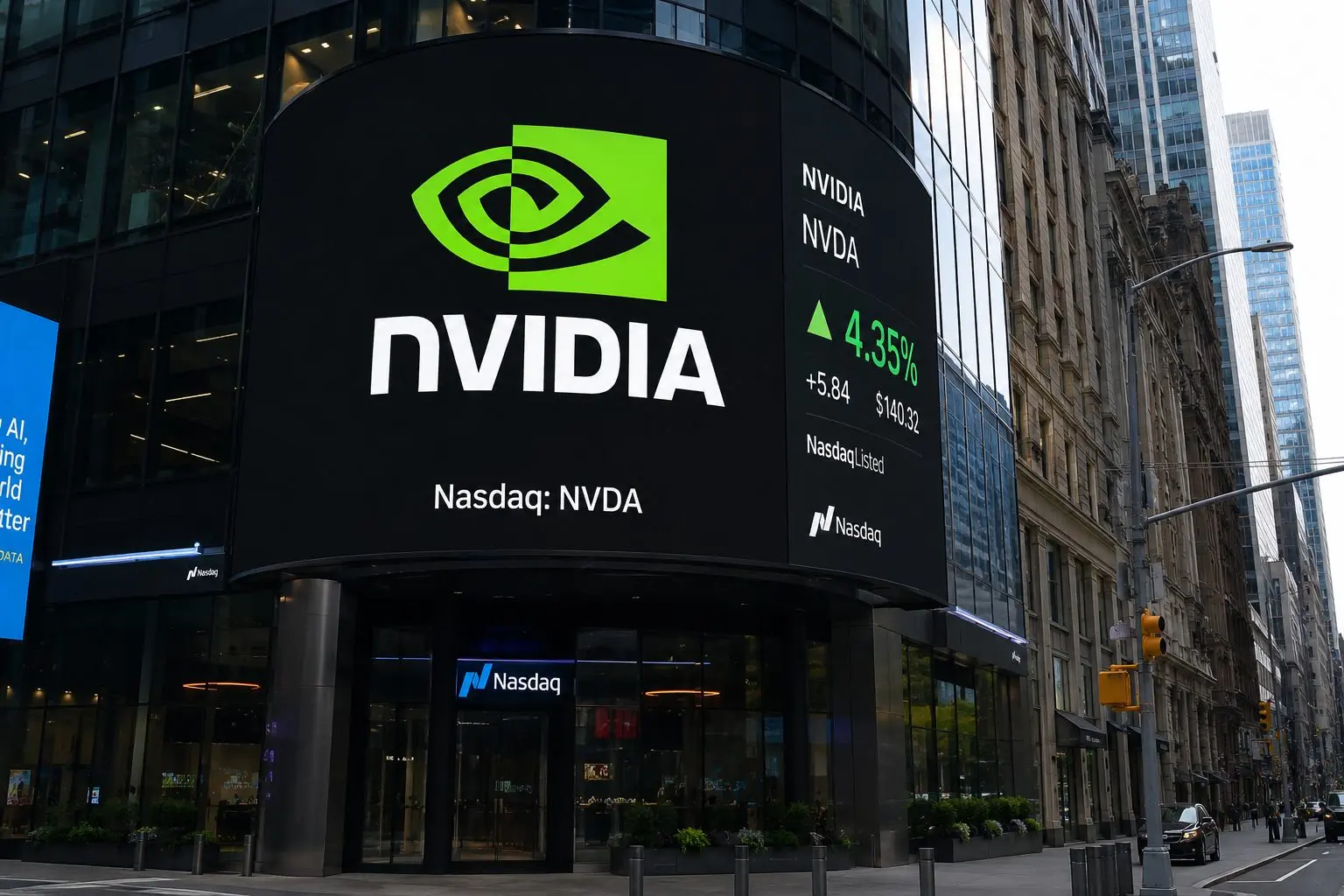
Nvidia shares climbed 6.2% to $224.27 soon after 2 p.m. EDT, raising its market cap to roughly $5.47 trillion. Intel dropped 3.7%. Qualcomm lost 7.3%. AMD was down 0.5%. The move came as investors reacted to a more aggressive Nvidia effort in PC chips.
Nvidia wants to prove its AI growth story doesn’t have to stay in data centers. The company is making its pitch that ordinary PCs could soon be running “AI agents”—software that does tasks on its own—directly on the hardware, skipping cloud servers for more of the work.
Nvidia said it worked with MediaTek to build RTX Spark, which is coming this fall in systems from ASUS, Dell, HP, Lenovo, Microsoft Surface and MSI. Acer and Gigabyte will offer models later. According to the company, the chip is good for up to one petaflop of AI performance — that’s about a quadrillion operations per second — and can handle up to 128GB of unified memory.
Nvidia CEO Jensen Huang said, “The PC is being reinvented.” Microsoft’s Satya Nadella said both companies want to put “unmetered intelligence to every home and every desk with Windows.” NVIDIA Investor Relations
Analysts said the launch goes beyond just a gaming or creator chip. Lian Jye Su, chief analyst at Omdia, pointed to rising demand for personal AI agents and said “for consumers, it means more choices.” Neil Shah, analyst and Counterpoint Research co-founder, called it a move toward “revolutionizing how PCs would look like in the next 10 years.” AP News
Nvidia’s new chip steps up pressure on AMD and Intel, Reuters said, putting the GPU maker in closer competition with the PC processor giants. Qualcomm and Microsoft also have pushed AI PCs. Reuters cited Shah describing the RTX Spark as possibly shifting PCs from app-driven machines to “Agentic AI personal computer.” Reuters
Nvidia rolled out the launch less than two weeks after posting fiscal Q1 revenue of $81.6 billion, up 85% year over year. Data-center revenue hit $75.2 billion, up 92%. Nvidia gave second-quarter revenue guidance of $91 billion, plus or minus 2%, saying the outlook assumes no data-center compute revenue from China.
But there are still hurdles for the trade. AI PCs have seen uneven demand. HP told Reuters that the devices boosted quarterly sales, but Dell earlier said demand was weaker than hoped. The China story still matters. If export rules get tighter, or buyers hold off, the stock’s high price doesn’t leave much space for errors.
Tech names did the heavy lifting. U.S. stock indexes traded near record levels Monday, with Nvidia out front, as investors looked past oil’s uptick and ongoing geopolitics, Reuters said.
Nvidia’s move on Monday wasn’t another typical AI story. The company is trying to bring the AI cycle down from the data center and into laptops, and investors were willing to pay on the chance that happens.
Related articles: NASDAQ:NVDA