
WARSAW, August 20, 2026, 16:16 CEST
- Nvidia traded at $217.86 after the U.S. open, 7.9% below its 52-week high.
- Its $105 billion Ohio guarantee equals roughly 2.0% of market value.
- Fiscal second-quarter results are due August 26 after the U.S. close.
NVIDIA Corporation NASDAQ:NVDA edged 0.14% higher to $217.86 on Thursday. The modest gain followed a sharp semiconductor selloff and left the stock 7.9% below its 52-week peak. Investors now face a two-part test: earnings growth must outrun rising bond yields, while new AI-financing guarantees must remain contingent rather than become cash costs.
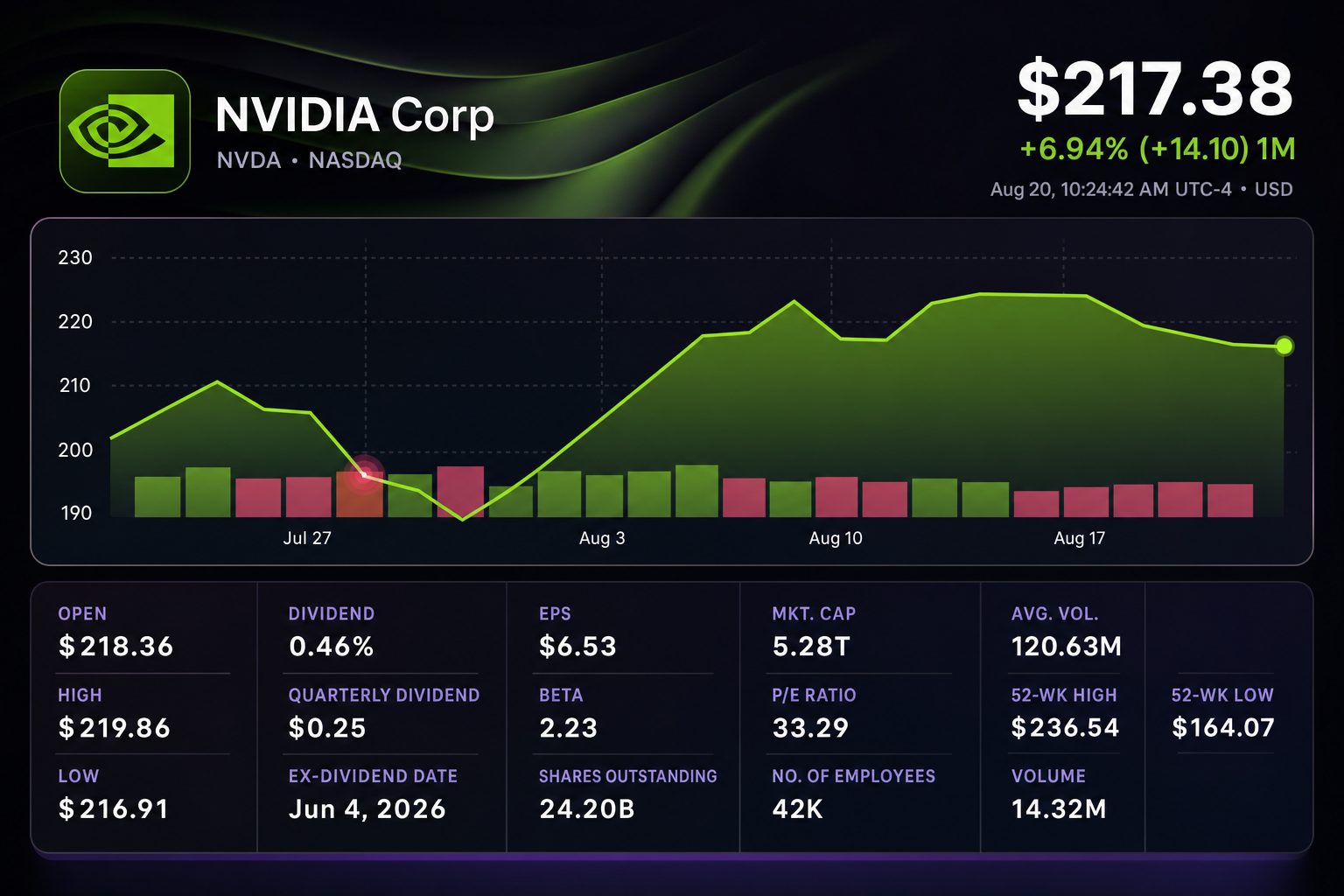
The valuation gap is unusually stark. Nvidia’s 33.38 trailing price-to-earnings ratio implies an earnings yield near 3.0%. The 30-year U.S. Treasury yield was around 5.28% on Wednesday, near its highest since 2007. That 2.3-point shortfall raises the bar for next week’s report.
| Market measure | August 20 snapshot | Investor read-through |
|---|---|---|
| Share price | $217.86 at 10:13:26 EDT | Up 0.14% intraday |
| Market value | $5.26 trillion | Largest semiconductor producer |
| Trailing P/E | 33.38 times | Implied earnings yield about 3.0% |
| 52-week range | $164.07–$236.54 | Price is 7.9% below the high |
| 30-year Treasury yield | About 5.28% on August 19 | Richer risk-free income pressures long-duration equities |
Tuesday’s move showed that sensitivity. The Philadelphia Semiconductor Index fell 5%, while Nvidia lost 2.3%. Micron Technology NASDAQ:MU dropped 7%. Higher oil prices and long yields drove the rotation away from technology.
The operating numbers remain formidable. First-quarter revenue reached $81.6 billion, up 85% from a year earlier. Data-center sales rose 92% to $75.2 billion and represented 92% of total revenue. Nvidia guided the July quarter to $91 billion, plus or minus 2%.
| Operating measure | Q1 fiscal 2027 | Comparison |
|---|---|---|
| Revenue | $81.615 billion | Up 85% year on year; up 20% sequentially |
| Data-center revenue | $75.2 billion | Up 92% year on year; 92.1% of total |
| GAAP gross margin | 74.9% | Q2 guidance also 74.9%, plus or minus 0.5 point |
| GAAP operating income | $53.536 billion | Up 147% year on year |
| Q2 revenue outlook | $91.0 billion midpoint | 11.5% above Q1 revenue |
The fresh concern sits below the income statement. Nvidia agreed to provide up to $105 billion of residual-value guarantees tied to an Ohio AI campus leased by an OpenAI affiliate. It also committed $1.5 billion to developer SB Energy. The guarantee is a maximum contingent obligation, not an immediate cash payment.
| AI-financing item | Amount | Scale or condition |
|---|---|---|
| Ohio guarantee cap | $105 billion | About 2.0% of Nvidia’s current market value |
| SB Energy investment | $1.5 billion | Committed equity capital |
| Ohio lease | 20 years | OpenAI affiliate is the tenant |
| Initial campus capacity | Up to 8 gigawatts | First 800 megawatts targeted for 2028 |
| Broader financing platforms | Over $500 billion | Third-party capital targeted over time |
| Potential Nvidia backstop | Up to $125 billion | About 25% of the broader platform |
The structure attempts to solve a bottleneck Nvidia itself has flagged. Customers need land, power and capital before they can install GPU systems. Nvidia’s latest annual filing warned that shortages in those inputs could delay deployments and reduce AI adoption.
Management is therefore turning chips into financeable infrastructure. “We began by building chips; today, we are helping create a new class of productive, investable infrastructure,” Chief Executive Jensen Huang said this month. Nvidia is working with Apollo, BlackRock, Blackstone, Brookfield, Goldman Sachs and KKR on the broader funding plan. Nvidia announcement
Wall Street remains bullish, but the dispersion matters. Bank of America’s Vivek Arya kept a $350 target and argued the contingent exposure was manageable. KeyBanc’s John Vinh set a $330 target, while flagging possible Vera Rubin ramp delays. Those targets sit well above Thursday’s price.
| Recommendation | Rating | Target | Upside from $217.86 | Date |
|---|---|---|---|---|
| Bank of America / Vivek Arya | Buy | $350 | 60.7% | August 11, 2026 |
| KeyBanc / John Vinh | Overweight | $330 | 51.5% | July 14, 2026 |
| Tracked consensus | Buy | $319.48 average | 46.6% | August 8, 2026 |
The August 26 report should separate operating demand from financing optics. Investors will watch whether revenue reaches the $91 billion midpoint, whether gross margin holds near 75%, and how management describes the guarantee’s triggers. Nvidia will release results at about 1:20 p.m. Pacific Time.
A clean beat would support the view that AI financing expands Nvidia’s addressable market. A weak outlook would make the guarantees look more like demand support. The distinction is crucial.
Risks: Higher yields can compress Nvidia’s multiple even if earnings grow. OpenAI or other tenants could miss obligations, triggering contingent payments. China restrictions, product delays, power shortages and custom AI chips could also slow sales.
Related articles: NASDAQ:NVDA
Evaluating growth amid a higher cap on yields
Market update: August 20, 2026, 10:13:26 EDT (16:13:26 CEST). The U.S. cash market is now open.
Shares are trading 7.9% under their peak and have moved 74.2% of the way through the 52-week range.
Implied earnings yield based on a trailing P/E of 33.38×
August 19, 30-year Treasury
Yield gap stands at −2.28 pts
Consensus points to a 46.6% implied upside, with KeyBanc at 51.5% and Bank of America at 60.7%. Targets reflect views, not assurances.