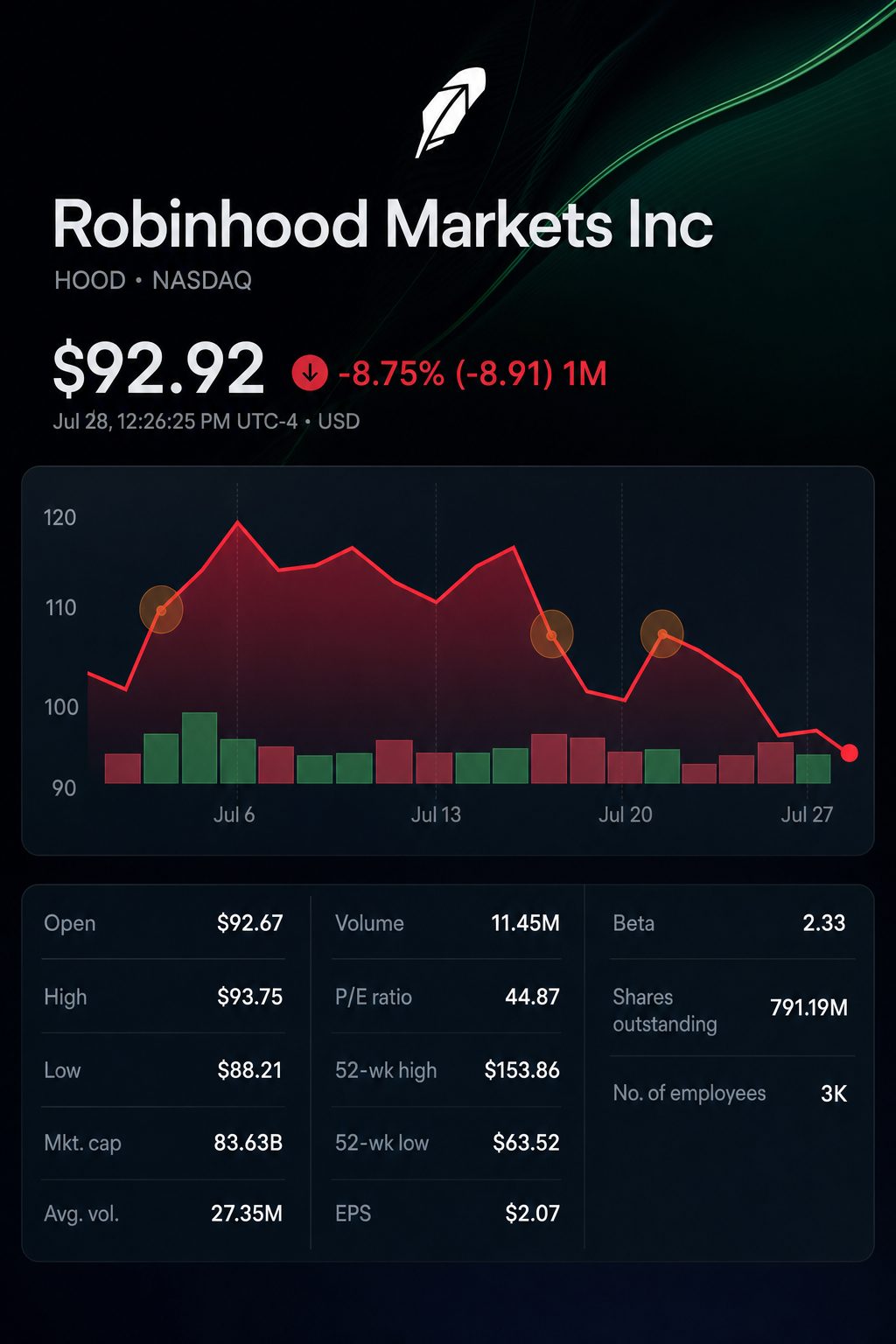
Shares of Robinhood Markets NASDAQ:HOOD dropped 2.6% early in Tuesday’s U.S. trading, ahead of its second-quarter earnings due the following day. The main focus has shifted from increased customer trading activity to whether prediction markets might offset crypto revenue without impacting margins.
Shares were last at $93.17 as of 11:46 a.m. EDT, after earlier falling to $88.22. That session low represented a 7.8% drop. The stock’s trailing price-to-earnings ratio was close to 45.
Robinhood is set to announce results following the market close on Wednesday. The company’s earnings call starts at 5 p.m. EDT.
Projected revenue is seen at $1.21 billion to $1.22 billion, with earnings expected between 39 cents and 41 cents per share. This suggests sales growth of 22%-24%, but earnings per share are forecast to decrease by 2%-7%.
Second-quarter measure
2025 actual
2026 estimate
Year-on-year change
Total revenue
$989 million
$1.21 billion-$1.22 billion
up 22% to up 24%
Diluted earnings per share
$0.42
$0.39-$0.41
down 7% to down 2%
Transaction-based revenue
$539 million
$723.6 million
up 34%
Crypto transaction revenue
$160 million
$83.5 million
down 48%
Other transaction revenue
$48 million
$171 million
up 256%
The numbers for 2026 represent published projections, not official company guidance. The overall range reflects forecasts from both Zacks and Benzinga; category-specific figures are the Zacks consensus.
The difference is clear. Transaction revenue could increase by 34%, but annual earnings might decline. As a result, investors want to see proof of profit margins rather than just another volume milestone.
Robinhood’s activity filings indicate a significant change in customer trading behavior. As of June 25, equity volume totaled approximately $906.8 billion, already 75% higher than the entire second quarter of 2025.
Options contracts climbed to 729.9 million, marking a 42% increase from the same quarter last year. Robinhood-app crypto volume stood at $17.3 billion, representing a 38% decrease compared to the entire previous-year quarter. The final days of June are expected to further close the gap.
June data is still subject to revisions and has not been audited. The figures do not cover the last five days of the month.
Event contracts accounted for the most pronounced offset. Combined volume for April, May and early June reached approximately 12.3 billion contracts, outpacing the whole first quarter by close to 40%.
However, volume does not equate to revenue. Equity data reflect notional values, whereas event markets tally contracts. Revenue is determined by pricing, incentives, and the mix of products traded.
Zacks projects other transaction revenue will rise to $171 million, up from $48 million. In its first-quarter filing, Robinhood reported $104 million in event-contract revenue separately. Crypto transaction revenue is estimated to decline by almost 48%.
Higher costs may offset gains. Operating expenses for the first quarter increased 18% to $656 million. Robinhood anticipates a $28 million restructuring charge following the elimination of around 290 positions.
Chief Executive Vlad Tenev stated the company had “never been stronger.” He additionally emphasized the need for a “lean, hyper-focused team.” Reuters
Robinhood Chain launched on July 1, following the end of the quarter. Crypto head Johann Kerbrat laid out the approach simply, saying the firm was “bringing the best of traditional finance and DeFi together.” The rollout will not impact revenue for the second quarter. Robinhood
Key numbers to be reported on Wednesday include event-contract revenue, customer deposits, and expenses. Investors are expected to monitor margin balances and net interest revenue as well. These results will indicate if earnings quality is benefitting from diversification.
Risks are evident. Event contracts are subject to lawsuits and regulatory scrutiny at the state level. Cryptocurrency remains volatile, and tokenization introduces further legal and execution risks. Ongoing investments may result in elevated expenses following restructuring.
Surpassing revenue forecasts may fall short. Robinhood needs to demonstrate that quicker trading leads to sustained profitability.
What is causing HOOD shares to decline today, and what is its current trading level?
HOOD was last seen trading near $93.10 at 11:43 a.m. ET, showing a decline of roughly 2.7%. Share prices fluctuated between $88.22 and $94.45, with volume reaching 10.7 million. The previous session ended at $95.65. The movement points to pre-earnings de-risking, but the precise reason is still unclear.
What is the timing of Robinhood's report, and which figures does it need to surpass?
Robinhood is set to announce Q2 earnings after Wednesday’s market close, with a conference call scheduled for 5 p.m. ET. FactSet’s consensus estimate for EPS stands at $0.43, while alternative sources indicate around $0.41. Revenue projections range from approximately $1.23 billion to $1.28 billion, signaling year-over-year growth of 24% to 29% from last year’s $989 million. Surpassing $1.28 billion in revenue and $0.43 EPS is needed for a clear beat on the top end of the guidance.
Have recent trading volumes indicated the potential for an earnings beat?
Equity trading volume in May totaled $315.3 billion, a 75% increase from a year ago. Options contracts traded rose by 29% to 231.1 million. Event contracts grew 22% from April, reaching 3.9 billion. As of June 25, equity trading amounted to roughly $343 billion and options reached 274 million. For June’s incomplete period, event contracts totaled 5.2 billion. The figures indicate robust transaction revenue, though June's complete data are still preliminary.
Does cryptocurrency remain the primary risk to earnings?
Crypto continues to be Robinhood’s most pronounced revenue weakness. First-quarter crypto revenue dropped 47% year-over-year to $134 million. In May, overall crypto volume climbed 4%, with $6.3 billion contributed by Bitstamp. However, volume on the Robinhood app slid 50% to $5.9 billion. By June 25, total crypto volume stood near $14 billion. The comparison is not exact, as Bitstamp did not contribute to last May’s figures.
Might prediction markets help counter declining crypto revenue?
Event-contract revenue for Q1 hit $104 million, up from $3 million before. The quarter saw 8.8 billion event contracts traded. In May, volume stood at 3.9 billion contracts, while June recorded 5.2 billion contracts as of June 25. This expansion helps buffer some softness in crypto. However, it cannot fully substitute for crypto. The business continues to face significant regulatory risk, with both federal and state actions potentially limiting available products.
Is the pace of growth in customer assets and deposits remaining strong?
The number of funded customers climbed to 27.7 million in May, a 7% increase from a year earlier. Overall platform assets jumped 48% to $377 billion. Net deposits for May totaled $5.6 billion, and deposits over the prior twelve months were $69.1 billion. Margin balances surged 117% to $19.5 billion. These results indicate rising engagement, though deposit momentum in June has yet to be disclosed.
What impact will the layoffs and restructuring charge have on margins?
Robinhood eliminated approximately 290 positions, representing 10% of its full-time workforce. The company anticipates about $28 million in restructuring costs in Q2. In Q1, adjusted operating expenses plus share-based compensation reached $607 million. For the full year, guidance is projected between $2.7 billion and $2.825 billion. Around half of the $100 million Trump Accounts investment was slated for Q2. This range does not include Rothera or certain acquisition and regulatory costs that are difficult to forecast. While job reductions could help decrease expenses moving forward, the revised guidance on Wednesday holds greater significance.
Could Robinhood’s convertible notes result in dilution for current shareholders?
Robinhood raised $2.2 billion through the issuance of zero-coupon convertible notes maturing in 2029. After fees, net proceeds totaled approximately $2.169 billion. The company used $290 million to buy back 2.743 million shares, and allocated an additional $123.2 million to fund capped calls aimed at minimizing potential conversion dilution. According to Robinhood, dilution is not expected below $237.85, or $303.95 including the effect of share repurchases. These figures are company projections and are not assured.
Does the recent pullback make HOOD a bargain?
HOOD is trading at $93.10, around 49 times FactSet’s projected 2026 EPS. The current price-to-earnings ratio stands at about 45. FactSet data shows an average price target of $125.19, spanning from $78 to $160. This average suggests an upside of about 34%, while the lowest target presents a downside risk. The wide range underscores how much the valuation hinges on performance.
In what ways might HOOD be impacted by the Federal Reserve's decision on Wednesday?
The Federal Reserve reveals its decision at 2 p.m. ET, three hours ahead of Robinhood’s earnings call. Net interest revenue for Q1 reached $359 million, accounting for about a third of overall revenue. This figure increased 24% from a year ago but dropped 13% compared with the prior quarter. If the Fed maintains a higher-for-longer stance, cash yields may benefit, while equities and crypto could face pressure. A dovish outcome may shift that balance. The overall impact is unclear.
Roman Perkowski is a senior markets reporter at TS2.tech. His coverage ranges from stocks and technology to economic developments across global markets. He graduated from the Cracow University of Economics and worked in investment research and corporate finance before becoming a financial journalist. Follow Roman Perkowski on Google News.
A figure above or below the 12.0 consensus could impact Treasury yields, the dollar, and cyclical stocks by influencing short-term growth outlooks.
#2
NAHB Housing Sentiment
A reading above or below 33 will influence expectations for housing demand, mortgage rate trends, and homebuilder stocks.
#3
Fabrinet After the Close
Investors are focusing on revenue, margins, and comments on datacom as key factors for companies involved in optical networking and AI infrastructure supply chains.