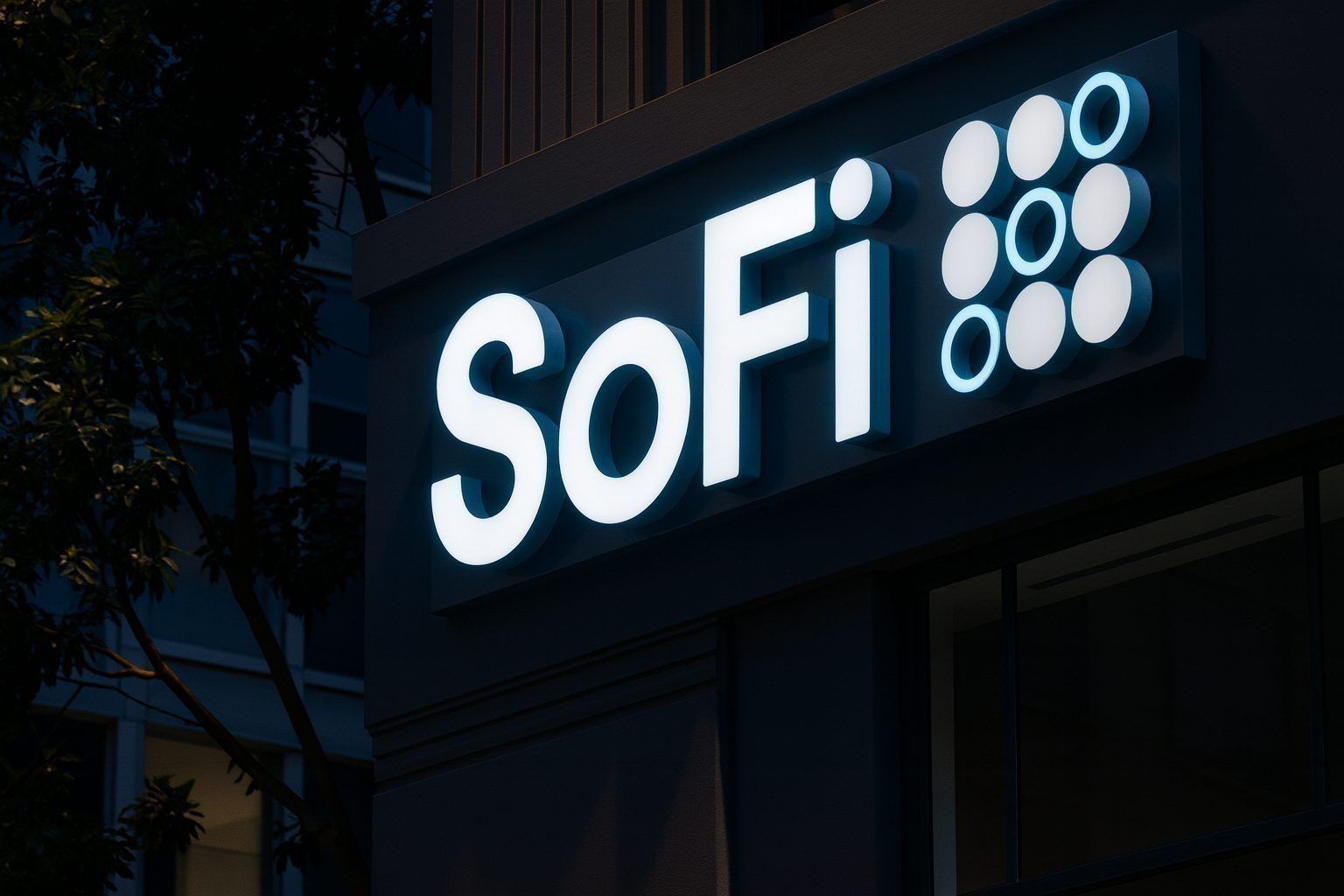

SoFi Technologies, Inc. NASDAQ:SOFI has spent 2025 rewriting its own story—from “fintech with big ambitions” to a bank-led platform trying to turn scale into durable profits. On Tuesday, December 23, 2025, SoFi stock is trading around $27 per share, giving investors a front-row seat to a very modern market debate: how much is real operating progress, and how much is future hype being priced in early?
The answer depends on which of SoFi’s late-2025 catalysts you think matters most: the company’s new SoFiUSD stablecoin, its return to consumer crypto trading, a $1.5 billion stock offering that strengthened capital but diluted shareholders, and a financial trajectory that (so far) has been moving in the right direction.
Below is a comprehensive roundup of the current news, forecasts, and analyses shaping SoFi stock as of Dec. 23, 2025—and what investors are watching next.
The headline stack: what’s driving SoFi stock right now
1) SoFi launches SoFiUSD, a fully reserved U.S. dollar stablecoin
SoFi announced SoFiUSD, a fully reserved U.S. dollar stablecoin issued by SoFi Bank, N.A. The company says it’s the first national bank to issue a stablecoin on a public, permissionless blockchain, positioning the product not just for SoFi members but also as stablecoin infrastructure for banks, fintechs, and enterprise partners (including white-label use cases).
Key details SoFi disclosed:
- Issued by SoFi Bank, N.A., described as an OCC-regulated insured depository institution.
- Fully reserved 1:1 by cash, with SoFi saying it can keep reserves in cash at its Federal bank account—framing this as “zero liquidity risk or credit risk” from reserves. SoFi
- Designed for near-instant, 24/7 settlement at very low cost, and intended to support settlement for SoFi’s crypto business, remittances, and partner flows across Galileo’s network.
- Available now for internal settlement activity, with broader availability to members expected in the coming months.
Market coverage has generally framed SoFiUSD as a meaningful escalation of SoFi’s crypto push, arriving after regulatory clarity and amid broader stablecoin experimentation by major payments and financial firms.
2) SoFi is back in retail crypto: “SoFi Crypto” launched via SoFi Bank
In November, SoFi announced the launch of SoFi Crypto, saying it became the first and only nationally chartered, FDIC-insured bank to offer consumers the ability to buy, sell, and hold crypto inside the SoFi ecosystem.
SoFi’s release positioned this as a “bank-grade” approach—integrated with SoFi’s checking and savings accounts—while emphasizing that crypto and digital assets are not FDIC or SIPC insured and can be volatile. SoFi
Industry reporting tied SoFi’s timing to a shifting U.S. regulatory posture in 2025, with federal banking regulators clarifying how banks can engage in certain crypto-asset activities.
3) The $1.5B share offering: capital strength vs. dilution
SoFi also had a very “grown-up bank” moment this month: it priced an underwritten public offering of 54,545,454 shares at $27.50 per share, for gross proceeds of about $1.5 billion, with an option for underwriters to purchase additional shares. SoFi said proceeds would be used for general corporate purposes, including enhancing capital position and funding growth opportunities. SoFi
When the offering plan was first announced, the market’s immediate reaction was classic dilution anxiety—shares fell sharply in after-hours trading, and coverage emphasized the discount to the prior close and investor concern about issuing stock after a major run-up.
SoFi’s fundamentals: the earnings engine underneath the headlines
SoFi’s late-2025 product blitz lands on top of improving operating results.
In its Q3 2025 report (released Oct. 28), SoFi posted:
- Total net revenue (GAAP) of $961.6 million (often rounded to ~$962 million) SoFi
- GAAP net income of $139.4 million SoFi
- Diluted EPS of $0.11 SoFi
- Adjusted EBITDA of $276.9 million SoFi
Just as important for stock narratives, SoFi raised full-year expectations. Management’s 2025 guidance (as stated in the Q3 release) included:
- At least 3.5 million new members in 2025
- Adjusted net revenue of approximately $3.54 billion
- Adjusted EBITDA of approximately $1.035 billion
- Adjusted net income of approximately $455 million
- Adjusted EPS of approximately $0.37 SoFi+1
Reuters’ coverage of the quarter highlighted a surge in fee-based revenue and strong performance in SoFi’s financial services business, while also noting management commentary on credit performance and member health. Reuters
The Wall Street Journal similarly emphasized the raised profit outlook, member growth, and product adoption as drivers of the improved forecast.
Why SoFi’s crypto/stablecoin push matters to the stock story
SoFi’s crypto narrative isn’t just “add a trading tab.” Strategically, the company is trying to connect three pieces:
- Consumer engagement inside the SoFi app (banking + investing + crypto in one place) SoFi
- Payments and remittances using blockchain rails (SoFi has discussed crypto-powered money movement as part of its broader roadmap) SoFi+1
- B2B infrastructure via Galileo and platform services—using stablecoins as a settlement primitive for partners SoFi+1
In the bullish version of the story, SoFiUSD is not mainly a speculative crypto asset—it’s an infrastructure product that could:
- Lower settlement frictions for partners
- Create new fee streams (or strengthen partner relationships that create fee streams)
- Differentiate SoFi as a regulated bank offering “on-chain” tools with bank oversight SoFi+1
In the skeptical version, stablecoins are an intensely competitive space, and the product’s ultimate contribution to earnings may be modest relative to how much investor excitement it generates.
Wall Street forecasts for SoFi stock: price targets, ratings, and EPS outlook
As of Dec. 23, 2025, the broad analyst stance looks mixed-to-neutral:
- MarketBeat shows a consensus “Hold”, with an average 12-month price target around $25.69 (and a wide range of $17 to $38). MarketBeat
- TipRanks’ SOFI vs. HOOD comparison similarly frames SOFI as a Hold, with an average price target around $27.50, roughly in line with where shares trade now.
On earnings power, Nasdaq’s analysis notes sell-side expectations around $0.37 EPS for 2025 and $0.58 EPS for 2026. Nasdaq
At roughly $27 per share, that implies a valuation of about 73x 2025 EPS and about 47x 2026 EPS (simple math, but it matters): SoFi is still priced like a company that needs to keep compounding growth and improving margins—fast.
That valuation setup is exactly why SoFi stock can look “expensive” to traditional bank investors while still looking “not crazy” to growth investors who believe SoFi is building a multi-product platform with long runway.
The dilution question: why the $1.5B offering still hangs over sentiment
Even bulls tend to concede one thing: issuing equity after a big run can spook the market.
SoFi’s offering was explicit about strengthening capital and increasing flexibility for growth and capital management. SoFi
But market coverage emphasized that investors were caught off guard and worried about dilution—especially since the stock had already rallied sharply in 2025.
The key investor debate isn’t whether dilution exists. It’s whether the capital:
- Reduces long-term funding constraints
- Improves SoFi’s ability to scale lending and platform ambitions safely
- Enables more resilient growth across cycles
If the answer is “yes,” the offering becomes a strategic reset. If the answer is “no,” it becomes an expensive way to fund optimism.
Insider and institutional signals: data points, not destiny
SoFi also saw fresh attention on insider trading disclosures.
For example, a TradingView report highlighted that SoFi’s CTO Jeremy Rishel sold 91,837 shares on Dec. 17, 2025 at $26.64 per share under a Rule 10b5-1 trading plan, while still holding a substantial position afterward.
Insider sales can mean many things (taxes, diversification, pre-scheduled plans), but in a stock that has run hard, they often get interpreted through whatever narrative investors already believe—bullish investors shrug, bearish investors circle it in red ink.
On the institutional side, routine 13F-based “stake increased” headlines also surfaced (typical in a widely held name), but they rarely change the core thesis on their own. MarketBeat
The bull case vs. bear case: what current analyses are arguing
Bull case themes showing up in late-2025 commentary
- Platform flywheel: More members, more products per member, more cross-sell, lower acquisition costs over time. (SoFi continues to highlight scale and product breadth; Q3 guidance and member targets reinforce that direction.
- New rails + new revenue pools: Stablecoin infrastructure and crypto capabilities could expand fee-based revenue and partner relationships—especially if stablecoin settlement becomes more mainstream.
- Operational momentum: Raised 2025 outlook and recent profitability strengthen the argument that SoFi is not just “growth at all costs.” SoFi+1
Bear case themes in current critical takes
- Valuation risk: After a huge rally, the stock can be vulnerable to any “good but not great” execution. Nasdaq’s analysis explicitly raises valuation concerns alongside credit-cycle risk. Nasdaq
- Credit-cycle exposure: SoFi’s lending business (especially unsecured personal loans) means macro deterioration or rising defaults can pressure results, even if the platform narrative is intact.
- Dilution + insider headlines: Some commentary argues dilution and insider selling worsen risk/reward at current prices, even acknowledging operational progress.
The honest takeaway: the “platform bank” thesis can be true and the stock can still be overpriced in the short run. Markets are perfectly capable of being both insightful and dramatic at the same time—often before lunch.
Other notable SoFi developments investors are factoring in
SoFi has also been active outside crypto:
- SoFi Smart Card: The company announced the SoFi Smart Card and promoted it as part of an “all-in-one” account strategy, tying card usage and savings behavior more tightly into its ecosystem. SoFi
- Private-market investing access: Through a SoFi–Templum partnership, SoFi opened a limited December window for accredited investors to access private-company exposure (Epic Games and Stripe) via the Cosmos Fund structure.
These aren’t necessarily immediate earnings drivers, but they reinforce SoFi’s strategy: expand product surface area, increase engagement, and keep members inside the app.
What to watch next for SOFI stock
Going forward, the next set of “make-or-break” checkpoints are straightforward:
- Execution on SoFiUSD rollout
Investors will want clarity on adoption, partner integration, and whether SoFi can monetize infrastructure without taking on new risk. - Crypto trading scale and risk controls
Crypto can drive engagement and transaction revenue, but it also adds reputational and regulatory complexity. SoFi itself emphasizes that digital assets are not insured and can lose value. - Credit performance and loan growth
SoFi’s leadership has pointed to strong member health and improving charge-off trends in recent coverage; markets will watch whether that holds if the consumer cycle turns. - Whether growth justifies the multiple
If the Street’s EPS path (roughly $0.37 in 2025 and $0.58 in 2026) holds, the stock still needs strong operating leverage to look “cheap” on traditional measures. Nasdaq+1
Bottom line
As of Dec. 23, 2025, SoFi stock sits at the intersection of real financial improvement (raised guidance, profitability, scale) and big narrative catalysts (stablecoin, crypto trading, infrastructure ambitions)—with dilution and valuation acting as the constant gravity pulling the conversation back to earth.
SoFi is trying to be two things at once: a regulated bank with improving earnings quality, and a modern financial platform building for an on-chain future. If it threads that needle, today’s volatility may look like noise. If it doesn’t, the stock’s 2025 rally leaves very little room for disappointment.
Related articles: NASDAQ:SOFI