
NEW YORK, August 2, 2026, 14:07 EDT
- SpaceX ended Friday at $108.37, a 5.8% decline for the week. The share price is down 19.7% from its June IPO.
- The U.S. Space Force has placed a $1.6 billion order for 18 Falcon 9 launches, averaging approximately $88.9 million per mission.
- Second-quarter earnings are due on Tuesday. As many as 911.5 million shares will be available for sale starting Thursday.
SpaceX shares finished Friday at their lowest closing level on record ahead of its inaugural public earnings release. U.S. cash markets were shut on Sunday. The stock declined even after SpaceX completed a successful Starlink launch on Friday night.
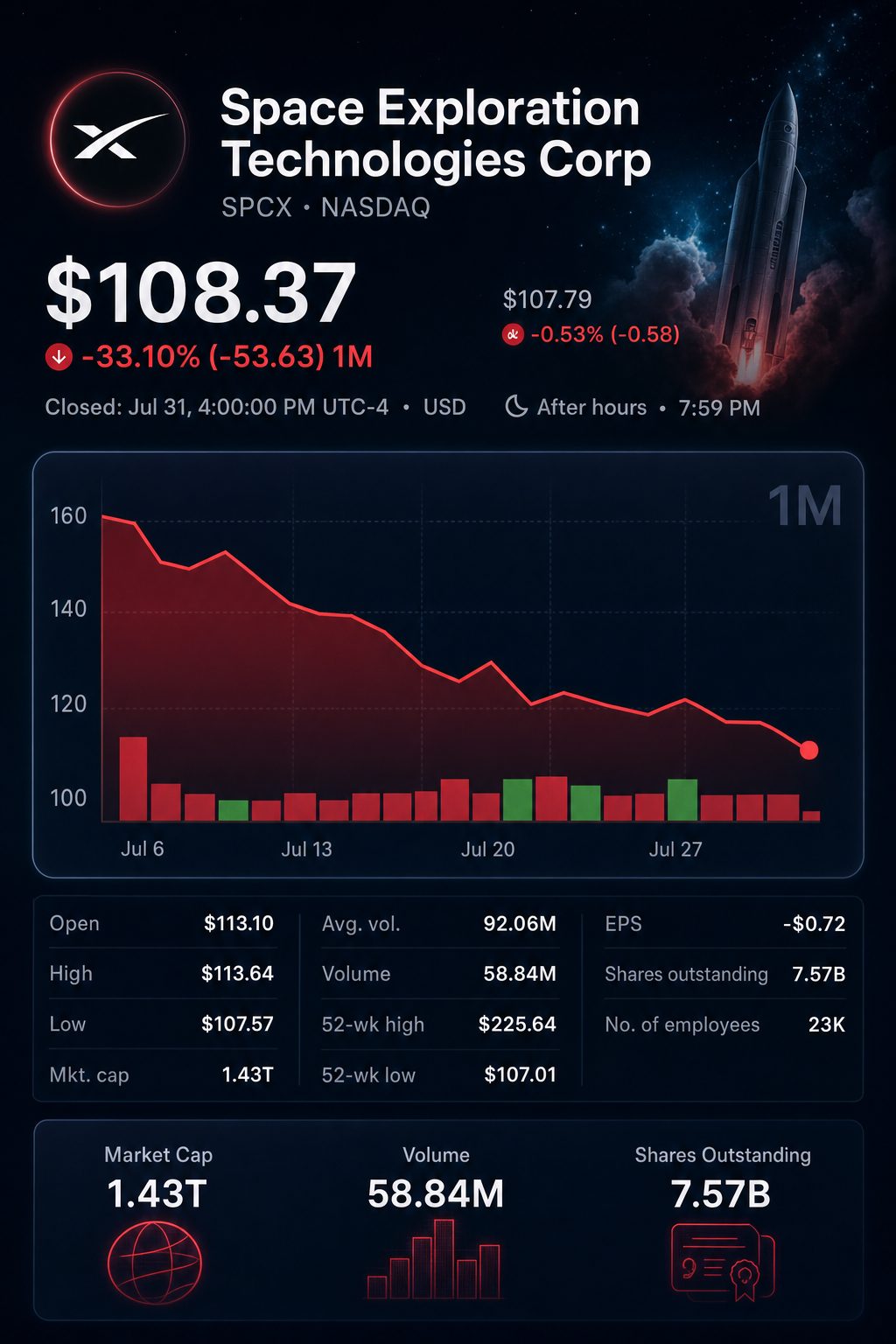
The market’s signal is clearer at present. Launch milestones and government contracts back the company, but are not enough by themselves to justify a $1.43 trillion valuation. The latest defense contract accounts for just 0.11% of the firm’s market value.
| Market scorecard | Performance |
|---|---|
| Friday’s close | $108.37 |
| Weekly movement | -5.8% |
| Shift from $135 IPO price | -19.7% |
| Shift from $225.64 peak | -52.0% |
| Nasdaq Composite, weekly | +1.6% |
| S&P 500, weekly | +1.0% |
Share moves are based on referenced closing prices. Index numbers reflect the week to July 31.
SpaceX lagged behind the Nasdaq Composite by 7.4 percentage points over the past week. The wider technology sector saw gains, but SpaceX recorded its fourth consecutive weekly loss.
Operations continued at a high level. On Friday, a Falcon 9 launched 24 satellites into orbit. The booster marked its 26th flight and achieved another landing.
| Launch and award measure | Value |
|---|---|
| Falcon missions completed from 2026 up to July 31 | 90 |
| Starlink launches within this total | 69 |
| Proportion of Falcon flights comprising Starlink | 76.7% |
| Falcon launches projected per year | About 155 |
| Latest Space Force contract | $1.6 billion |
| Total missions included | 18 |
| Estimated average contract amount per launch | $88.9 million |
| Contract value as percent of market value | 0.11% |
Calculated annualized rates and ratios use reported data on launches, market activity, and orders.
The company is currently sending a Falcon rocket into space about once every 2.4 days. Its most recent flight brought SpaceX’s total number of orbital-booster landings to 643. There are now over 10,800 Starlink satellites in orbit.
The Space Force contract applies to missions until 2027. Acquisition official Eric Zarybnisky described it as an “unprecedented two-month acquisition timeline.” So far this year, SpaceX has landed no less than $7 billion in Pentagon deals. Reuters
Order value and equity value are distinct metrics. However, their comparative size helps clarify the subdued market reaction. A $1.6 billion award alone is not enough to significantly impact a company valued in the trillions.
| Listed space and connectivity comparison | Market capitalization | SpaceX multiple |
|---|---|---|
| SpaceX | $1.43 trillion | 1.0 times |
| Rocket Lab USA Inc. NASDAQ:RKLB | $39.3 billion | 36.4 times |
| AST SpaceMobile Inc. NASDAQ:ASTS | $17.1 billion | 83.4 times |
| Viasat Inc. NASDAQ:VSAT | $10.8 billion | 131.9 times |
Their products and levels of development vary. The comparison reflects how much growth is already factored into SpaceX’s valuation.
SpaceX is scheduled to report earnings on Tuesday following market close. Early consensus from Visible Alpha projects second-quarter revenue at $6.9 billion. The operating margin for Connectivity is forecast at 35.9%.
| Investor tests for the coming week | Initial or planned figures |
|---|---|
| Q2 revenue | $6.9 billion |
| Connectivity margin percentage | 35.9% |
| Projected EPS range | Loss of $1.26 to gain of $0.33 |
| Projected capital spending for 2026 | $48.7 billion |
| Shares available for sale as of August 6 | Up to 911.5 million |
| Value to be unlocked at Friday’s close | About $98.8 billion |
| Unlock relative to Friday’s turnover | 15.5 sessions |
Consensus figures represent analyst estimates and do not reflect company guidance. Unlock calculations are based on Friday’s closing price and a share volume of 58.84 million.
The broad earnings spread shows conflicting trends. Expenditures on space and artificial intelligence impact outcomes. Starlink generates most operating profit.
SpaceX reported first-quarter Connectivity revenue of $3.26 billion, with operating income at $1.19 billion, indicating a 36.5% margin. The upcoming report on Tuesday will show if profitability remained steady as the network grew.
The immediate focus shifts to Thursday. The potential unlock is 64% bigger compared to the IPO’s base offering of 555.6 million shares. Being eligible does not guarantee that all holders will choose to sell.
Starship continues as the critical long-term cost factor. The 13th flight carried 20 test Starlink V3 satellites and showed better heat-shield results. Five engines on the booster did not reignite during descent.
SpaceX has also scheduled a Falcon 9 Starlink launch window on Tuesday, providing investors with a further operational update ahead of the earnings report. Planned launches are still dependent on weather and any technical adjustments.
Risks: A disappointing earnings result, reduced Starlink margins, or increased AI-related costs could drive further declines. Additional pressure may arise from lock-up expirations. Options pricing suggests an anticipated swing of about 14% to 15% around the earnings release.
The initial test for the stock is financial rather than technical. SpaceX has demonstrated its ability to launch at scale, but now it needs to prove that Starlink earnings can support its ambitions in AI and Starship.
Related articles: Space Industry