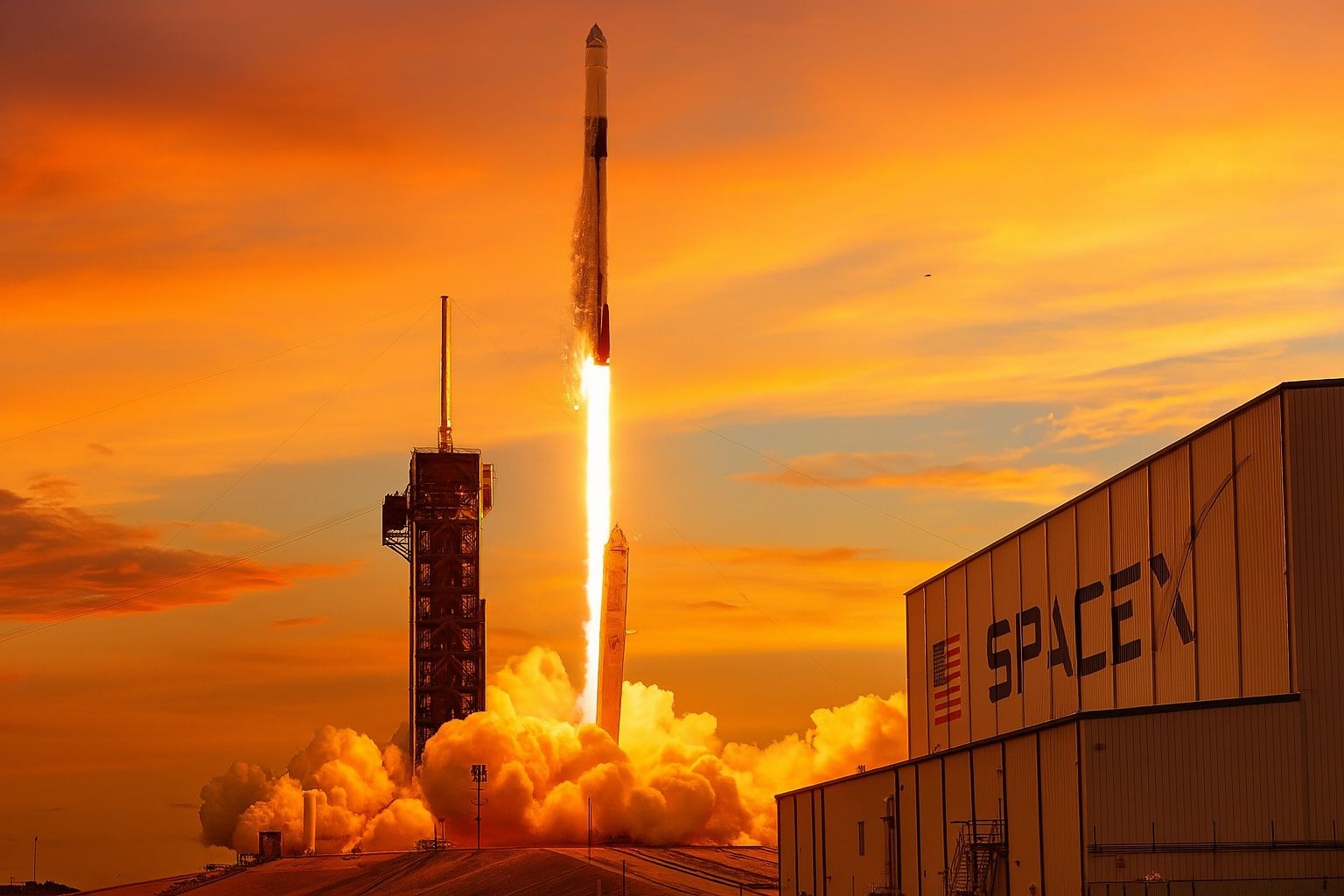

- The USSF-178 task order is an $81.6 million NSSL Phase 3 Lane 1 award to SpaceX to launch WSF-M2 on a Falcon 9 from Vandenberg SFB in the first half of FY2027, including a BLAZE-2 rideshare.
- This award marks SpaceX’s third consecutive Lane 1 win under NSSL Phase 3, following two earlier Lane 1 awards totaling $733.5 million for SDA and NRO missions.
- WSF-M2 is the second Ball Aerospace–built microwave weather satellite, following WSF-M1 (USSF-62) which flew on a Falcon 9 on 11 April 2024, with Ball renamed to BAE Systems Space & Mission Systems after the 2024 acquisition.
- Each WSF-M2 satellite carries a multi-frequency passive microwave imager and an Energetic Charged-Particle sensor, enabling retrievals of ocean-surface vector winds, snow/soil moisture, and LEO particle flux.
- The WSF-M program aims to fill three critical environmental-monitoring gaps identified after the aging DMSP program began retiring, amid concerns DMSP could shut down as soon as 30 June 2025.
- DMSP last launched in 2014, only two satellites have fuel past 2026, and WSF-M is positioned as the near-term DoD weather asset.
- SpaceX’s USSF-178 price undercuts the Phase 2 average by about 25 percent, with Phase 2 launches typically $95-150 million versus $81.6 million for USSF-178.
- The launch window targets the first half of FY 2027, with as little as three months for late-manifested rideshare integration.
- The contract emphasizes strategic value in flexibly manifesting small satellites on launch vehicles with additional capacity for SSC.
- The broader market context notes potential gaps if ULA Vulcan and Blue Origin New Glenn are delayed, potentially leaving SpaceX as the sole certified heavy-lift provider for national-security launches by 2025, with a field possibly limited to SpaceX, Blue Origin, and ULA by 2027.
The U.S. Space Force has tapped SpaceX for a $81.6 million National Security Space Launch (NSSL) Phase 3 Lane 1 task order to loft the Weather System Follow-on–Microwave 2 (WSF-M2) satellite and a rideshare stack of small DoD spacecraft (the BLAZE-2 mission) in the first half of fiscal 2027. The award—designated mission USSF-178—marks SpaceX’s third straight win under the new NSSL contracting framework and underscores the company’s tightening grip on U.S. national-security launches. Below is a deep-dive on what the contract covers, why the WSF-M satellites matter, and how the deal reshapes the military-launch market.
1. What the USSF-178 Contract Covers
- Award specifics. The $81.6 million task order was issued June 27 by Space Systems Command (SSC) and covers a single Falcon 9 launch from Vandenberg SFB with “multi-manifest” capacity for secondary payloads. ssc.spaceforce.mil
- Third consecutive Phase 3 win. SpaceX already secured two earlier Lane 1 awards—worth a combined $733.5 million—covering seven Space Development Agency and two National Reconnaissance Office missions; USSF-178 cements a clean three-for-three record.
- Tier-3 assurance. SSC classified USSF-178 as the first Lane 1 mission requiring Tier-3 mission assurance, reflecting the operational importance of WSF-M2.
- Launch window. SSC says liftoff is targeted for “the first half of FY 2027,” allowing as little as three months for late-manifested rideshare integration. ssc.spaceforce.mil
- Official rationale. “It is a strategic advantage when we can flexibly manifest small satellites on our launch vehicles with additional capacity,” noted Col. Matthew Flahive, chief of Launch Mission Solutions Delta at SSC. spacenews.com
2. Inside the WSF-M Program
2.1 Spacecraft Heritage
- WSF-M2 is the second of two Ball-built microwave weather satellites; the first, WSF-M1 (mission USSF-62), flew aboard a Falcon 9 on 11 April 2024.
- Ball Aerospace (now BAE Systems Space & Mission Systems after the 2024 acquisition) received a $78 million modification in 2022 to build the second vehicle.
David Betz, SSC WSF-M program manager, said at the 2023 contract option exercise: “The second WSF-M space vehicle extends our ability to measure wind speed and direction over the Earth’s oceans and provide timely tropical-cyclone intensity data beyond the first vehicle’s end-of-life.” americaspace.com
Note: SSC press material credits BAE Systems following its 2024 purchase of Ball Aerospace.
2.2 Sensors and Data Products
- Each satellite carries a multi-frequency passive microwave imager and an Energetic Charged-Particle (ECP) sensor, enabling retrievals of ocean-surface vector winds, snow/soil moisture and LEO particle flux.
- Collected data backfill three critical “space-based environmental-monitoring gaps” identified when the aging Defense Meteorological Satellite Program (DMSP) began retiring. americaspace.com
3. Why Military Weather Data Are Urgent
- Legacy at risk. The Guardian reports DMSP spacecraft could be shut down as soon as 30 June 2025, a move that scientists say would “send hurricane forecasting back decades.” theguardian.com
- Operational impacts. C4ISRNET notes the last DMSP launch occurred in 2014 and only two satellites have fuel past 2026, leaving WSF-M the sole DoD-owned replacement in the near term.
4. SpaceX’s Rising Launch Monopoly Concerns
- Breaking Defense warns that delays to ULA Vulcan and Blue Origin New Glenn could leave SpaceX the only certified heavy-lift provider for a span of national-security launches starting in 2025.
- Space-policy analyst Todd Harrison observes: “Allowing more than two competitors sends a strong signal … but by 2027 the field may still be just SpaceX, Blue Origin and ULA, with real uncertainty about the latter two.” breakingdefense.com
- Former NASA administrator Jim Bridenstine adds: “The only thing worse than a government monopoly is a private monopoly that government is dependent on.” breakingdefense.com
5. Financial & Programmatic Context
| Metric | NSSL Phase 2 | NSSL Phase 3 Lane 1 (to date) |
|---|---|---|
| Award structure | Fixed-share (60 % ULA / 40 % SpaceX) | IDIQ task orders, open competition |
| Typical price per launch | $95-150 M (Phase 2 avg.) | $81.6 M (USSF-178) spacenews.com |
| Mission assurance tier | Category A/B equivalent | Tier 0-3 (risk-based) spacenews.com |
SpaceX’s USSF-178 price undercuts the Phase 2 average by roughly 25 percent, highlighting how Lane 1’s lighter assurance and reuse-driven economics translate into cost savings for lower-risk payloads.
6. Broader Weather-Sensing Roadmap
| Capability gap | WSF-M solution | Follow-on / commercial options |
|---|---|---|
| Ocean vector winds & cyclone intensity | Microwave imager (WSF-M1/2) | Potential “Electro-Optical Weather System” sats (first EO-WS launch slated 2025). c4isrnet.com |
| Energetic charged particles | ECP sensor (WSF-M1/2) | SDA “space-weather” cubesats under study |
| Cloud imagery & theater weather | Commercial LEO imagery providers under SSC market survey | Industry-day planned Q3 FY 2025. c4isrnet.com |
7. Launch and Integration Timeline
- 2025–2026: SpaceX conducts mission design reviews; Ball/BAE finishes spacecraft environmental tests.
- Early FY 2027: Falcon 9 static-fire on SLC-4E; rideshare payloads (BLAZE-2) integrated within 90 days of launch per Lane 1 rapid-call-up requirement.
- Post-launch: Initial Operational Capability targeted ≈ 9 months after on-orbit checkout, tying into NOAA and Joint Typhoon Warning Center modeling pipelines.
8. Expert Takeaways
- Col. Matthew Flahive (SSC): “We deliver assured access to space and maximize value for the American taxpayer.” ssc.spaceforce.mil
- Todd Harrison (Metrea Strategic Insights): “Starship will fundamentally change everything … we could see SpaceX’s effective launch capacity triple within five years.” breakingdefense.com
- Courtney Albon (C4ISRNET): The DMSP backlog shows “back-to-back failed modernization efforts have weakened an already obsolescing national-security weather enterprise.” c4isrnet.com
Conclusion
The USSF-178 award signals both progress and pressure points for U.S. military space operations: it accelerates the transition from Cold-War-era weather assets to modern sensors, yet it further concentrates critical launch capability in SpaceX’s hands. Whether forthcoming Lane 1 on-ramps and Lane 2 competitions restore balance—or whether SpaceX’s cost and cadence keep it dominant—will shape the strategic landscape well beyond this $81.6 million mission.
Related articles: Space