
NEW YORK, August 3, 2026, 11:13 EDT
- Strategy sold 1,638 bitcoin for $104.7 million at an average $63,957. That was 15.2% below its company-wide average purchase price.
- It issued 3.01 million common shares and repurchased 912,143 Stretch preferred shares NASDAQ:STRC for $81.2 million.
- A preliminary calculation puts the latest annual STRC dividend saving near $10.9 million. That equals only 0.6% of Strategy’s estimated annual financing commitments.
Common shareholders supplied 73.5% of Strategy’s $395.3 million financing pool last week. A bitcoin sale supplied the rest. The company placed $250 million into its dollar reserve and spent $81.2 million repurchasing STRC.
The funding split is the investor signal. Strategy’s equity engine is now supporting its preferred stack and cash reserve. It is no longer used solely to accumulate bitcoin.
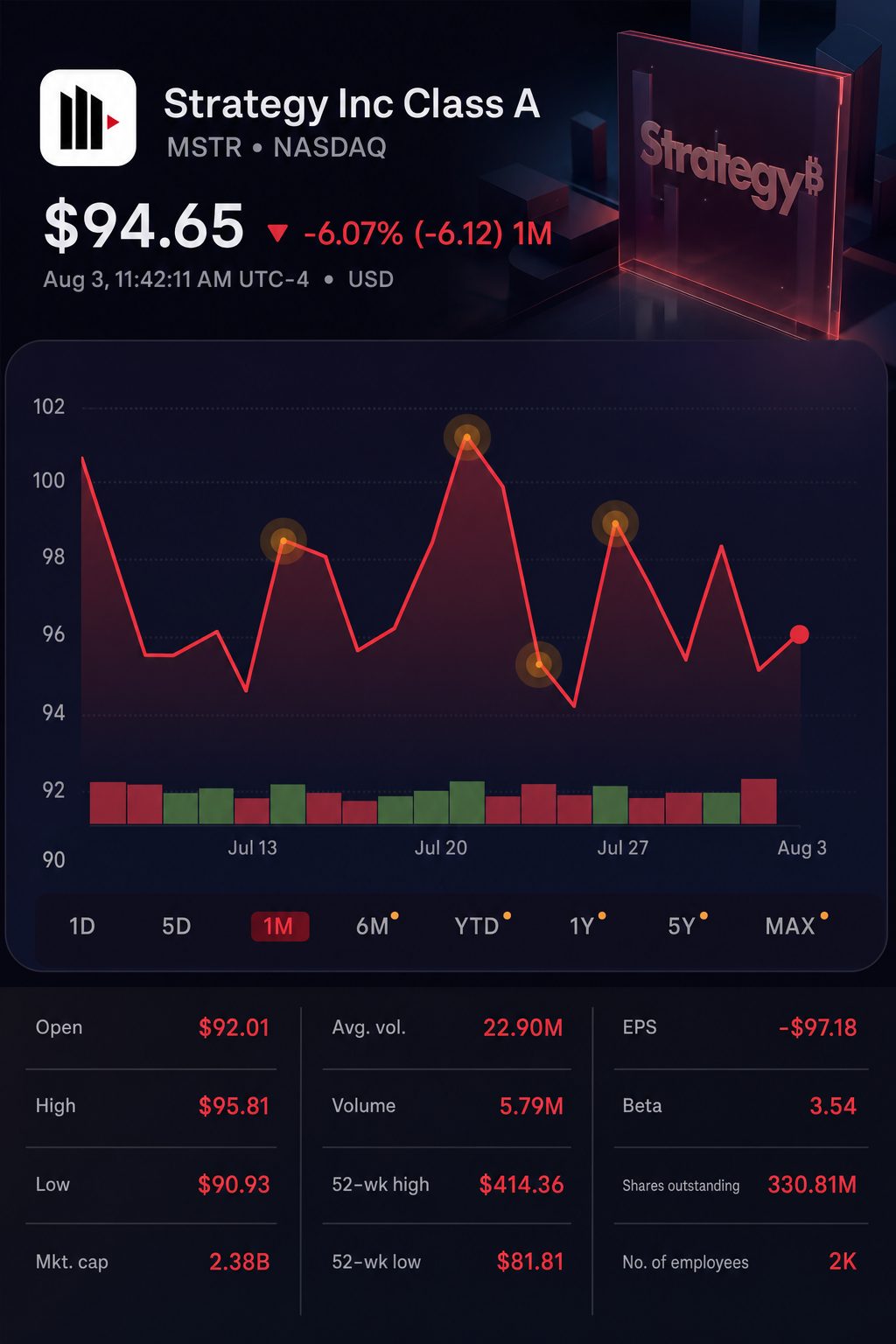
U.S. markets were open at the dateline. MSTR rose 2.3% to $95.46, while STRC gained 2.8% to $91.95. Bitcoin advanced 1.2% to $63,801.
The movement of cash was direct.
| Funding source | Cash raised | Share of funding | Main allocation |
|---|---|---|---|
| Sale of 1,638 bitcoin | $104.7 million | 26.5% | $52.4 million dividends; $52.3 million STRC repurchase |
| Sale of MSTR common shares | $290.6 million | 73.5% | $250 million reserve; $28.9 million STRC repurchase; $11.7 million retained cash |
| Total | $395.3 million | 100.0% | $250 million reserve; $81.2 million STRC; $52.4 million dividends; $11.7 million cash |
Figures are rounded. Strategy disclosed the allocations in its August 3 regulatory filing.
Strategy sold 3,011,361 common shares at an implied net price of $96.50. That issuance equalled about 0.7% of assumed diluted shares afterward. MSTR traded roughly 1.1% below the implied sale price on Monday.
The bitcoin transaction carried less favourable arithmetic. Strategy received $63,957 per coin. Its aggregate purchase price was $75,419.
The resulting $18.8 million difference is a preliminary benchmark calculation. It is not a realized accounting loss because individual tax lots were not disclosed.
| Sale period | Bitcoin sold | Average sale price | Proceeds | Sale price versus company-wide average cost |
|---|---|---|---|---|
| May 26–31 | 32 | $77,135 | $2.5 million | +1.9% |
| June 29–30 | 1,363 | $59,256 | $80.8 million | -21.6% |
| July 1–5 | 2,225 | $60,773 | $135.2 million | -19.5% |
| July 27–August 2 | 1,638 | $63,957 | $104.7 million | -15.2% |
| Total or weighted average | 5,258 | about $61,474 | $323.2 million | — |
The comparisons use Strategy’s company-wide average cost after each sale. They do not identify gains or losses on specific coins.
Strategy has therefore sold 5,258 bitcoin since late May. The last three transactions occurred below the aggregate purchase price. However, August’s discount was narrower than those recorded in June and early July.
The STRC repurchase produced better near-term economics. Strategy paid an average $89.02 for shares carrying a $100 stated amount. That represents an 11.0% discount.
| STRC repurchase | Shares acquired | Cash spent | Average price | Discount to $100 | Preliminary annual dividend reduction |
|---|---|---|---|---|---|
| Earlier repurchase | 288,930 | $25.0 million | $86.53 | 13.5% | $3.5 million |
| July 27–August 2 | 912,143 | $81.2 million | $89.02 | 11.0% | $10.9 million |
| Combined | 1,201,073 | $106.2 million | $88.42 | 11.6% | $14.4 million |
The dividend estimates assume STRC’s current 12% annual rate continues. They also assume repurchased shares remain outside public circulation.
Chief Executive Phong Le called discounted repurchases “an attractive use of capital that reduces our future preferred dividend requirements at a discount.” Strategy
The combined transactions imply a 13.6% avoided-dividend yield on the cash spent. Yet the estimated $14.4 million annual saving equals only about 0.8% of Strategy’s $1.76 billion annual interest and preferred-dividend commitments. The reserve increase provided the larger cushion.
Strategy’s dollar reserve reached $4.0 billion after the latest contribution. Executive Chairman Michael Saylor said the deposit added 57 days of coverage. Reserve duration increased to about 2.3 years.
Le described the policy change more bluntly: “The biggest lesson so far from 2026 is the importance of holding liquid U.S. dollars.” Investing.com
Second-quarter figures explain the urgency. Reported preferred-stock dividends rose to $400.7 million from $49.1 million a year earlier. They were more than three times quarterly revenue of $122.4 million.
Strategy retains $893.8 million of preferred-share repurchase authority. It also has $22.69 billion of remaining MSTR issuance capacity. That provides a large liquidity backstop, but also leaves a substantial dilution overhang.
Risks: A bitcoin rebound would increase the opportunity cost of further sales. A deeper decline could require more common-stock issuance or bitcoin monetisation. STRC’s variable dividend may also change and is not guaranteed.
Investors now have two prices to watch. STRC’s distance from $100 measures pressure on Strategy’s preferred funding model. MSTR’s placement price shows how much of the repair common shareholders must finance.
Related articles: NASDAQ:MSTR