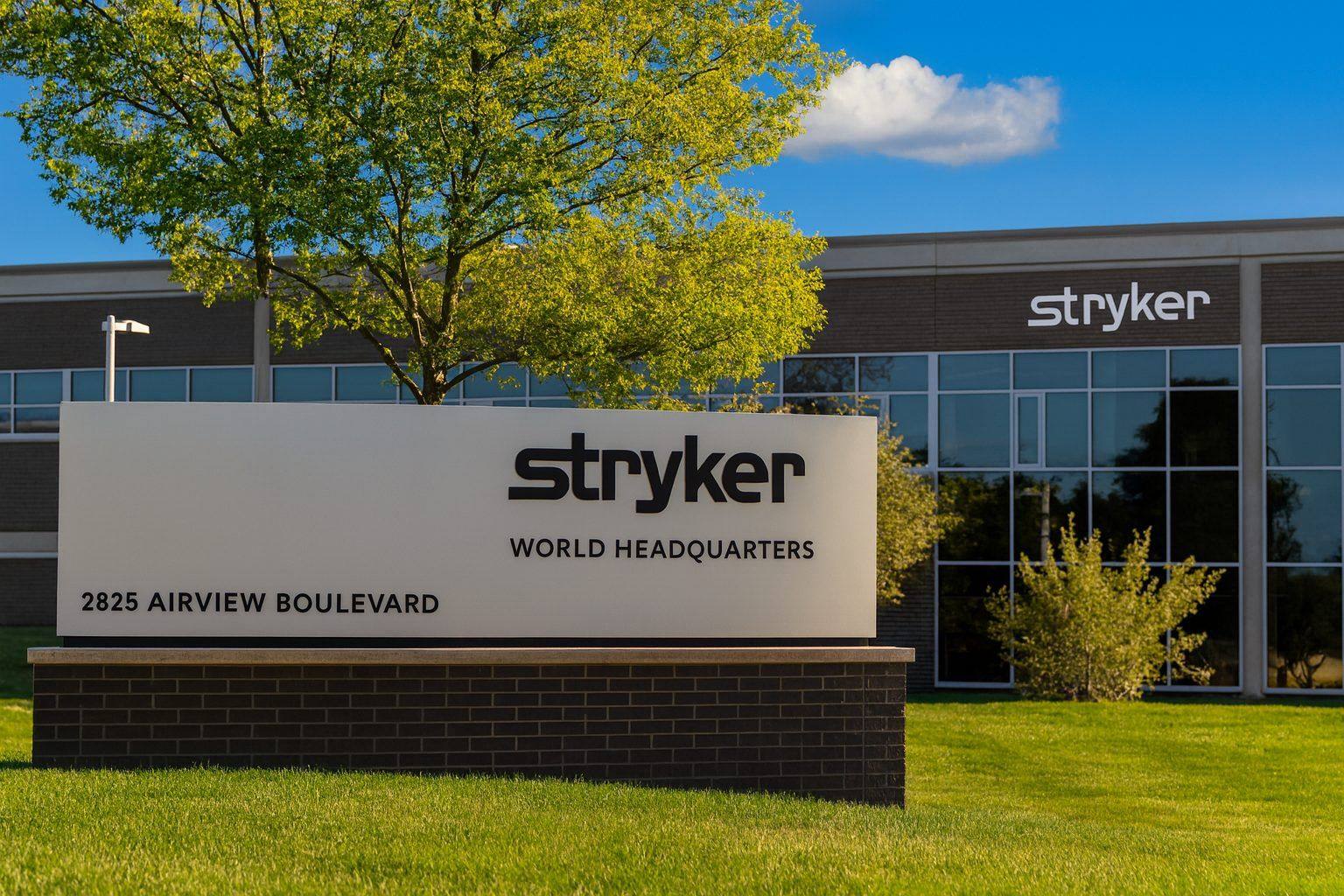

Stryker Corporation (NYSE: SYK) closed Friday, December 12, 2025, at $354.09, finishing the session up 0.32% and stabilizing after a choppy stretch that began with a sharp selloff early in the week.
Stryker is a global medical technology company spanning MedSurg, Neurotechnology and Orthopaedics, with products used across a wide range of procedures worldwide.
Below is a detailed, publication-ready breakdown of what moved Stryker stock this week, the fresh headlines investors are watching, and the catalysts that could matter next week.
Stryker stock performance recap (week ending Dec. 12, 2025)
After closing the prior week (Dec. 5) at $364.02, SYK ended this week at $354.09, a decline of roughly 2.7% week-over-week.
The week in one glance: a drop, a bounce, then a grind
Daily closes show the “down-then-rebound” pattern clearly:
- Mon (Dec. 8): $353.60 (−2.86%)
- Tue (Dec. 9): $349.23 (−1.24%)
- Wed (Dec. 10): $353.80 (+1.31%)
- Thu (Dec. 11): $352.97 (−0.23%)
- Fri (Dec. 12): $354.09 (+0.32%) MarketWatch+3Investing.com+3MarketWatch+3
The week’s trading range was wide: SYK traded as high as $363.74 (intraday high on Dec. 8) and as low as $347.26 (intraday low on Dec. 10).
Key headline 1: Stryker boosts its dividend to $0.88 per share
The most shareholder-friendly headline of the week landed Thursday, Dec. 11: Stryker’s board declared a quarterly dividend of $0.88 per share, payable Jan. 30, 2026, to shareholders of record as of Dec. 31, 2025. The company said the dividend represents an increase of 4.8% versus the prior year and the prior quarter.
Why the dividend matters for SYK stock right now
Dividend increases in mega-cap medtech often serve two purposes:
- Signals confidence in cash generation through cycles.
- Broadens the buyer base to include income-oriented investors—especially relevant when growth-stock multiples are under pressure.
At Friday’s close of $354.09, the new $0.88 quarterly dividend implies an annualized payout of $3.52, or roughly ~1.0% annualized yield (before taxes; and assuming the dividend level is maintained).
Key headline 2: Major leadership move — Spencer Stiles named President and COO
Another headline investors digested this week: on Dec. 4, 2025, Stryker announced Spencer Stiles will become President and Chief Operating Officer, effective Jan. 1, 2026. The company said Stiles will lead Stryker’s global businesses, strategy, and mergers and acquisitions. The release also noted Dylan Crotty will be promoted to Group President, Orthopaedics.
Industry coverage framed the appointment as a meaningful C-suite elevation for a long-tenured operator, aligning responsibility for execution and M&A under a single leader as the company continues to scale.
Investor read-through
For large medtech, leadership transitions can become a near-term stock catalyst if markets perceive a shift in:
- capital allocation priorities (M&A pace vs. buybacks)
- operating discipline (margin trajectory)
- portfolio mix (divestitures, tuck-in acquisitions, category bets)
Stryker explicitly called out strategy and M&A in Stiles’ remit—language investors tend to notice given Stryker’s history of dealmaking.
Key risk headline: FDA Class I recall entry for TMJ Bilateral Implant
On the risk-monitoring side, Stryker also sits in a heavily regulated industry where recalls and safety notices can influence sentiment even when financial impact is limited.
The FDA’s recall database includes a Class I recall entry for a TMJ Bilateral Implant, noting the firm issued an “Urgent: Medical Device Recall” notification on Sept. 30, 2025, and an expansion notification to additional consignees on Dec. 4, 2025, with instructions to locate, quarantine, and discontinue use of affected products. FDA Access Data
What investors typically watch next
A recall entry doesn’t automatically translate into material earnings risk, but it can impact the stock if investors fear:
- rising remediation costs (product replacement, field actions)
- litigation exposure
- reputational spillover into adjacent product lines
- higher regulatory scrutiny
The practical investor approach is to watch for company commentary, incremental regulatory updates, and any sign the issue broadens beyond a narrow SKU set.
Analyst outlook: Citi trims target; Street still leans bullish overall
Analyst sentiment remained broadly constructive, with one notable adjustment:
- Citigroup reportedly lowered its price target to $420 from $455 while maintaining a Buy rating (as part of a medical technology sector outlook refresh).
Consensus snapshots from market-data aggregators still point to a Street view clustered above the current price, though targets vary by methodology and update cadence:
- MarketBeat lists an average target around the low $430s with a range roughly $400–$456 (figures vary by the set of analysts included).
- Benzinga’s analyst ratings page shows a consensus price target in the mid-$420s and highlights Citi’s $420 as the latest update.
How to interpret targets in late 2025
Price targets are often less about “the number” and more about the assumptions behind the number:
- procedure volumes (hips/knees, trauma, spine)
- hospital capital budgets
- FX and international demand
- margins (manufacturing efficiency, mix, pricing)
- the cost of compliance/quality actions and any recall spillovers
- M&A integration and synergy delivery
This week’s Citi move reads less like a thesis break and more like valuation/risk recalibration—but it still matters because it can influence near-term institutional positioning.
Fundamentals backdrop: what the Street is betting on (and what could go wrong)
Stryker’s bull case has long been built around a durable blend of:
- recurring procedure demand (demographics + elective procedure recovery)
- innovation cycles (robotics, implants, instruments)
- operating leverage as scale increases
- consistent tuck-in dealmaking
In its most recent earnings season, Reuters reported that Stryker raised the lower end of its full-year profit forecast after beating third-quarter expectations, citing strong demand for medical and surgical devices.
But valuation remains part of the debate
At Friday’s close, SYK’s market cap sits around $141B, and the stock trades at a high trailing P/E based on some market data feeds—typical of high-quality, premium medtech franchises, but still sensitive to changes in rate expectations and growth confidence.
Technical/positioning check: where SYK traders are focused
Even long-term investors keep an eye on trend indicators, especially in a volatile tape:
- Several market snapshots show SYK trading below commonly watched moving averages (50-day and 200-day), reflecting the pullback from earlier highs.
- The stock remains meaningfully below its 52-week high of $406.19, referenced in market coverage earlier this week.
From a pure price-action standpoint, this week set up two obvious zones:
- Support zone: the $348–$350 area (this week’s low and Tuesday’s close neighborhood) Investing.com+1
- Resistance zone: the $360–$364 area (last week’s close and Monday’s intraday highs before the selloff) Investing.com+1
Week-ahead outlook: what could move Stryker stock next week (Dec. 15–19)
Stryker-specific news can always surface (analyst notes, regulatory updates, conference commentary), but for the next five trading days, the biggest driver may simply be the macro calendar—because macro moves can re-rate “premium multiple” healthcare names quickly.
1) A data-heavy U.S. week could swing rates and medtech multiples
Kiplinger’s calendar preview flags a busy week (Dec. 15–19) with key releases including a delayed jobs report, retail sales, and CPI inflation—the kind of mix that can shift expectations for the path of interest rates.
For SYK, the mechanism is straightforward:
- Softer data → yields can fall → high-quality compounders often catch a bid
- Hot inflation / strong demand → yields can rise → valuation pressure can return
2) The Fed just cut rates — and added a liquidity wrinkle
In the Dec. 9–10 meeting, the Federal Reserve said it lowered the federal funds target range by 0.25 percentage points to 3.5%–3.75%, and it also said it would initiate purchases of shorter-term Treasuries “as needed” to maintain ample reserves. Federal Reserve
Reuters also reported the Fed would begin short-dated Treasury bill purchases starting Dec. 12 as a technical liquidity management move.
This matters for equities—especially steady-growth names—because liquidity conditions and rate expectations influence both risk appetite and discount rates.
3) Stryker-specific items to watch
Going into the week ahead, SYK investors will likely track:
- Dividend follow-through: whether the dividend increase supports incremental demand from income funds (or gets overshadowed by macro).
- Leadership transition narrative: any additional color from management or trade outlets on strategic priorities ahead of the Jan. 1 effective date.
- Recall-related headlines: any sign the TMJ recall entry expands further, or any additional communications that clarify scope.
- Analyst target churn: follow-on 2026 outlook notes after Citi’s move (upgrades/downgrades can be incremental catalysts in a thin year-end tape).
Bottom line for SYK stock (as of Dec. 12, 2025)
Stryker stock ends the week near $354 after a volatile reset, with two fresh positives—a dividend increase and a clear leadership succession step—arriving against a backdrop of broader market sensitivity to rates and inflation.
The near-term tug-of-war looks like this:
- Bullish supports: dividend growth, stable medtech demand profile, and a generally constructive analyst bias even after target trims Stryker Investors+2TipRanks+2
- Overhangs to watch: recall/regulatory headlines, valuation sensitivity, and macro-driven multiple compression risk if next week’s data pushes yields higher FDA Access Data+2Kiplinger+2
Related articles: Dividends








![US Stock Market Today 08/28/2026 [UPDATE: 02:04 EDT] [Marvell Stalls Near Overnight Low as Price Discovery Fades]](https://ts2.tech/wp-content/uploads/2026/08/US-market-dashboard-2026-08-28-0159-480x384.jpg "US Stock Market Today 08/28/2026 [UPDATE: 02:04 EDT] [Marvell Stalls Near Overnight Low as Price Discovery Fades]")