
New York, April 27, 2026, 17:23 (EDT)
- Tesla shares were recently changing hands at $378.67, a gain of roughly 0.6%. The stock moved between $364.13 and $380.72 during Monday’s session.
- Tesla listed 303,960,630 shares connected to Elon Musk’s 2018 CEO award in a filing-fee table that pegged the value at $114.65 billion.
- The relief rally has its complications—Musk’s potential stock sales remain a concern for investors, who are also eyeing Tesla’s robotaxi schedule and a capital spending plan topping $25 billion by 2026.
Tesla shares rebounded from an initial dip Monday, trading close to $379 after the U.S. session ended, as attention shifted from Elon Musk’s new stock-award filing to the company’s ability to fund bigger bets on AI and robotaxis. TSLA last changed hands at $378.67, a gain of roughly 0.6%, with about 66.5 million shares moving on the day.
This filing lands squarely in the spotlight, pinning real figures to an issue Tesla watchers have tracked for years: Musk’s 2018 pay package. By registering shares tied to that award on Friday, Tesla spells out just how many could go to Musk — a number big enough to potentially sway investor thinking on dilution, voting strength, and even what Musk may need to sell down the line for tax reasons.
Tesla wants the spotlight on its cash as well as compensation. The company posted first-quarter revenue of $22.39 billion, with free cash flow at $1.44 billion—money remaining after capital expenditures. Cash, cash equivalents and short-term investments stood at $44.74 billion.
The filing landed with a softer edge than the headline suggested. Tesla’s fee table attached a maximum aggregate offering price of $114.65 billion, strictly for filing-fee calculations. Elsewhere, an implementation agreement pegged the exercise price at $23.34 for each restricted share—bringing the total closer to $7.09 billion.
The deal curbs quick-sale speculation: Musk can’t exercise the award until at least 30 days have passed since April 21, and he has to move by Aug. 15. Those restricted shares, they’re set to vest Jan. 19, 2028, and the agreement blocks sales during the holding period—unless it’s to cover taxes or a handful of allowed items. Musk still gets full voting rights on those restricted shares after they’re issued, as long as he’s the record owner.
Tesla posted a 6% year-over-year rise in first-quarter deliveries, hitting 358,023 vehicles—a figure that offered the stock some breathing room. Global vehicle inventory reached 27 days of supply. Energy storage deployment dropped 15%, marking a weak point in a quarter that still managed to deliver stronger auto revenue and improved cash flow.
Spending is where the pressure shows. Tesla hiked its 2026 capital expenditure target above $25 billion, with Musk channeling funds into AI, robotics, custom chips, and Cybercab production. According to Reuters, the move bumps up planned spending for 2026 by roughly 25%.
Robotaxi remains a sticking point for the stock. Musk told investors he’s aiming to roll out robotaxis and fully driverless vehicles in roughly a dozen U.S. states before year-end. Still, he cited “rigorous validation” as the main hurdle, and added that robotaxis likely wouldn’t be “super material” this year. Reuters
Analysts saw this as a sign the immediate outlook looks less upbeat. “The stakes are very high,” Morningstar’s Seth Goldstein told Reuters, adding that Tesla is proceeding with caution. Morgan Stanley analysts flagged delays, saying robotaxi development isn’t keeping pace with what investors had hoped. And for CFRA’s Garrett Nelson, this is familiar—he pointed out that anyone who’s watched Tesla for a while knows everything works on “Elon time.” Reuters
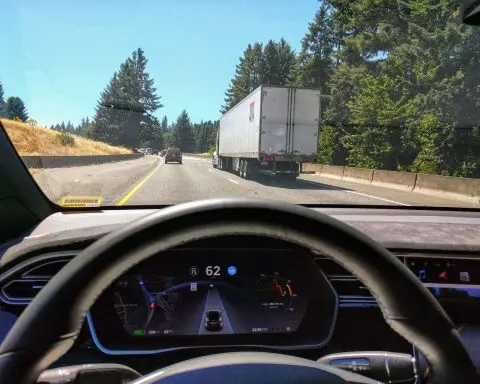
Tesla isn’t the only company struggling to make autonomy work at scale. Alphabet’s Waymo, for example, has spent years inching through city-by-city pilots and safety hurdles—now, Tesla’s facing the same scrutiny from investors. Tesla’s Full Self-Driving (Supervised), or FSD, is still just a driver-assist system; the company insists drivers must stay alert, and the cars aren’t actually autonomous.
Bulls point to Tesla’s balance sheet as a buffer. The company reported 1.28 million active FSD subscriptions in Q1—a 51% increase year-on-year—while noting Cybercab and Tesla Semi are in pilot production. Optimus factory buildouts are happening in both California and Texas.
The downside’s pretty straightforward. If Musk sells for tax reasons, if robotaxi deadlines slip again, or if capex eats through cash quicker than forecasts, shares could easily come under renewed pressure. Monday’s bounce isn’t the key issue—it’s about whether Tesla delivers tangible results from all this spending on robotaxi, AI, and manufacturing before investors run out of patience.
Related articles: NASDAQ:TSLA