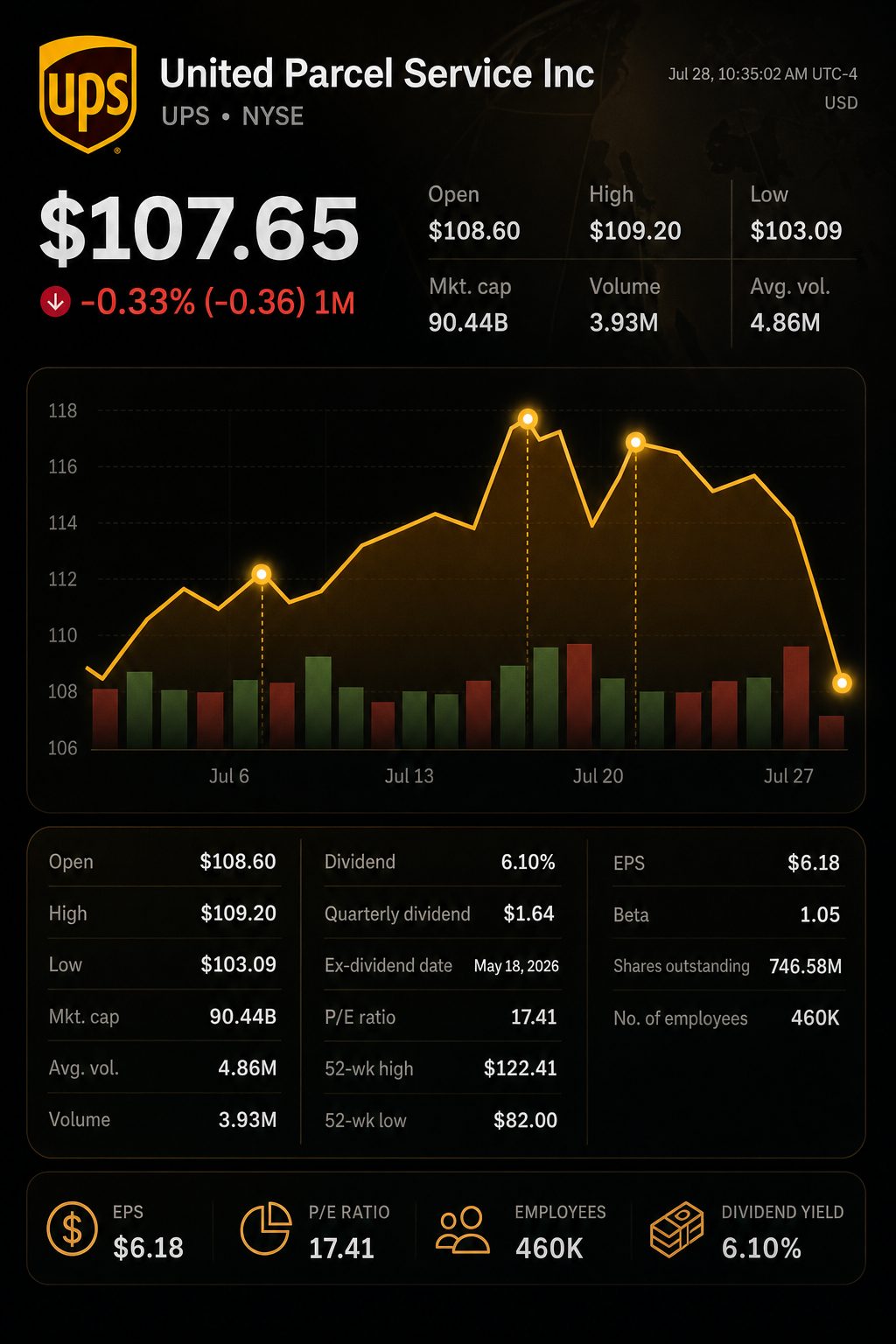
Shares of United Parcel Service, Inc. NYSE:UPS declined 6.1% to approximately $106 as of 10:01 a.m. EDT, erasing an earlier premarket increase following results that topped expectations and a raised outlook.
UPS revised its 2026 revenue outlook higher to $91.2 billion from the previous $89.7 billion. The company now projects adjusted operating profit of $8.65 billion, indicating a margin of approximately 9.5%. This compares to its earlier 9.6% margin forecast.
Revenue outlook increased by $1.5 billion, an approximate gain of 1.7%. Implied adjusted operating profit was up just $39 million, or close to 0.5%. The share drop indicates investors prioritised earnings quality over the headline boost.
Fuel is a major factor behind the difference. Chief Financial Officer Brian Dykes stated that increased fuel costs raised both revenue and expenses. “The net impact to consolidated operating profit dollars was modest,” he said. StockAnalysis
Investor measure
Earlier or first half
Latest or implied second half
Difference
2026 revenue forecast
$89.7 billion
$91.2 billion
+1.7%
2026 adjusted operating earnings
$8.61 billion implied
$8.65 billion
+0.5%
2026 adjusted operating margin
9.6%
Roughly 9.5% implied
Roughly -0.1 point
Adjusted operating margin by period
Near 7.8% in H1
Estimated 11.1% in H2
Approximately +3.3 points
UPS guidance and first-half performance serve as the basis for implied estimates. All figures are approximate.
Revenue for the second quarter increased by 7.6% to $22.83 billion, surpassing analysts’ prediction of $21.81 billion. Adjusted earnings reached $1.76 per share, higher than the expected $1.66.
UPS reported a decrease in earnings, with diluted earnings at $0.71 after accounting for $891 million in after-tax transformation charges, the majority connected to employee separation initiatives.
Revenue within the U.S. increased by 6%, with revenue per item up 9.3%. Adjusted domestic margin improved to 8.0%, gaining one percentage point. International revenue saw a 12.5% increase, but margin fell by 1.2 points due to fuel costs.
UPS has finalized its withdrawal from Amazon.com, Inc. NASDAQ:AMZN, eliminating roughly 2 million lower-margin packages each day along with $4.5 billion in associated costs. Amazon accounts for 9% of UPS revenue, down from its peak of over 13%.
Impact from network reductions is becoming evident. UPS eliminated close to 30,000 operational jobs and shuttered 45 facilities in the first half. Automated facilities now process 68.5% of U.S. volume, with costs per piece around 28% less.
The challenge shifts to the latter half of the year. The annual forecast suggests adjusted operating profit of approximately $5.23 billion on revenue of $47.17 billion. This represents a projected margin of 11.1%, compared to about 7.8% in the initial six months.
Dykes said global momentum is expected to give further support. UPS is also looking for a boost from easier year-on-year comparisons following the September 2025 de minimis policy update. However, domestic volume for the third quarter is projected to decline by a mid-single-digit percentage. Domestic margin guidance stands at roughly 7%.
UPS expects U.S. volume in the fourth quarter to increase by roughly 24% compared to the third quarter. This seasonal boost is crucial for the company’s profit outlook. The pace needs to pick up in the fourth quarter.
Shares of FedEx Corp. NYSE:FDX fell around 0.7% just before 10 a.m., while the S&P 500 declined approximately 0.3%. UPS’s steeper drop reflects ongoing concerns specific to the company’s margin goal.
Risks: Higher fuel prices could reduce U.S. shipment demand. UPS also faces the challenge of maintaining prices amid subdued package volumes. If the peak season underperforms, pressure will mount on its margin target for the second half.
What caused UPS stock to decline even after surpassing quarterly earnings estimates?
UPS shares were last down roughly 5.3% at $106.94 at 9:48 a.m. ET, after having reached $116.76 earlier before retreating sharply. The company's results came in above forecasts, so this was not a standard earnings miss. One possible worry is that the company's revenue outlook increased much more quickly than its profit outlook. This remains an interpretation, with UPS yet to make an official statement.
What was the performance in the second quarter?
Revenue climbed to $22.83 billion, representing a 7.6% rise compared with the same quarter last year. That beat the LSEG consensus estimate of $21.81 billion by about $1.02 billion. Adjusted EPS stood at $1.76, topping both the projected $1.66 and the previous year's $1.55. Adjusted operating profit increased 12% to $2.10 billion. GAAP EPS came in at $0.71, reflecting an $891 million after-tax transformation charge.
Has UPS significantly increased its profit outlook?
UPS raised its 2026 revenue forecast to approximately $91.2 billion, up from a previous estimate of $89.7 billion. The company now expects adjusted operating profit to reach around $8.65 billion, compared to the earlier projected $8.61 billion based on a 9.6% margin. This adjustment shows revenue up by $1.5 billion, while profit increases only about $39 million. The latest numbers point to a 9.5% margin, just below the prior 9.6%. Both projections are rounded, which may partially account for the difference.
Is UPS no longer feeling the impact from Amazon's reduced shipping volumes?
UPS reports it has finalized both the Amazon volume reduction and network restructuring. Amazon now makes up 8.8% of UPS’s business, down from a peak of over 13%. Overall, consolidated package volume decreased by 3.7% in the second quarter. Revenue, however, increased by 7.6%, with average revenue per piece rising 11.3%. This aligns with UPS’s strategy to prioritize higher-yield shipments over volume growth, though margin conversion is still not complete.
What does UPS need to deliver in the second half?
Adjusted EPS for the first half reached $2.82, meaning $4.40 is still required to hit the annual target. Adjusted operating profit in the first half was $3.42 billion, with about $5.23 billion remaining. Based on around $47.16 billion of revenue left to book, company objectives reflect an 11.1% margin—above the 9.2% margin posted in the second quarter and the approximately 7.8% margin for the first half. Achieving this margin in the second half is the main challenge ahead.
Is the rebound in U.S. domestic margins progressing quickly enough?
Domestic revenue rose by 6.0% to $14.93 billion in the quarter. Adjusted operating profit increased 21% to $1.19 billion. The adjusted margin stood at 8.0%, compared with around 7.0% in the same period last year. Average daily volume slipped 3.3%, while revenue per piece was up 9.3%. Pricing and mix saw improvement. Additional margin gains remain necessary.
What caused International profit to decline even with revenue increasing by double digits?
International revenue rose 12.5%, while revenue per piece advanced 18.9%. Average daily package volume dropped 5.8%, indicating a higher value mix. Adjusted operating profit slipped 8.7% to $623 million. The segment's margin declined to 12.4%, compared with about 15.2% a year ago. International operating expenses increased 15.9%, outpacing revenue growth of 12.5%. UPS did not specify a single factor, making precise attribution unclear.
Is the dividend yield above 6% sufficiently supported?
A quarterly dividend of $1.64 amounts to an annual payout of $6.56 per share. Based on a price of $106.94, the yield is close to 6.1%. Free cash flow for the first half was $1.57 billion compared to $2.71 billion paid in dividends. This created a shortfall of about $1.14 billion. Cash reserves dropped to $4.65 billion, and UPS did not repurchase any shares in the first half. The company still expects to pay around $5.4 billion in dividends in 2026. Continued dividend coverage will rely on generating higher cash in the second half.
What will be key events for investors to monitor over the upcoming week?
UPS’s next earnings call is set for October 27. Attention will center on analyst updates related to the $7.22 adjusted EPS outlook. Investors will scrutinise if the projected margin decline is due to temporary expenses. Fuel surcharges supported margins last quarter, but ongoing fuel inflation may hurt demand. With shares moving within a $13.15 range today, volatility is expected to remain high.
Leokadia Głogulska is a financial and technology journalist at TS2.tech. Her coverage ranges from stocks and artificial intelligence to space technology and developments across global markets. She graduated from Wrocław University of Economics and Business and worked in financial analysis before becoming a business journalist.




![Australia Stock Market Today 26/08/2026 [UPDATE: 12:44 AEST] [Hot Core Inflation Tests ASX Advance as Hike Odds Rise]](https://ts2.tech/wp-content/uploads/2026/08/AU-market-dashboard-2026-08-26-1239-480x384.jpg "Australia Stock Market Today 26/08/2026 [UPDATE: 12:44 AEST] [Hot Core Inflation Tests ASX Advance as Hike Odds Rise]")