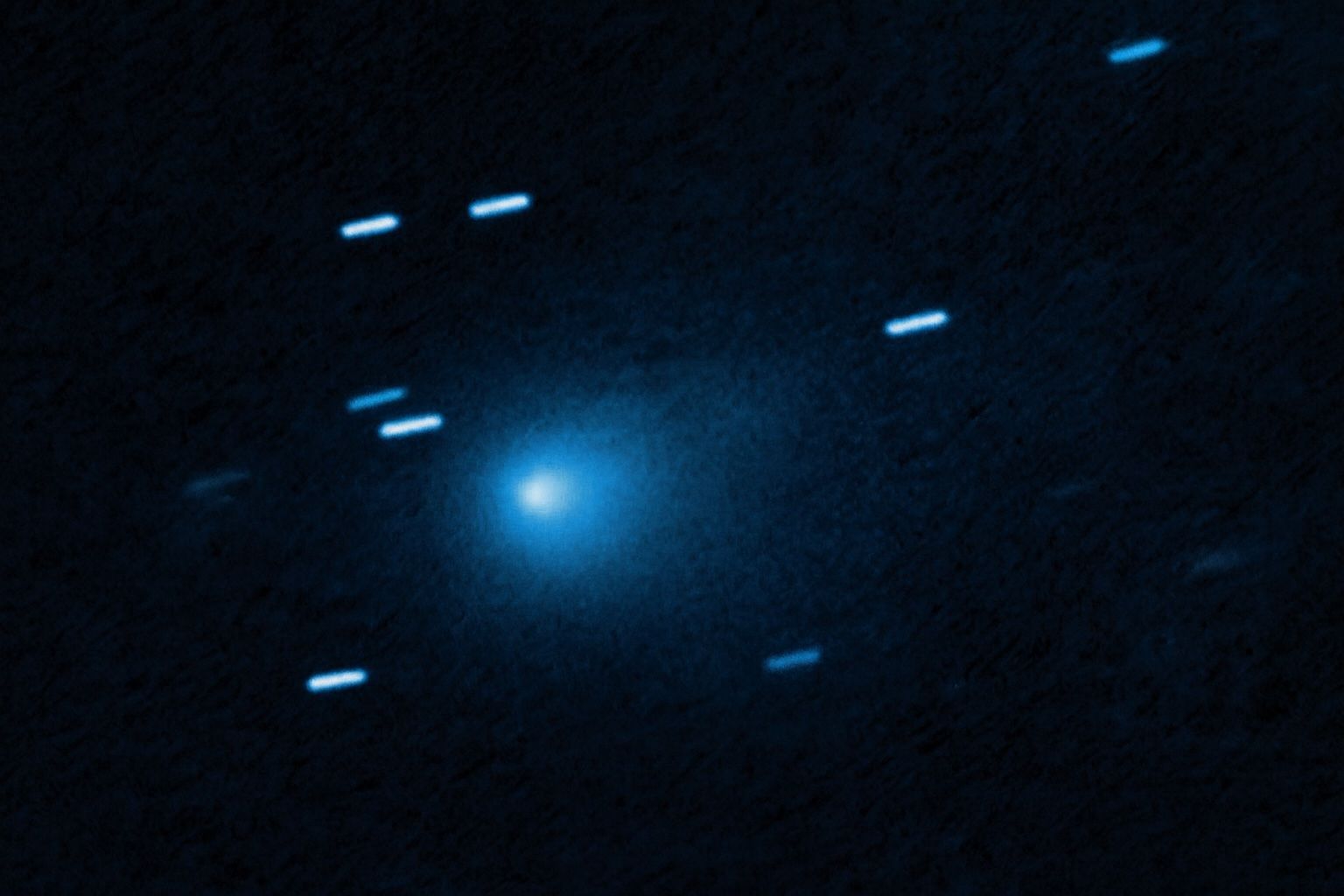

Updated: 6 November 2025 — A rapid, reader-friendly briefing on the third interstellar object ever found, tailored for Google News & Discover.
At a glance — what’s new on Nov 5–6
- China confirms a Mars‑orbit view: China’s Tianwen‑1 orbiter photographed 3I/ATLAS from ~30 million km during its early‑October pass by Mars; the images and a short animation were released today, Nov. 6.
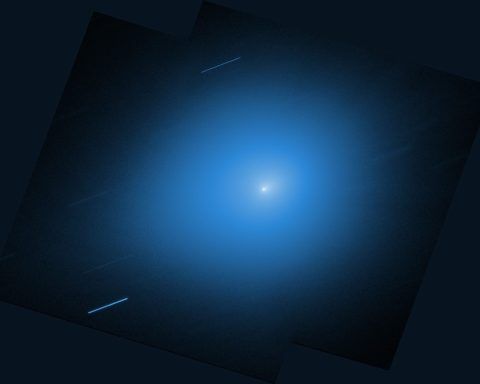
- Color shift & odd motion: Independent reports this week say the comet appears to have changed color again (toward blue) and is showing signs of non‑gravitational acceleration—behavior that researchers are still trying to explain.
- Back in Earth’s morning skies: After solar conjunction, 3I/ATLAS has reappeared for ground observers; Italy’s Virtual Telescope Project shared a fresh post‑perihelion image on Nov. 5.
- Data‑release pressure: U.S. media report renewed calls for NASA to publish Mars Reconnaissance Orbiter HiRISE images captured near the comet’s early‑October Mars flyby.
China’s Tianwen‑1 just gave us a rare Mars‑orbit look at 3I/ATLAS
China’s space agency says the Tianwen‑1 Mars orbiter used its high‑resolution camera to observe 3I/ATLAS during the object’s close pass by Mars (early October), when the spacecraft was ~30 million km from the comet—one of the nearest probe‑based looks so far. The agency released images and a brief 30‑second sequence showing the comet’s motion, adding that the observation also serves as a technical pathfinder for future small‑body missions.
China Daily’s summary notes the team had planned the observation since early September and confirms the pass occurred around Oct. 3. Today’s publication offers a new vantage point to compare with ESA’s Mars‑orbit snapshots from ExoMars TGO and Mars Express taken the same week.
The comet’s color keeps changing — and its path may not be purely gravitational
On Nov. 5, Live Science reported that 3I/ATLAS may have shifted to a bluish tint, following earlier red and green appearances. The color swings likely track changing gases in the coma (for example, cyanides and dicarbon can glow green; CO or ammonia can contribute to blue), but the transient nature of the hues—and the timing around perihelion—still puzzle scientists.
At the same time, IFLScience highlighted signs of non‑gravitational acceleration near perihelion. That’s not unheard of for comets—outgassing jets can nudge the nucleus—but teams say the effect here bears closer scrutiny given 3I/ATLAS’s interstellar origins and recent activity spike. For now, it’s an open investigation, not a verdict on the comet’s nature.
First post‑perihelion images from Earth: the observing season resumes
With the comet emerging from behind the Sun, the Virtual Telescope Project captured a new image on Nov. 5 marking the start of the post‑perihelion observing window. This will let professional and amateur astronomers track the comet’s brightness, color, and morphology (coma, jets, possible tail) from night to night.
Some commentary pieces circulating today argue that two post‑perihelion frames show no obvious tail, but those notes are informal and reflect early interpretations; tail appearance can depend on exposure depth, filter choice, and geometry. Expect professional teams to publish quantitative analyses as datasets accumulate.
What scientists know (and don’t) about 3I/ATLAS
- It’s interstellar and on a hyperbolic track. NASA classifies 3I/ATLAS as the third known interstellar object, following 1I/‘Oumuamua and 2I/Borisov, and confirms it poses no danger to Earth. Perihelion occurred around Oct. 30 (UTC date differences can show Oct. 29), at roughly 1.4 AU—just inside Mars’s orbit. Closest approach to Earth comes Dec. 19 at about 1.8 AU (~270 million km).
- It brightened more than expected at perihelion. Space‑based monitors saw a sharper‑than‑predicted surge in brightness, suggesting unusual outgassing or dust‑to‑gas behavior. Researchers are modeling the physics behind this “extra boost.” Space
- Its surface seems ancient and weathered. Last week’s reporting on JWST results described a radiation‑altered outer shell potentially 15–20 meters deep, implying billions of years of exposure in interstellar space—a reminder that what we see may be a processed crust rather than pristine core material.
How to see 3I/ATLAS this week
- When: Just before dawn on clear mornings through November, as the comet climbs into the eastern sky for Northern Hemisphere observers. Visibility should improve into December as the Earth‑comet geometry opens up.
- What you’ll need: A small to medium telescope under dark skies. Don’t expect a naked‑eye spectacle; look for a fuzzy “coma” and check nightly for subtle changes in brightness or color. (Astrophotographers: track with comet‑centric guiding to avoid star trails.) Live Science
- Where to get coordinates: Use reputable ephemerides (e.g., JPL Horizons in your planetarium app) and follow observatory blogs that post fresh pointing charts as new astrometry rolls in.
Why today’s updates matter
- Multiple vantage points: With China’s Tianwen‑1 imagery now public and ESA’s Mars orbiters already contributing, scientists can triangulate behavior from different lines of sight, improving models of outgassing jets and dust dynamics.
- Physics under the microscope: The bluish turn and non‑gravitational push are precisely the kinds of anomalies that interstellar visitors are expected to surface—either confirming comet basics in extreme regimes or revealing chemistry not common in our Oort Cloud. Early claims should be treated as hypotheses until peer‑reviewed.
- Public‑data debate: Pressure to release all spacecraft imagery (e.g., any MRO/HiRISE frames from the October Mars encounter) is rising, both to accelerate science and to tamp down speculation. NASA has emphasized that 3I/ATLAS poses no threat and that the object is being studied across multiple missions.
Key numbers (quick facts)
- Type: Interstellar comet (hyperbolic orbit) — the third such object observed.
- Perihelion: ~Oct. 30, 2025 at ~1.4 AU.
- Closest to Earth:Dec. 19, 2025 at ~1.8 AU (about 270 million km).
- Today’s headline update:Tianwen‑1 releases Mars‑orbit imagery; post‑perihelion ground imaging resumes; blue hue and odd acceleration under study.
The bottom line
3I/ATLAS is doing exactly what a once‑in‑a‑generation interstellar traveler should: surprising us. Today’s Mars‑orbit images from China add a valuable angle, while Earth‑based telescopes are back on the case after conjunction. The reported color shift and non‑gravitational acceleration are signals to investigate, not conclusions—expect deeper analyses and cross‑checks as more data arrive. In the meantime, early risers with a telescope can start chasing that faint, fast visitor in the pre‑dawn east.
Background & context used in this report also drew on ESA mission notes and recent perihelion coverage to frame today’s developments.
Related articles: Space Exploration