
November 28, 2025
A dramatic week for human spaceflight has left Russia’s Baikonur Cosmodrome with a damaged launch pad and the International Space Station (ISS) with three new crew members — including NASA astronaut Chris Williams — safely on board. While the Soyuz MS‑28 mission reached orbit and docked as planned, post‑launch inspections revealed serious damage to Baikonur’s Site 31, the only pad currently certified for Russia’s crewed Soyuz flights to the ISS.
On Friday, November 28, officials and analysts were balancing two realities: the crew is healthy and beginning an eight‑month mission, but the infrastructure that launched them may be unusable for future flights until major repairs are completed.
Key facts at a glance
- Mission: Soyuz MS‑28, crew transport to the ISS (Expedition 73/74).
- Launch: November 27, 2025, 4:27 a.m. EST (2:27 p.m. Baikonur time) from Site 31/6 at Baikonur Cosmodrome, Kazakhstan.
- Crew:
- Chris Williams (NASA, first spaceflight, physicist/medical physicist)
- Sergey Kud‑Sverchkov (Roscosmos, second spaceflight)
- Sergei Mikaev (Roscosmos, first spaceflight) AP News+1
- Docking: About 3 hours after launch, to the ISS Rassvet module; the station’s crew temporarily increased to 10 people.
- Planned mission duration: ~8 months, with return to Earth expected in late July 2026.
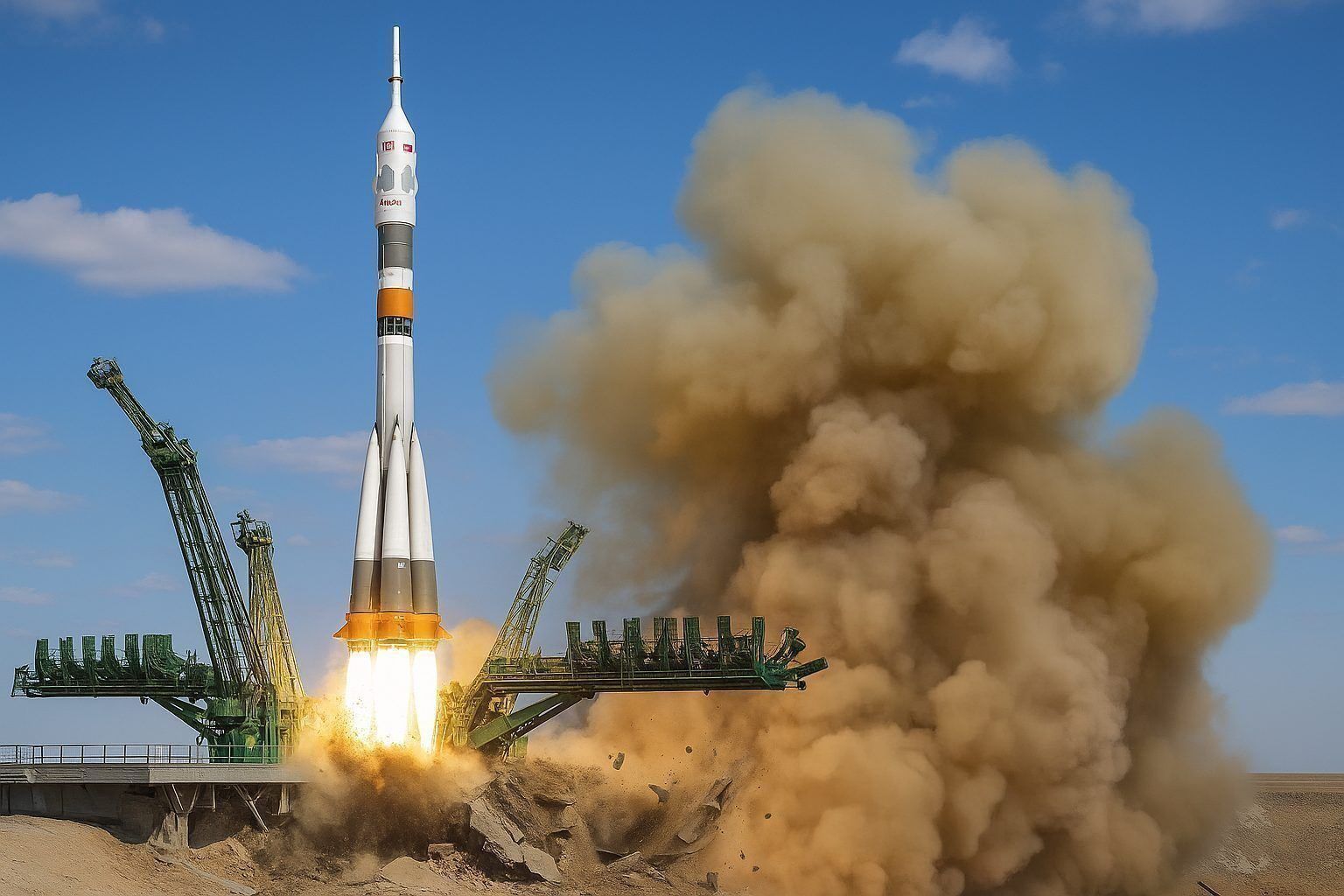
- Ground incident: Mobile service structure beneath the Site 31 launch pad appears to have collapsed into the flame trench, damaging key hardware used to prepare Soyuz and Progress missions.
Thanksgiving Day launch delivers new ISS crew
The Soyuz MS‑28 mission lifted off from Baikonur’s Site 31 on Thursday, November 27, at 4:27 a.m. Eastern (09:27 UTC), riding a Soyuz‑2.1a rocket into low Earth orbit.
On board were:
- Chris Williams, a NASA astronaut on his first spaceflight and a board‑certified medical physicist with a PhD in physics,
- Sergey Kud‑Sverchkov, a veteran cosmonaut returning to the ISS after a previous long‑duration mission, and
- Sergei Mikaev, a former military pilot making his space debut.
After a two‑orbit rendezvous profile, Soyuz MS‑28 docked with the station’s Rassvet module at 7:34 a.m. EST (12:34 UTC). NASA and Roscosmos confirmed that the docking was nominal and that the spacecraft’s systems performed as expected.
Once hatches opened, the trio joined the seven‑member Expedition 73 crew — NASA astronauts Mike Fincke, Zena Cardman, and Jonny Kim; JAXA astronaut Kimiya Yui; and Roscosmos cosmonauts Sergey Ryzhikov, Alexey Zubritsky, and Oleg Platonov — briefly bringing the ISS population to 10.
In a light‑hearted touch befitting a Thanksgiving Day arrival, Russian cosmonauts on the station had even baked a celebratory cake for the new arrivals, according to a TASS correspondent aboard the ISS.
Post‑launch inspection reveals serious damage at Baikonur
The successful launch initially appeared routine, but a closer look at Baikonur’s Site 31 told a more troubling story.
Russia’s space agency Roscosmos reported late on Thursday that a standard post‑launch inspection revealed damage to “a number of elements” of the launch complex. Officials stressed that such inspections are mandatory after each liftoff and said all necessary spare parts are on hand, with repairs expected “in the near future.” Reuters+3Reuters+3TASS+3
On Friday morning, additional reporting painted a clearer — and more serious — picture:
- The Kyiv Independent, citing Russian outlet Meduza, reported that a movable servicing cabin beneath the pad collapsed immediately after the rocket departed, damaging equipment critical to readying Soyuz and Progress vehicles.
- Open‑source imagery and discussion among spaceflight analysts indicate that the mobile service platform, sometimes described as a service tower or access platform, appears to have fallen into the flame trench.
According to these reports, the affected structure gives technicians access to the rocket and spacecraft during pre‑launch processing. Its destruction could delay both crewed and uncrewed Soyuz flights until repairs or a replacement structure can be installed.
Roscosmos, for its part, continues to downplay longer‑term risks, emphasizing that the launch itself was nominal and that the crew is safe on orbit while engineers assess the pad’s condition.
Why damage at Site 31 matters for Russia — and for the ISS
The incident is especially concerning because Site 31/6 is currently the only launch complex at Baikonur configured to support crewed Soyuz missions to the ISS.
- Baikonur, located in Kazakhstan and leased to Russia until at least 2050, has been the departure point for every Russian crewed spaceflight in recent years.
- The historic “Gagarin’s Start” at Site 1 — from which Yuri Gagarin launched in 1961 — has been out of service for upgrades and is widely expected to retire from crewed use. Wikipedia+2spacedaily.com+2
Spaceflight historians and analysts note that with Site 31 damaged and Site 1 inactive, Russia may temporarily lack any operational pad capable of sending crew to the ISS, at least until repairs are complete.
The Soyuz MS‑28 mission itself is safe: the spacecraft is in orbit and docked, and the crew will not need the Baikonur pad again until their planned return in July 2026, when they’ll land on the Kazakh steppe using the capsule’s own parachute and braking rockets.
However, the damage raises urgent questions about:
- Upcoming Progress cargo flights, including the planned Progress MS‑33 mission in late December, which was also slated to launch from Site 31.
- Future crew rotations, which rely on a steady cadence of Soyuz launches to ensure at least one NASA astronaut and one Russian cosmonaut are always aboard the station.
For now, Roscosmos insists that repairs will be “eliminated very soon,” but independent coverage from outlets such as Meduza and Militarnyi suggests the collapse of the service tower could take considerable time to fully address. The Kyiv Independent+2Militarnyi+2
Chris Williams’ first flight: science, health and station upgrades
While engineers on the ground grapple with hardware damage, Chris Williams is settling into his first weeks aboard the ISS — and into a packed research schedule.
Williams, 42, is a NASA astronaut with a background in both astrophysics and cancer treatment. He studied physics at Stanford, earned a PhD from MIT with research in radio cosmology, and later became a medical physicist at Harvard‑affiliated hospitals, where he helped pioneer MRI‑guided radiation therapy.
During Expedition 73/74, NASA says Williams will: NASA+1
- Help install and test a new modular workout system designed to support long‑duration missions by combining cycling, rowing, resistance training and rope‑climbing movements.
- Support experiments to improve cryogenic fuel management, critical for deep‑space missions that rely on super‑cold propellants.
- Assist in growing semiconductor crystals in microgravity, where the absence of convection can produce higher‑quality materials than are possible on Earth.
- Contribute to new re‑entry safety protocols, aimed at making crew returns to Earth safer for future vehicles.
Russian mission planners say the broader Expedition 74 program will feature more than 40 experiments and two spacewalks, including the installation of a Sun‑Terahertz instrument to help predict solar flares and maintenance work on the station’s Zarya module.
A rare US–Russia partnership still hanging on in orbit
The Soyuz MS‑28 flight is also a test of diplomacy. Despite Russia’s full‑scale invasion of Ukraine in 2022 and deep political rifts between Moscow and Western capitals, the ISS has remained one of the last major venues of formal US–Russia cooperation.
This mission carries added symbolic weight:
- Soyuz MS‑28 was originally expected to be the first flight after the end of NASA and Roscosmos’s barter “seat‑exchange” agreement, under which NASA astronauts flew on Soyuz and Russian cosmonauts rode aboard SpaceX’s Crew Dragon without direct cash payments. Wikipedia+2NASA Office of the Inspector General+2
- Negotiations ultimately extended joint seat assignments, allowing Williams to fly on Soyuz while a Russian cosmonaut continues to train for future missions on US‑built spacecraft.
Recent high‑level meetings between NASA and Roscosmos leaders in Florida underscored that, at least for now, both agencies still see the ISS as a shared project running through 2030, despite plans on both sides to build separate national or commercial stations.
The pad damage at Baikonur adds a new layer of risk to that cooperation. If repairs are slower than Moscow projects, NASA could face added pressure to guarantee continuous Russian access to orbit via US commercial vehicles — or confront new uncertainties about how long the current partnership can function smoothly.
What happens next?
As of November 28, 2025, here’s where things stand:
- The crew of Soyuz MS‑28 is safe, healthy, and beginning an eight‑month research mission aboard the ISS.
- Roscosmos engineers are inspecting Site 31, cataloguing damage and preparing a repair plan, while publicly insisting all needed spare parts are already available.
- Independent observers believe the collapse of the mobile service structure has, at least temporarily, removed Russia’s only operational crew‑rated launch pad, potentially affecting both crew and cargo flights.
- NASA and Roscosmos planners will now have to factor Baikonur repair timelines into their already complex rotation schedule for crews and cargo, alongside ongoing concerns about aging ISS hardware such as long‑running air leaks in the Russian Zvezda module.
Related articles: NASA