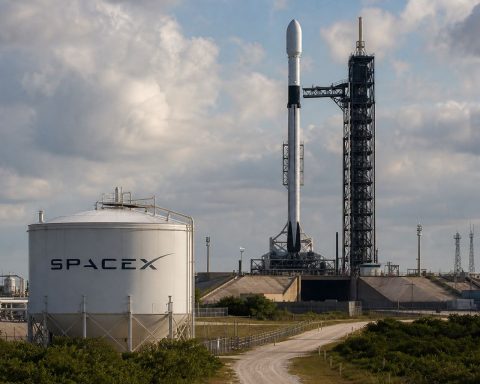

Blue Origin’s heavy‑lift New Glenn rocket is poised for its second orbital mission this afternoon, carrying NASA’s twin ESCAPADE spacecraft on a path toward Mars along with a Viasat communications demo. The launch window opens at 2:45 p.m. ET (19:45 UTC) from Launch Complex 36 at Cape Canaveral Space Force Station; Blue Origin’s official webcast begins ~45 minutes before liftoff.
Key facts at a glance
- Rocket / Mission: Blue Origin New Glenn (NG‑2) launching NASA’s ESCAPADE (two small Mars orbiters “Blue” and “Gold”) + a Viasat technology demo for NASA’s Communications Services Project. Blue Origin
- Launch time:Window opens 2:45 p.m. ET (19:45 UTC); live stream via Blue Origin.
- Window length:~88 minutes today.
- Weather:~65% “go” at the opening of the window, with cumulus and electric‑field rules the main concerns. mynews13.com+1
- Booster recovery: Drone‑ship landing attempt on Jacklyn downrange in the Atlantic.
How to watch the New Glenn ESCAPADE launch
- Official webcast: Blue Origin’s stream starts about 45 minutes before liftoff on the company’s website.
- Media simulcasts: Space.com is also carrying the live feed and coverage throughout the window.
- In person: The Kennedy Space Center Visitor Complex is selling Launch Transportation Tickets for The Gantry at LC‑39 (about 9.4 miles/15.1 km from LC‑36; check‑in from 12:45 p.m.) and offers viewing at Banana Creek and the Main Visitor Complex. (Gantry LTTs are $99 in addition to admission.
What’s launching: ESCAPADE, NASA’s twin Mars probes
ESCAPADE (Escape and Plasma Acceleration and Dynamics Explorers) is NASA’s first multi‑satellite mission to another planet, led by the University of California, Berkeley. The two identical small orbiters—“Blue” and “Gold”—will fly in formation around Mars to map its magnetic environment and upper atmosphere in 3D, key to understanding how the planet lost most of its air over time and to planning future crewed missions. Berkeley News
The spacecraft were built by Rocket Lab and integrated at its Long Beach facility, using the company’s deep‑space‑capable Explorer/Photon platform.
A novel route to Mars
Because of earlier delays, ESCAPADE will not follow a standard Hohmann transfer. Instead, the probes first head to an Earth‑Sun Lagrange region, loop for roughly a year, then slingshot by Earth to intercept Mars. Arrival is targeted for 2027.
Flight plan: what to expect from New Glenn’s NG‑2 mission
- Ascent & staging: After liftoff from LC‑36, New Glenn’s first stage separates; the upper stage ignites two BE‑3U engines to continue to orbit.
- Fairing & payload ops: After fairing jettison, ESCAPADE Blue and Gold deploy to begin their journey. Blue Origin plans to safe and inert the upper stage after mission completion in line with NASA orbital debris standards.
- Timeline: Spaceflight Now expects payload deployment ~T+33 minutes, with the Viasat demo activating shortly afterward.
- Booster landing: The first stage will attempt recovery on the autonomous landing platform “Jacklyn.” Blue Origin
Why today’s launch matters for Blue Origin
Today marks New Glenn’s second orbital mission after the rocket reached orbit on its debut in January. Blue Origin did not recover the booster on that first flight and has since implemented corrective actions ahead of NG‑2; today’s drone‑ship attempt is a high‑profile step toward routine reusability.
There’s also broader context: amid a federal government shutdown, NASA personnel participation at some pre‑launch forums has been limited, and the FAA has announced temporary restrictions on commercial rocket launches that will take effect after this mission. That makes today’s daytime liftoff window particularly notable.
Weather & viewing tips for the Space Coast
The 45th Weather Squadron calls conditions ~65% favorable at the opening of the window, easing later to around 55% with increasing thunderstorm risk—so earlier in the window is better if conditions allow.
- Best official viewing:The Gantry at LC‑39 (limited seats; check‑in from 12:45 p.m.), Banana Creek at the Apollo/Saturn V Center, and Main Visitor Complex viewing areas (with admission).
- Pro tip: Allow extra time for causeway traffic and security; check KSC’s official channels for last‑minute updates or scrub policies.
FAQ
What time is liftoff?
The window opens at 2:45 p.m. ET (19:45 UTC) and lasts about 88 minutes. The webcast begins roughly 45 minutes before the window opens.
What is ESCAPADE trying to find out?
How the solar wind interacts with Mars’ patchy magnetic fields and drives atmospheric escape—vital knowledge for understanding climate evolution and for future human explorers.
When will ESCAPADE reach Mars?
Using a staging loop near an Earth‑Sun Lagrange point, the spacecraft are aiming for 2027 arrival at Mars, followed by orbital trimming before the main science phase.
Who built the spacecraft?
Rocket Lab built and integrated the twin satellites for NASA and UC Berkeley.
The bottom line
If weather and systems cooperate, New Glenn’s NG‑2 will boost NASA’s ESCAPADE on the first leg of an innovative journey to Mars today. The mission blends a big‑rocket milestone for Blue Origin with low‑cost, dual‑orbiter planetary science designed to illuminate how Mars lost its atmosphere—and to help pave the way for safer human exploration of the Red Planet.
Sources: Blue Origin mission page; KSC Visitor Complex viewing details; Spaceflight Now live coverage; Space.com live stream notice; AP reporting on New Glenn’s first flight; Spectrum News 13 weather; FAA restrictions coverage.