London, July 13, 2026, 09:29 (BST)
European shares edged lower on Monday, but the broad move hid a much steeper repricing of fuel risk. The STOXX 600 was down 0.2% in early trade and travel and leisure fell 1.2%; Deutsche Lufthansa ETR:LHA lost 2.6%, Air France-KLM EPA:AF dropped 2.4% and Wizz Air LON:WIZZ slid just over 2%.
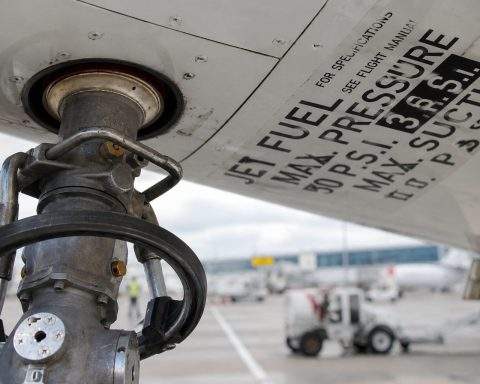
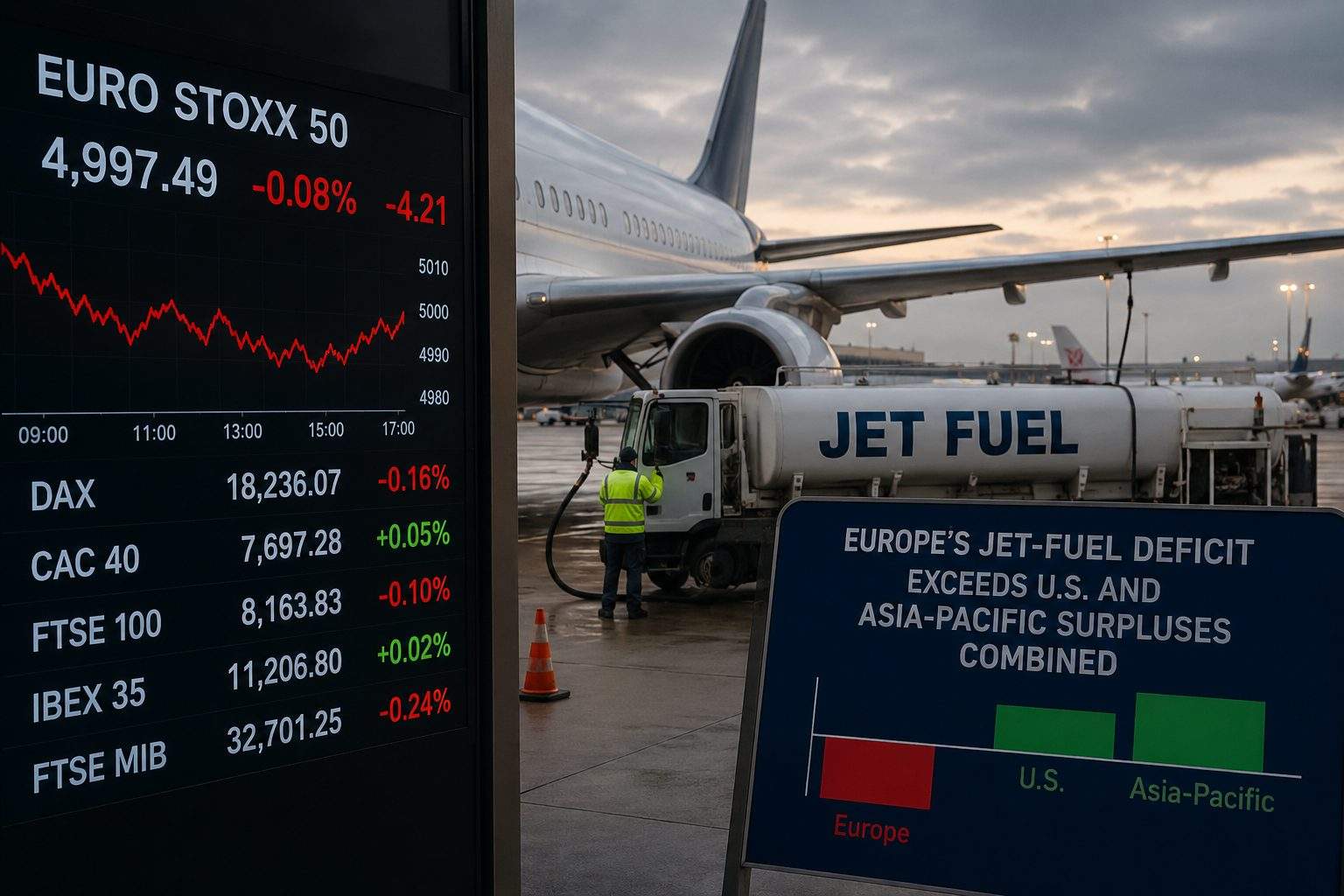
The news for investors is in physical jet fuel, not crude alone. Energy Aspects projects a third-quarter European deficit of nearly 600,000 barrels per day, or bpd, against surpluses of 116,000 bpd in the United States and 425,000 bpd in Asia-Pacific. Even if every spare barrel could be redirected, the published estimates still leave Europe short by about 59,000 bpd before accounting for the practical limits of moving cargoes between regions.
| Third-quarter jet-fuel balance | Estimated bpd |
|---|---|
| Europe | Nearly -600,000 |
| United States | +116,000 |
| Asia-Pacific | +425,000 |
| U.S. and Asia-Pacific combined | +541,000 |
| Residual European shortfall | About -59,000 |
Europe began June with 38 million barrels in stock, equivalent to less than 30 days of demand cover — the time inventories could meet consumption without fresh supply. Imports then reached 673,000 bpd in June, their highest since October 2025, yet the projected quarterly deficit is roughly 89% of that import pace. Fuel makes up 20% to 25% of airline operating costs. “We still do expect some tightness through August at this rate,” Rystad analyst Janiv Shah said. Northwest European jet fuel was around $133.27 a barrel, about 38% below its record March level. Reuters
Brent crude rose 4.3% to $79.31 a barrel as the United States and Iran traded attacks and Tehran claimed it had closed the Strait of Hormuz. U.S. officials said about 20 vessels had been escorted through the passage in the previous 24 hours, although ship-tracking services showed little traffic. The shock lifted the U.S. two-year Treasury yield to 4.2393%, while futures priced about 39 basis points — 0.39 percentage point — of Federal Reserve tightening by year-end. U.S. inflation data are due Tuesday and Fed Chair Kevin Warsh is set to testify to Congress this week.
The sector split was sharper than the index loss. STOXX 600 energy shares gained 1.6%, while technology fell 1.2%, a spread of 2.8 percentage points. Higher oil supports producers, but it raises costs for airlines and adds to the interest-rate pressure already bearing on richly valued technology stocks.
Hedging does not fully solve that problem. Lufthansa told investors that derivatives — financial contracts used to offset price changes — covered about 80% of its required kerosene volume for 2026. In the same report, the company separately listed the availability of fuel as a risk to its operations and finances. A hedge can soften a price rise; it cannot deliver fuel to an airport.
But the bearish airline trade could reverse quickly. The European Commission said alternative imports and higher production inside the bloc had partly replaced missing Middle Eastern volumes, with the International Energy Agency’s coordinated action adding supply. The 38% retreat in jet-fuel prices from March also shows how quickly the risk premium can shrink when shipping flows improve.
The next threshold is physical: sustained traffic through Hormuz before Europe reaches the late-summer stock draw. If flows remain thin, Monday’s airline losses could turn from a one-day oil trade into an earnings-downgrade cycle. If cargoes normalise, the remaining 59,000-bpd theoretical gap may be covered through extra refining, inventory releases and additional imports. The broad index’s modest decline is unlikely to signal that turn first.