LONDON, July 13, 2026, 09:29 (BST)
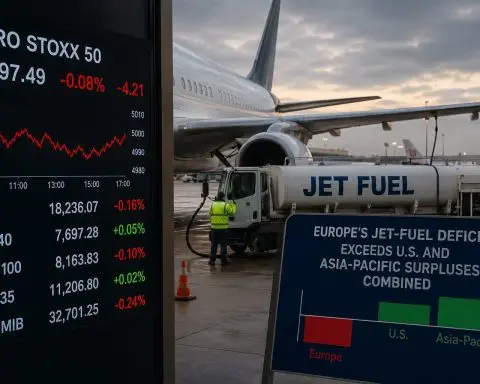
European airline shares fell on Monday as renewed U.S.-Iran strikes lifted crude, but the sharper investor signal sits in fuel inventories: Europe has less than 30 days of jet-fuel demand cover, the thinnest cushion among major markets. At the start of June it held 38 million barrels and faced a third-quarter deficit of nearly 600,000 barrels per day, or bpd, while the United States and Asia-Pacific were projected to run surpluses. “We still do expect some tightness through August at this rate,” Rystad analyst Janiv Shah said. Reuters
| Region | Estimated third-quarter jet-fuel balance | Latest inventory snapshot |
|---|---|---|
| Europe | About -600,000 bpd | 38 million barrels; less than 30 days’ demand |
| United States | +116,000 bpd | 99 million barrels |
| Asia-Pacific | +425,000 bpd | Not stated |
The gap turns a geopolitical oil move into a regional earnings problem. Fuel hedges—contracts that lock in future prices—can delay the hit rather than remove it. European airline chiefs warned in March that much of the sector’s protection would expire in the following months, leaving carriers more exposed during the summer travel season.
Brent crude was up 3.5% at $78.68 a barrel at 0743 GMT, and only six vessels crossed the Strait of Hormuz on Sunday, the fewest in five weeks. The supply recovery was incomplete even before the weekend: global output rose 4.1 million bpd in June after the interim U.S.-Iran agreement, yet remained 9.4 million bpd below pre-war levels.
By 0847 BST, Deutsche Lufthansa ETR:LHA was down 2.6%, Air France-KLM EPA:AF fell 2.4% and British Airways owner International Consolidated Airlines Group LON:IAG lost nearly 2%. Europe’s travel-and-leisure index dropped 1.2%, against a 0.2% decline in the broader STOXX 600.
Investors already have reference points for what another fuel squeeze could do. Disclosures compiled in May showed Lufthansa expected a €1.7 billion hit from fuel in 2026, Air France-KLM projected a $2.4 billion increase in its bill, and IAG warned annual profit would be lower than forecast. Fuel can account for as much as a quarter of an airline’s operating expenses.
The oil move also tightened the financial conditions around those costs. Two-year U.S. Treasury yields rose to 4.2393%, their highest since early 2025, while futures priced 39 basis points—0.39 percentage point—of Federal Reserve tightening by year-end. Nasdaq futures fell 1.3%, more than twice the S&P 500 futures decline of 0.6%. Tuesday’s U.S. consumer-price report and Fed Chair Kevin Warsh’s congressional debut will test whether that repricing sticks.
South Korea showed how a macro shock can collide with leveraged positioning. SK Hynix KRX:000660 fell a record 15.4%, while Samsung Electronics KRX:005930 helped drag the KOSPI down 9% and trigger a 20-minute trading halt; a fund designed to deliver twice SK Hynix’s daily move lost more than a third. U.S. American depositary receipts, or ADRs—claims on foreign shares traded in America—still stood at a 37% premium to the Korean stock. Morningstar NASDAQ:MORN director Lorraine Tan said AI monetisation “remains uncertain.” Reuters
In Europe, the cross-sector split was cleaner than the headline index: energy stocks gained 1.6% while technology fell 1.2% and the STOXX 600 slipped 0.3%. That pattern suggests investors were pricing a transfer of margin from fuel users to producers, rather than a broad demand collapse—at least at the open.
But the trade cuts both ways. If tanker traffic resumes under a renewed deal, the oil premium could drain quickly; if attacks spread to neighbouring Gulf infrastructure, ING AMS:INGA analysts said the market risked a return to conditions seen early in the war. The first path would make part of Monday’s airline selloff look overdone. The second could turn Europe’s thin inventory buffer into a capacity problem.
For airline investors, the cleanest near-term signal may be ship count, not the next dollar move in Brent. Of Sunday’s six crossings, two loaded tankers carried 2.5 million barrels combined; no visible liquefied-natural-gas tanker entered, and most tankers disabled their automatic tracking signals. A sustained rise in traffic would ease the squeeze, while another weak count would keep pressure on earnings estimates into August.