WARSAW, July 25, 2026, 12:00 (CEST)
- Brent closed at $96.78 on Friday, slipping almost 4% following news of China-led peace initiatives, but finished the week up nearly 10%
- The main U.S. refining margin reached a record peak, climbing above $70 per barrel, while top independent refiners are currently trading higher than consensus price targets, according to
- Looking ahead: The Federal Reserve announces its decision and EIA data is due Wednesday, with earnings from the second-biggest U.S. refiner on Thursday and both major supermajors reporting Friday
Oil prices slipped on Friday following a turbulent week, with Brent crude dropping close to 4% to finish at $96.78 per barrel. This move came after Reuters reported, referencing three sources, that Pakistan seeks to mediate renewed U.S.–Iran negotiations supported by China. U.S. West Texas Intermediate fell 3% to $89.31. Despite Friday’s declines, WTI advanced around 8% over the week, while Brent surged nearly 10%. Markets remain shut for the weekend.
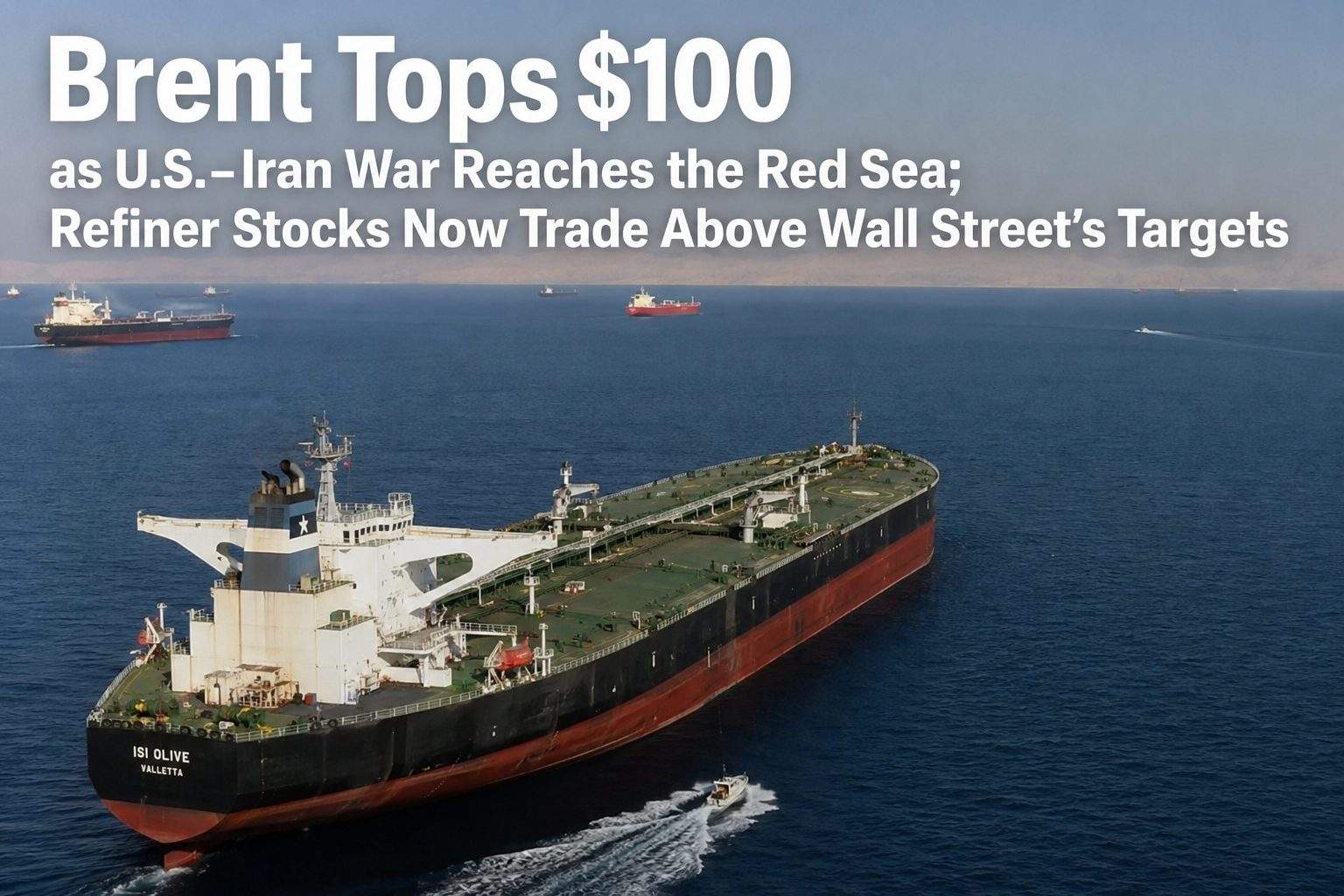
The retreat came after a surge, with Brent climbing past $100 on Thursday before retreating. WTI gained 6.2% to settle at $92.19, marking its highest closing level since June 4, following claims by Tehran-backed Houthi rebels that they had attacked two Saudi oil tankers in the Red Sea. The Houthis also announced a maritime blockade against Saudi Arabia.
The surge is now affecting rates. Jim Reid, Deutsche Bank ETR:DBK head of macro research, noted that inflation has returned as a main concern for markets, as the U.S.–Iran strikes continue with “no sign of easing”. The 10-year Treasury yield rose as high as 4.7% early Thursday, reaching its highest level since January 2025. The Nasdaq recorded its steepest loss in over a month. Gold futures climbed above $4,100, a two-week high. NBC News + 3
For equity investors, the clearer market signal is found further along the supply chain. The 3-2-1 crack spread—the industry benchmark measuring the profit from converting three barrels of crude into two barrels of gasoline and one of diesel—has surged to a record high above $70 per barrel, Bloomberg data show. It is refiners, rather than drillers, who are benefiting from the current war premium.
This week in overview
| Measure | Latest | Direction |
|---|---|---|
| Brent crude | $96.78 (Fri close) | up about 10% for the week |
| WTI crude | $89.31 (Fri close) | gained roughly 8% this week |
| NYMEX 3-2-1 crack | new record, over $70/bbl | almost three times January’s value |
| U.S. avg. gasoline | $4.06/gallon | up 17 cents from a month ago |
| 10-yr Treasury yield | 4.7% (Thu) | marks highest level since Jan 2025 |
The conflict continues to expand. It started with combined U.S.–Israeli airstrikes on Feb. 28. U.S. forces have now targeted Iranian command centers, marine assets, and drone sites for at least 11 nights in a row, Central Command reports. President Donald Trump stated Iran would face consequences for the deaths of three U.S. troops, while Tehran attacked a Kuwaiti power and desalination facility twice over two days and a Malta-flagged vessel, the Kavomaleas, was abandoned by its crew following a strike near Oman.
On Thursday, the threat of escalation increased. Trump told Axios that he was considering a response more severe than any action taken in the conflict so far, adding that he was nearing a decision. By Friday, a shift emerged: a Pakistani official informed Reuters that Beijing is pushing for renewed talks, citing how Iran’s strikes against Gulf nations and the closure of the Strait of Hormuz are impacting Chinese interests. CNBC
Supply calculations account for the narrowing margins. The strait typically handles about 20% of global seaborne oil shipments, but crossings dropped to just eight on July 17, marking the lowest in three weeks. Around 2.1 million barrels per day out of the 3 million barrels per day of disrupted refining capacity are still shut, while Russian refined product shipments have continued to decline as Ukrainian attacks persist. Diesel is under the most pressure, with its crack breaching $91 a barrel this month.
The energy sector ranking has shifted significantly. Shares of Marathon Petroleum NYSE:MPC and Valero Energy NYSE:VLO have nearly doubled in 2026, while Phillips 66 NYSE:PSX has advanced 66%, with roughly one-third of those gains recorded in the past month. The VanEck Oil Refiners ETF (NYSEARCA:CRAK) has risen 18.3% in July, poised for its strongest monthly performance since November 2020. Energy now leads all sectors this year with a 29% advance, surpassing technology. The S&P 500’s total return is about 11%.
The data reveals a surprise: the rally has outpaced analyst expectations. Marathon is trading around $315, while the average price target is $255—roughly 19% lower than its current level. Analysts are increasing their targets to keep up. On July 13, Raymond James NYSE:RJF lifted its target to a Street-high $335, followed by Citigroup NYSE:C, which raised its target to $303 a day after. Goldman Sachs NYSE:GS moved Valero’s target to $357 from $286 this week. Marathon recently reported a 787% rise in quarterly adjusted earnings per share.
Refiners in contrast with the Street
| Company | 2026 share move | Latest Street signal |
|---|---|---|
| Marathon Petroleum | shares almost doubled | trading near $315, consensus at $255; new targets lifted to $335, $303 |
| Valero Energy | shares have nearly doubled, at highs on record | Goldman sees target up at $357 from $286 |
| Phillips 66 | gained 66% | about a third of that rise in just a month |
| S&P 500 | up around 11% | energy leads 2026 sectors, up 29% |
Margins remain supported by underlying physical factors. U.S. gasoline inventories dropped to 210.5 million barrels, marking the lowest seasonal level since 2012, as refineries operated at 96.2% capacity. Last week, preliminary API industry data indicated increases in crude and distillate supplies, but a decline in gasoline stocks. Diesel prices at the pump are about $5.11 per gallon. Valero’s board maintained its quarterly dividend at $1.20.
Certain strategists believe investors are still underestimating how gradual the return to normal conditions will be. UBS SWX:UBSG Global Wealth Management strategist Giovanni Staunovo stated on Thursday that Middle East production is likely to rebound “slower than the market anticipates” due to persistently low incoming vessel flows, which keeps market conditions tight. The bank maintains its year-end Brent forecast at $85. Should crude prices fall while fuel prices remain steady, refining margins would likely expand rather than contract. CNBC + 2
Diplomacy remains active. U.S. Secretary of State Marco Rubio stated Washington continues to indicate openness to talks, as Iranian spokesman Esmaeil Baghaei commented, “Diplomacy is a tool through which we pursue our national interests, just like war.” Yahoo Finance
This week brings several key events. The Federal Reserve announces its decision Wednesday, followed by second-quarter GDP and PCE inflation readings on Thursday. The EIA will release petroleum data Wednesday. Valero is set to report results before Thursday’s market open, while reports from Exxon Mobil NYSE:XOM and Chevron NYSE:CVX will wrap up the week on Friday. Jobless claims remain at 187,000, near a six-decade low, indicating continued demand.
Risks are balanced on both sides. Advancing China-led negotiations could reduce the war premium built into oil prices, and, after some delay, impact refining margins; UBS’s $85 Brent forecast suggests considerable downside from Friday’s close. Refiner stocks, trading above most analyst estimates, offer little in the way of valuation buffer as gasoline over $4 challenges demand. A larger attack on Iran could push up feedstock prices quicker than fuel sales, pressuring the margins fueling current market activity. CNBC