NEW YORK, July 28, 2026, 13:04 EDT — U.S. equities start regular trading.
- Byrna dropped 3.9% to $3.97, following a 16.7% jump on Monday.
- As of June 30, BlackRock held 383,826 Byrna shares, representing a 68.9% decrease from its last reported holding.
- Four company insiders have recently reported buying a combined 74,900 shares, which represents close to one-eleventh of the shares that BlackRock reduced from its position.
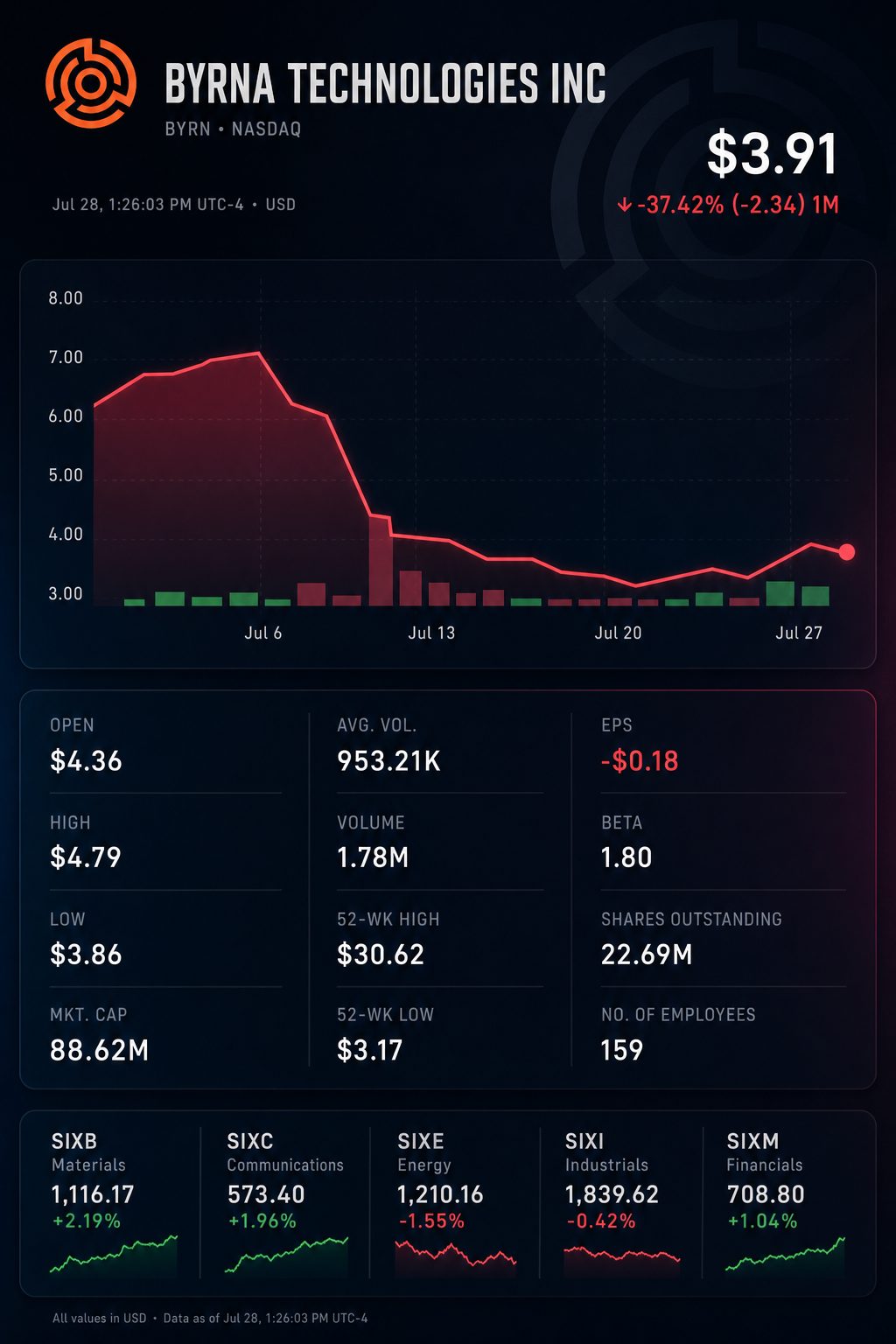
Shares of Byrna Technologies Inc. NASDAQ:BYRN dropped 3.9% to $3.97 on Tuesday afternoon, after gaining 16.7% in the prior session.
The shift happened alongside an updated ownership filing. BlackRock Inc. NYSE:BLK revealed a stake of 383,826 Byrna shares, representing 1.7%, as of June 30.
BlackRock had earlier reported holding 1.233 million shares, representing 5.4%. The change was 849,576 shares, or 68.9%.
The timing introduces a key detail. Byrna was deleted from the Russell 3000 by FTSE Russell following the close on June 26.
The overlap suggests that passive index rebalancing could partly explain BlackRock’s reduction. This remains an inference. BlackRock’s filing provided no reason.
Insiders provided a less prominent counter-signal. Four separate filings disclosed purchases totaling around 74,900 shares across July 22 and July 23.
The transactions amounted to approximately $260,000 at a weighted average price of about $3.48. This sum covers shares bought via an account reported by director Herbert Hughes.
| Ownership signal | Reported shares | Quantified comparison |
|---|---|---|
| BlackRock position shift between reported dates | -849,576 | Decreased by 68.9% between Oct. 24, 2024, and June 30, 2026 |
| Four insider buys | About +74,900 | Estimated $260,000 at an average of $3.48 |
| Relative magnitude | — | BlackRock decrease was 11.3 times greater |
The comparison uses different transaction periods. BlackRock disclosed positions on two separate dates, whereas the insider forms listed individual purchases.
Byrna ended Monday’s session at $4.13 as 1.55 million shares changed hands. The stock advanced 59 cents, up 16.7%.
The day’s trading range remained broad on Tuesday, as shares moved between $3.86 and $4.77. Volume hit 1.75 million by 12:42 p.m. EDT.
Byrna’s public float totals roughly 17.76 million shares. As of July 15, short interest stood at 2.1 million shares, equal to 11.85% of the float. This setup can intensify price surges and pullbacks.
The underlying environment continues to be unfavourable. Fiscal second-quarter revenue declined to $16.4 million, compared to $28.5 million in the same period last year.
Byrna posted a net loss of $10.1 million, with results reflecting a $5.9 million write-down of inventory and a $3.5 million impairment on equipment.
Gross margin fell to 11%. Excluding designated one-off charges, Byrna’s adjusted gross margin stayed close to 62%.
The data highlights demand and stock turnover as key elements of the investment rationale. CEO Conn Davis stated that “fiscal 2026 will not be a revenue-growth year” and described the quarter as having “reset the revenue baseline.” Byrna Technologies Inc.
As of May 31, inventory totaled $30.4 million, representing 1.9 times the amount of quarterly revenue and close to three times the combined value of cash and marketable securities.
Byrna’s $20 million credit facility had no outstanding borrowings at the end of the quarter. The company also met all requirements under its lending covenants.
Early company figures pointed to a possible bright spot. Around 30% of those in a try-before-you-buy test made purchases, and users of the product-finder tool converted at about double the average site rate.
Risks are still significant. Demand might remain weak, excess inventory could need further markdowns, and high short interest has the potential to increase volatility in the stock price.
Byrna was trading at $3.97, representing an increase of around 14% compared to insiders’ average acquisition price. Despite this, the stock was still down approximately 76% in 2026. Insiders have shown confidence, but soft sales and significant changes in ownership reduce the impact.