Intel Shares Fall Further as Investors Scrutinise AI Revenue Growth

Intel Shares Fall Further as Investors Scrutinise AI Revenue Growth

NEW YORK, July 29, 2026, 04:29 EDT

  • Intel shares were seen down 1.6% at $84.96 ahead of Wednesday’s regular market open.
  • Server prices climbed by 48% in the second quarter, as shipment volumes grew 9%.
  • FactSet’s EPS projection for 2026 increased to $1.48 from $1.08 over the past month.

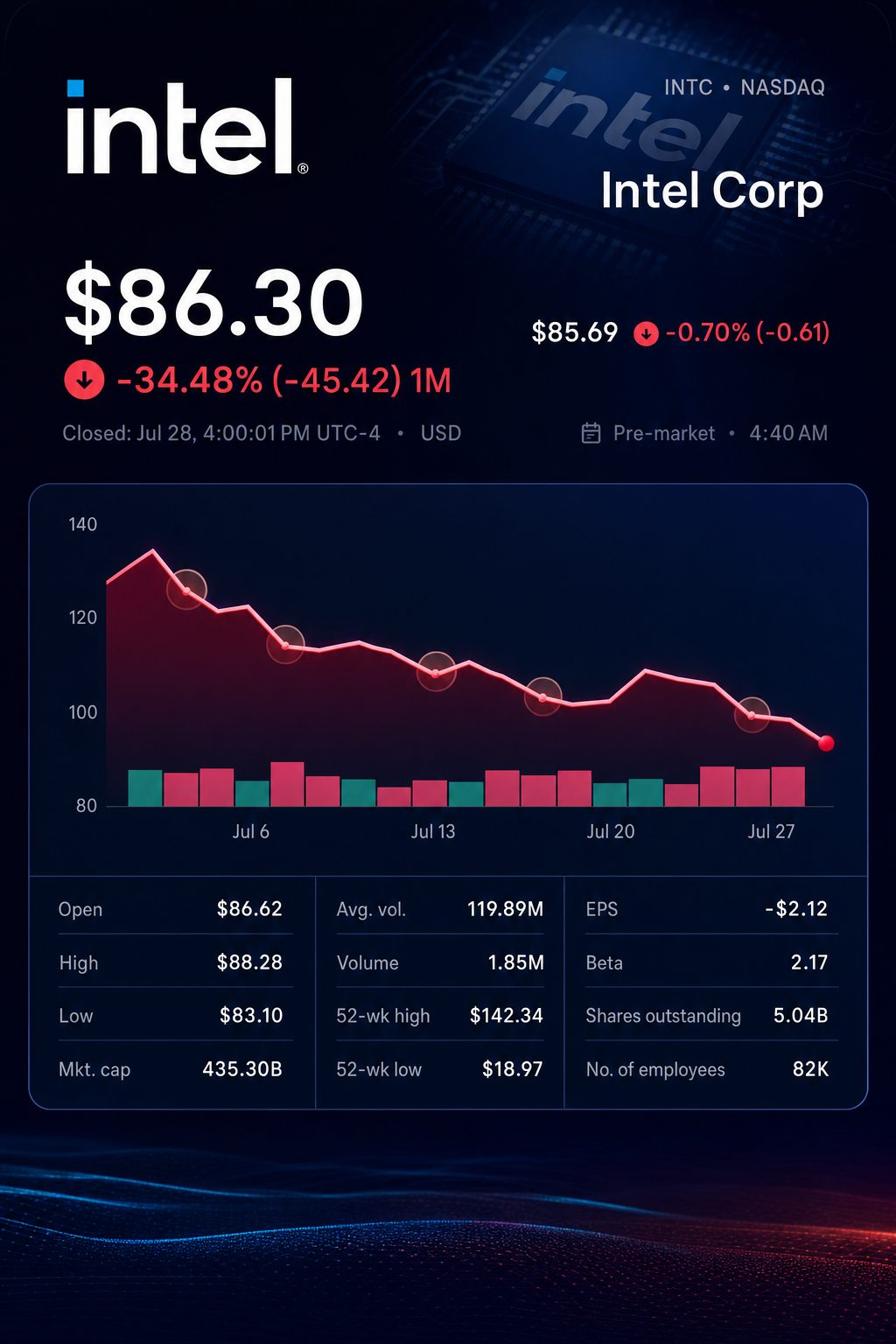
Intel Corporation slipped 1.6% to $84.96 in premarket trade early Wednesday. Shares declined 5.9% on Tuesday, finishing the session at $86.30.

The stock traded around 15% lower than its Thursday close, even after last week’s earnings surpassed forecasts. This decline highlights a debate over growth quality rather than a shift in estimates.
Stock chart for NASDAQ:INTC

FactSet figures indicate consensus EPS for 2026 climbed 37% in the past month, while the forecast for 2027 went up 28% during the same timeframe.

With Intel priced at $84.96, an initial estimate puts the company’s valuation at close to 42 times expected 2027 earnings. The stock’s decline has reduced this multiple, though execution risk remains.

Intel’s filing highlights the reason for doubt. Growth in the second quarter was largely driven by higher prices and changes in product mix.

Server average selling prices climbed 48% as unit volume went up 9%. Client prices increased 27%, despite an 8% dip in volume.

Intel’s Q2 investor testReported resultInvestor read-through
Total revenue$16.1 billion, up 25%Marked recovery in sales growth
Data Center and AI revenue$6.3 billion, up 59%Faster expansion in data-center segment
Server prices / volume+48% / +9%Increase driven mainly by pricing
Client prices / volume+27% / -8%Higher pricing made up for volume decline
External foundry revenue$293 million; about 5%Business with external clients stays small
Foundry operating loss$2.1 billion; 36% margin lossDeficit narrows, though still substantial

Initial estimate uses $293 million in external revenue and $5.765 billion in overall foundry revenue.

The majority of the external foundry growth resulted from Altera’s shift to an external customer. This constrains indications of wider customer uptake.

Investors now face two distinct challenges. Intel needs to maintain CPU prices and secure additional third-party foundry contracts.

Chief Executive Lip-Bu Tan noted that AI is fueling “unprecedented demand for compute.” Intel reported a 59% surge in data-center and AI revenue, reaching $6.3 billion. Intel Corporation

Intel lifted its capital spending outlook for 2026 to $20 billion, up from $18 billion. Melius Research noted that the higher guidance signals “confidence in cash flow upside and demand visibility.” Reuters

The timing is challenging. On Tuesday, the PHLX Semiconductor Index dropped 4.5%. It is currently around 25% lower than its record high set on June 22.

Investors are raising doubts about the payoff from significant AI data-center investments. The issue impacted Asian chip stocks on Wednesday.

SK hynix Inc. posted operating profit that climbed over six times, but the outcome fell short of analyst forecasts, further weighing on sector stocks.

Investors await major tech company results and the Federal Reserve’s rate decision, both due later Wednesday. The outcomes will gauge opinions on artificial intelligence investment and borrowing expenses.

Intel forecast third-quarter revenue between $15.8 billion and $16.8 billion, with the midpoint nearly matching Q2’s figure of $16.1 billion. The company set its adjusted EPS outlook at $0.38.

Risks persist in both directions. Reduced supply pressures might boost unit volumes but could dampen premium pricing. On the other hand, ongoing shortages may limit shipments, and foundry losses continue to tie up capital.

Wednesday’s test is simple. Intel must show higher unit sales to support its updated earnings outlook. Relying solely on pricing may fall short.

What caused Intel’s share price to decline despite reporting strong quarterly results?

Intel ended Tuesday at $86.30, falling 5.86% with 154.35 million shares traded. The PHLX Semiconductor Index dropped 4.5%, indicating widespread sector weakness. Investors are raising doubts about whether significant spending on AI infrastructure will support sustained chip growth. Intel remains roughly 39% lower than its June peak of $142.35. The decline signals concerns over sector risk and valuation, rather than a drop in reported demand. Investing.com

How significant was Intel’s outperformance in second-quarter earnings?

Revenue totaled $16.13 billion, up 25.4%, exceeding guidance by $1.8 billion. Adjusted EPS came in at $0.42, compared to guidance of $0.20 and a consensus near $0.21. Adjusted gross margin hit 41.8%, surpassing guidance by around 280 basis points. GAAP operating income stood at $1.80 billion, reversing a $3.18 billion loss from the prior year. Outperformance was broad-based. Intel Corporation

What led Intel to announce a GAAP net loss of $11.0 billion?

A $12.53 billion mark-to-market charge accounted for the bulk of the loss. This charge is linked to escrowed shares as part of Intel’s agreement with the U.S. government and is non-cash. On a non-GAAP basis, quarterly net income totaled $2.2 billion. However, analysts say investors should still consider its impact. At the end of the quarter, 143 million escrowed shares had yet to be released, each subject to various conditions. The corresponding derivative liability stood at $15.6 billion, which may contribute to accounting swings in future quarters. Intel Corporation

Is the outlook for the third quarter backing expectations for continued strong performance?

Intel forecast revenue in the range of $15.8 billion to $16.8 billion, with a midpoint of $16.3 billion. That figure represents an increase of roughly 19% from the third quarter of the previous year. The company projected adjusted earnings per share at $0.38, compared to a consensus of $0.27 prior to the report. Adjusted gross margin is expected at 42.0%, a slight improvement from the 41.8% posted in Q2. Nonetheless, the forecasted EPS is around 10% lower than Q2’s $0.42. The ramp-up in server supply remains concentrated toward the end of Q3 and into Q4. Intel Corporation

Is Intel currently seeing substantial gains from the AI surge?

Management reported that AI-related businesses generated approximately 70% of revenue for the quarter and expanded over 70% compared to a year ago. DCAI revenue jumped 59% to reach $6.26 billion, surpassing forecasts. DCAI’s operating profit totaled $2.47 billion, resulting in a 39.5% margin for the segment. Revenue from purpose-built silicon was almost three times higher than the prior year. At present, supply remains the chief limitation. Intel Download Center

Is Intel’s PC segment seeing real gains, or are results mainly due to pricing factors?

CCPG revenue increased 13% to $8.88 billion, delivering an operating profit of $2.34 billion. The segment achieved an operating margin near 26%. AI PC revenue rose 26% quarter-over-quarter, accounting for two-thirds of client revenue. Intel anticipates PC consumption in 2026 will decline in the low double digits. Higher memory costs and constraints on components pose significant risks in the second half. Client unit volumes dropped, but average selling prices climbed due to a stronger product mix. Intel Corporation

Is Intel Foundry now demonstrating real signs of a credible recovery?

Foundry revenue climbed 31% to $5.77 billion in the second quarter. Operating loss was reduced to $2.09 billion from $3.17 billion. External foundry sales reached just $293 million, accounting for about 5% of the segment’s revenue. The bulk of foundry revenue continues to be generated by Intel’s internal product businesses. Intel aims for 14A risk production in late 2027 and expects volume ramps in 2028. Customer engagement is on the rise, though large-scale external demand has yet to be demonstrated. Intel Corporation

Can Intel support increased capital expenditures without issuing additional stock?

Intel lifted its 2026 capital expenditure forecast to more than $20 billion and projects a notable increase for 2027. At the end of June, the company reported $29.73 billion in cash and short-term investments. Total debt stood at $50.54 billion compared to $46.59 billion in December. Operating cash flow for the first half totaled $8.10 billion, up from $2.86 billion a year earlier. Intel maintains a $10 billion credit facility. No equity offering is currently authorized, though management has not dismissed the possibility.

Does Intel remain highly valued despite the recent significant decline?

Intel ended Tuesday with a market capitalization near $435 billion. Due to negative trailing earnings, the GAAP price-to-earnings ratio does not have meaning. Using the Q3 revenue midpoint of $16.3 billion on an annualized basis translates to about 6.7 times sales. Annualized adjusted EPS of $0.38 equates to around 57 times earnings. These run-rate figures are not comprehensive Wall Street forecasts. The current valuation assumes significant growth ahead and considerable improvement in the foundry business. MarketWatch

What factors might impact Intel stock over the next week?

Microsoft and Meta are set to report on Wednesday, with Amazon following on Thursday. The AI investment outlooks from these companies will challenge Intel’s expectations for server demand. The Federal Reserve will announce its policy decision on Wednesday at 2 p.m. Eastern. Guidance on rates remains important as Intel continues to trade at an elevated earnings run-rate. Keep an eye on the PHLX Semiconductor Index after its 4.5% drop on Tuesday. With Intel having reported results last week, broader semiconductor sector movements take precedence. Microsoft

Mateusz Kaczmarek is a financial and technology journalist at TS2.tech, covering stocks, artificial intelligence, semiconductors and global market developments. A graduate of the Poznań University of Economics and Business, he previously worked in financial analysis before moving into business journalism. His reporting focuses on technology companies, market trends and the forces shaping global investment markets. Follow Mateusz Kaczmarek on Google News.

Google Preferred Source

Stock Market Today

  • S&P 500, Nasdaq futures edge up before Fed policy decision
    July 29, 2026, 6:40 AM EDT. S&P 500 and Nasdaq futures rose modestly on Wednesday with investors focused on the upcoming Federal Reserve monetary policy decision while persistent Middle East tensions weighed. At the same time, chip stocks lagged as markets looked ahead to Big Tech earnings later this week.
SK hynix faces record earnings hurdle after ₩190 trillion value loss
Previous Story

SK Hynix (KRX:000660) Quarterly Results Disappoint, Sparking KOSPI Drop as Traders Deleverage

Nvidia (NASDAQ:NVDA) Slips 5% in Premarket Trade, Wiping Out $250 Billion in Value — Parallels with OpenAI Backstop
Next Story

Nvidia (NASDAQ:NVDA) shares fall following projected $238 billion loss amid scrutiny of AI investment