Transocean (NYSE:RIG) Shares Rise as Merger Spread Reaches 2.4%
30 July 2026
2 mins read

Transocean (NYSE:RIG) Shares Rise as Merger Spread Reaches 2.4%

NEW YORK, July 30, 2026, 15:05 EDT

  • Trading hours on the NYSE continued as normal. Transocean shares rose 2.2% to $5.06, according to delayed data.
  • Valaris Ltd. was assigned a fixed ratio value of $77.09, above its current market price of $75.28.
  • Preliminary: A closing scenario on September 29 results in a simple annualized gross spread of 14.4%.

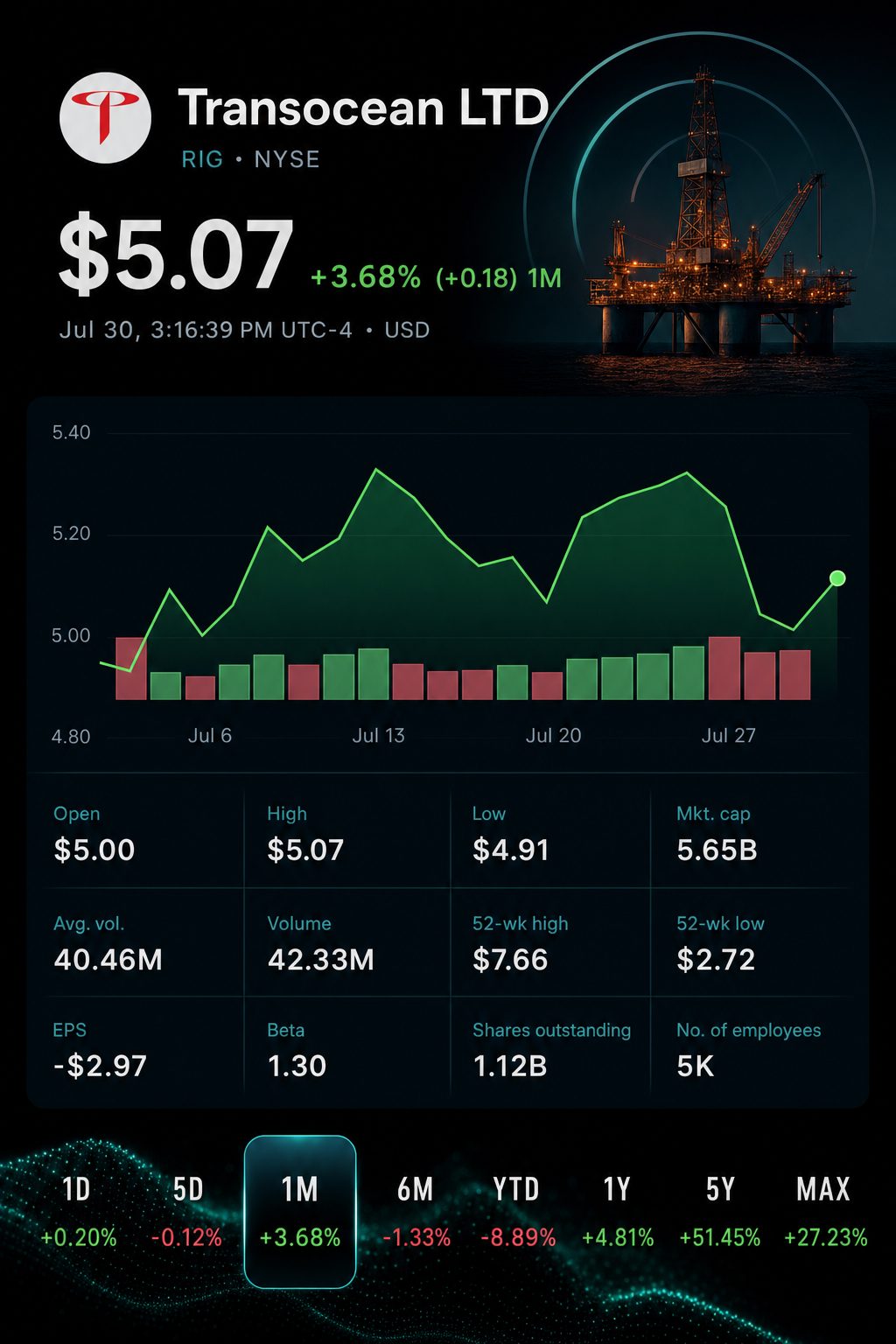
Shares of Transocean Ltd. advanced 2.2% to $5.06 as of 2:49 p.m. EDT, increasing the merger spread with Valaris to 2.4%.
Stock chart for NYSE:RIG

Shares of Valaris Ltd. rose 1.5%, closing at $75.28. The fixed exchange ratio valued each Valaris share at $77.09.

The gap serves as the most evident short-term signal for investors. It connects the timing of regulations with changes in Transocean’s daily share price.

Deal-spread measureWednesday closeThursday, 14:49 EDTChange
Transocean share price$4.95$5.06+2.2%
Valaris share price$74.18$75.28+1.5%
Implied Valaris consideration$75.41$77.09+2.2%
Total merger spread1.66%2.40%+0.74 percentage point

Pricing information is not live. Implied valuations are based on the set exchange ratio of 15.235 shares.

Every Valaris share will be exchanged for 15.235 Transocean shares. A merger arbitrage strategy would involve shorting 15.235 shares of RIG for each VAL share held. If the transaction goes through as planned, the RIG shares received can be used to settle the short position.

Valaris investors without hedges will see their final payout fluctuate along with the value of Transocean shares.

The Committee on Foreign Investment approved the transaction on June 29. The Department of Justice made a second request for information on May 4.

The parties agreed not to certify compliance prior to July 31. Unless there is early termination, the closing cannot take place until 60 days have passed after both firms have certified.

Preliminary: Certification on the same day indicates a target around September 29. The companies continue to anticipate finalizing the deal in the second half of 2026.

Sample closing scenarioDays since July 30Total spreadAnnualized simple spread
September 29 regulatory scenario612.40%14.4%
December 31 fiscal year case1542.40%5.7%

These initial estimates are independent of company forecasts. They are based on stable prices, existing terms, and presume the deal concludes as intended. Stock-borrow costs, fees, taxes, dividends, and trading costs are not included.

This schedules earnings within the expected regulatory window. Transocean is set to announce second-quarter results and fleet status post-market on August 5. The company’s conference call will be held on August 6.

First-quarter figures established a solid operational benchmark. Revenue totaled $1.081 billion, while adjusted EBITDA—used to gauge operating profit—stood at $440 million.

Operating measureFirst-quarter actualSecond-quarter company guidance
Contract-drilling revenue$1.081 billion$930 million-$970 million
Revenue efficiency97.3%96.5%
Operating and maintenance expense$606 million$630 million-$660 million

Company guidance for the second quarter is based on preliminary data and does not reflect final reported results.

The update gains some backing from the backlog. Since May 4, Transocean has announced a conditional contract in Norway valued at over $1 billion, along with other awards totaling $185 million. Gross new awards represent about 1.1 times first-quarter revenue prior to typical backlog reduction.

RIG’s advance was not merely linked to crude oil prices. By 2:07 p.m. EDT, Brent declined 1.6% to $89.28. Offshore drilling stocks showed mixed performance.

Offshore drillerPriceDay moveIntraday range
Transocean $5.06up 2.2%$4.91-$5.06
Valaris $75.28up 1.5%$73.34-$75.28
Noble Corporation plc $40.93down 0.2%$40.29-$41.39
Seadrill Ltd. $42.75up 3.4%$40.85-$42.86

Intraday data delayed as of 2:49 p.m. EDT.

Debt is still the central factor in the transaction’s strategy. Transocean closed March holding $5.137 billion in principal debt.

Chief Executive Keelan Adamson acknowledged, “We know that our debt level negatively impacts our equity value,” as the deal was announced. The company’s management aims to bring leverage down to about 1.5 times within 24 months of the deal’s completion. Reuters

Risks: The deal could face delays or be blocked by a Justice Department review, shareholder approvals, or additional requirements. Fluctuating rig availability, changes in oil prices, interest on debt, and costs for borrowing shares might eliminate the arbitrage opportunity.

Two key dates are now relevant. Certification can occur as early as July 31. On August 5, operating performance will be evaluated to determine if the transaction remains economically viable.

TS2 TECH • EXTENDED COVERAGE

Further analysis

On which exchange is Transocean stock listed, and how has its price moved?

During the most recent July 30 session, RIG was last traded around $5.04, valuing the company at close to $5.65 billion. The stock was up about 22% since the beginning of 2026. Shares remained around 34% beneath their 52-week peak of $7.66. The 52-week low stood at $2.72, indicating a wide price range. The Wall Street Journal

Is Transocean now seeing its operations move into profitability?

Revenue for the first quarter totaled $1.081 billion, marking a 19% increase from $906 million a year earlier. Adjusted EBITDA rose by 80% to hit $440 million in the period. The adjusted EBITDA margin expanded to 40.7%, up from 26.9%. Fleet utilization surged to 86.7%, compared with 63.4% a year ago. GAAP net income came in at $71 million, while the adjusted net loss stood at $28 million. The turnaround continues, but is not yet complete. Deepwater

What can investors anticipate from Q2 and full-year 2026 performance?

Management projects second-quarter drilling revenue in the $930 million to $970 million range, or around 10% to 14% below the previous quarter. Revenue efficiency for the fleet is still targeted at 96.5% this quarter. Operating and maintenance expenses are forecast between $630 million and $660 million. Guidance for full-year drilling revenue remains at $3.8 billion to $3.9 billion. The company is scheduled to report results on August 5, after the close of trading in New York. Deepwater

What is the strength of Transocean’s backlog following the most recent contract awards?

As of May 4, the official contract backlog was reported at $7.1 billion, with the implied average contracted dayrate over $450,000. Announcements regarding contracts in June contributed an additional $185 million in firm backlog. Separately, a deal with Equinor surpasses $1 billion over seven rig-years, but this larger contract is still dependent on the necessary offshore license approvals. Ongoing recognized revenue consistently decreases the backlog, which means straightforward addition is no longer dependable.

Does debt remain the main issue on the balance sheet?

As of March 31, debt principal amounted to $5.137 billion, a decrease of $1.597 billion compared to a year earlier. Unrestricted cash was $330 million, with total reported liquidity at $1.125 billion. Free cash flow for the first quarter came to $136 million after limited capital expenditures. Transocean redeemed $358 million of 8.375% secured notes ahead of schedule. Management expects this move will save nearly $40 million in interest through maturity. Excluding a $153 million bond-accounting item, interest expense for the quarter was $123 million. Debt remains a central focus. Deepwater

How does the Valaris deal affect RIG investors?

The all-stock deal between Valaris and RIG, announced in February, was valued at $5.8 billion. Valaris shareholders would get 15.235 shares of RIG for every Valaris share they hold. RIG’s current shareholders would control around 53% of the merged company. Together, the company would operate a fleet of 73 rigs, supported by a backlog near $10 billion. Management expects to achieve more than $200 million in cost savings and reach a leverage ratio of 1.5 times within 24 months. The CFIUS has cleared the deal, though it still requires approval from the DOJ and shareholders. The target for completion is the second half of 2026, but closing is not assured. Deepwater

Do utilization levels and dayrates have sufficient strength to sustain the cycle?

Average daily revenue in the first quarter was $475,600, up 7% from a year earlier. Utilization for ultra-deepwater was at 82.1%, with harsh-environment rigs fully utilized at 100%. May projections put ultra-deepwater contract dayrates close to $455,000 for the second quarter, rising to an estimated $462,000 for the third. Estimates for harsh-environment dayrates were about $447,000 and $448,000 in quarters two and three. Three drillships remained stacked in May. Pricing remains robust, but unused capacity is keeping a lid on overall fleet earnings. Deepwater

What is the latest Wall Street outlook for RIG shares?

Currently, 14 analysts collectively rate the stock as Hold. Their mean 12-month price target is about $6.40 per share. With the stock trading around $5.04, this suggests a potential upside of roughly 27%. Analyst targets show significant divergence, spanning from $4 to $10. Recent July ratings include an $8 Buy and a $4 Sell, highlighting substantial variance in views. These price targets reflect possible scenarios and are not guarantees. marketscreener.com

What upcoming events could have the biggest impact on the stock in the short term?

The upcoming catalyst is the second-quarter earnings release on August 5, which will coincide with the quarterly fleet-status update. Revenue surpassing $970 million would be above management’s forecasted range, while fleet-wide revenue efficiency exceeding 96.5% would top current guidance. Additional backlog on top of June awards could further enhance outlook for 2027 and 2028. Demonstrable progress in the DOJ review could help reduce uncertainty surrounding the merger. Fluctuating oil prices, operational downtime, or delayed project starts could lead to swift share pressure. Deepwater

Jerzy Lewandowski is a senior markets editor at TS2.tech covering stocks, artificial intelligence, semiconductors and global financial markets. He studied economics at the University of Warsaw and previously worked in investment analysis before moving into financial journalism. His daily coverage focuses on the trends and events that matter most to investors worldwide. Follow Jerzy Lewandowski on Google News.

AI PORTFOLIO

Top Stock Picks

Today’s highest-ranked model selections.

#1 BUY ON PULLBACK

Microsoft

NASDAQ: MSFT 94 / 100
#2 BUY

L3Harris Technologies

NYSE: LHX 90 / 100
#3 BUY

Xylem

NYSE: XYL 89 / 100
#4 BUY IN TRANCHES

Lam Research

NASDAQ: LRCX 87 / 100
#5 BUY ON WEAKNESS

GE HealthCare

NASDAQ: GEHC 84 / 100
View full portfolio
Editorial model selection. Not personalised advice.
UiPath (NYSE:PATH) Shares Fall as Q2 Outlook Indicates Reduced ARR Growth
Previous Story

UiPath (NYSE:PATH) Shares Fall as Q2 Outlook Indicates Reduced ARR Growth

Ambev Shares (NYSE:ABEV) Rebound After 5.5% Drop; Q2 Cash Flow Surges
Next Story

Ambev Shares (NYSE:ABEV) Rebound After 5.5% Drop; Q2 Cash Flow Surges