NEW YORK, July 31, 2026, 12:06 EDT — Transocean NYSE:RIG shares climbed 3% in early trading as the spread on the planned Valaris deal showed little movement.
Shares of Transocean and Valaris both rose roughly 3.5%. The exchange spread held close to 2.4%.
WTI gained 2.3%, and all four offshore drillers listed below saw share prices climb.
The earliest date allowed for DOJ compliance certification is July 31. Second quarter results are expected on August 5.
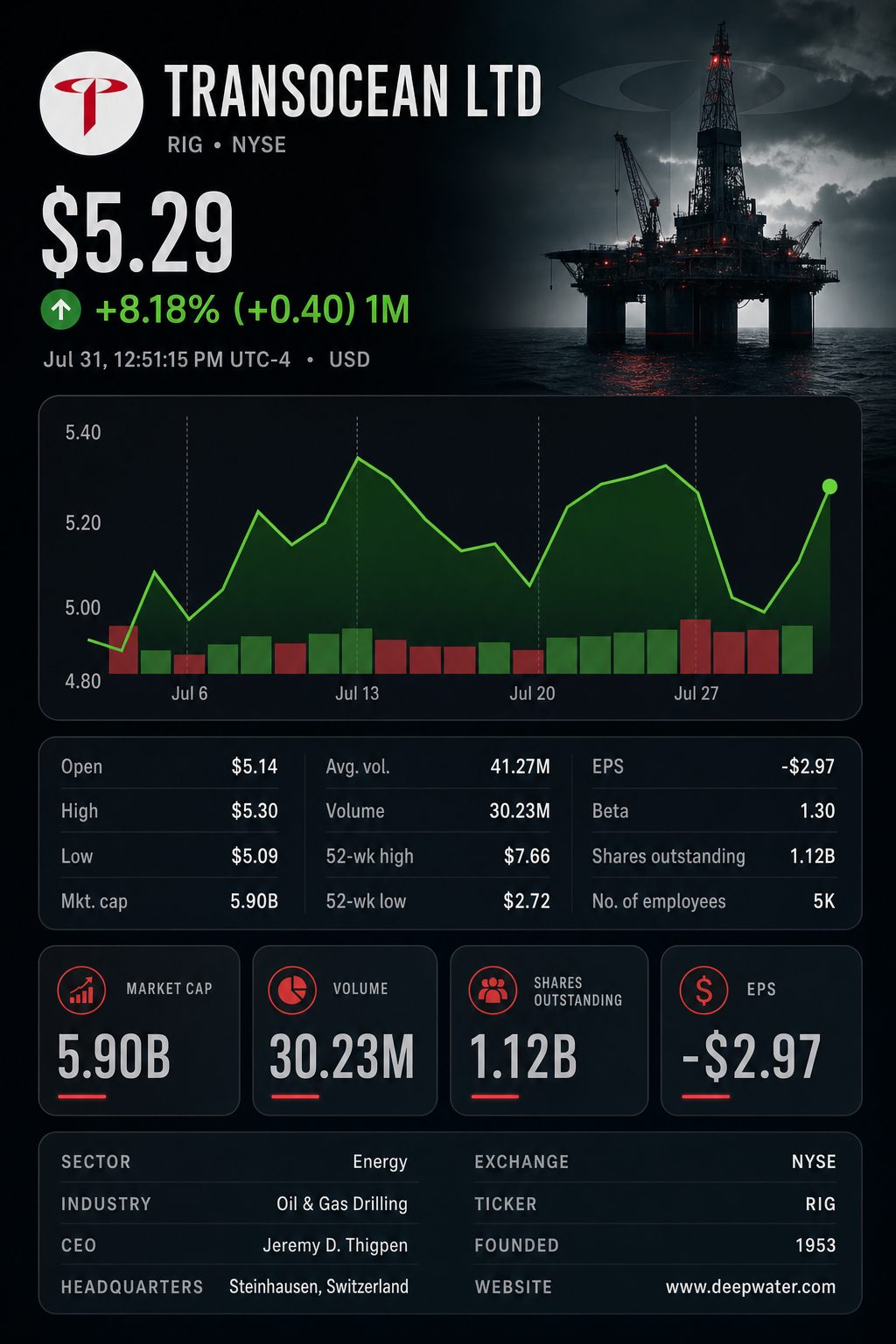
Transocean Ltd. NYSE:RIG advanced 3.5% to $5.26 around midday Friday. Valaris Ltd. NYSE:VAL increased 3.5% to $78.23.
The fixed-ratio merger spread saw little movement, expanding roughly four basis points to reach 2.4%.
This indicates sector momentum was behind Friday’s rise, rather than a significant reassessment of deal chances. Oil prices and offshore counterparts climbed as well.
WTI climbed 2.3% to $85.54 earlier Friday, with Brent advancing 1.5%. Both crude benchmarks were set for July increases of more than 20%. “The market has stopped trading the war and started trading the shipping data,” said analyst Ole Hvalbye. reuters.com
Valaris shareholders are set to receive 15.235 shares of Transocean for each Valaris share they own. The spread now reflects ongoing risks tied to completion and timing.
Merger-spread metric
Closing price July 30
Nearing midday July 31
Transocean share value
$5.08
$5.26
Valaris share value
$75.58
$78.23
Implied value of Valaris
$77.39
$80.14
Total spread
2.40%
2.44%
Based on present prices, the exchange formula places Valaris at roughly $80.14, while its shares are trading around $1.91 lower.
Initial estimate: Should the closing occur in 60 days, the gross spread would annualize at 14.8%. This figure does not include financing, taxes, slippage, or possible timing extensions.
July 31 marks the earliest date when both firms can confirm substantial DOJ compliance. After certification, a 60-day waiting period is triggered, unless ended sooner.
Deal milestone
Status
Investor relevance
Transaction signed
February 9
15.235-share fixed exchange ratio in place
CFIUS review
Approved June 29
National-security requirement met
DOJ compliance certification
Earliest allowed July 31
Period begins after certifications by both firms
DOJ waiting period
Pending
Lasts 60 days unless terminated sooner
Shareholder and other approvals
Pending
Must be received to close deal
Company closing target
Second half of 2026
Dependent on outstanding conditions
CFIUS has granted approval. Shareholder voting, antitrust approvals, and additional closing requirements are still pending. Management continues to aim for completion in the second half of 2026.
The upcoming operating test is set for August 5. Transocean is scheduled to release Q2 results and publish its fleet report following the market close. The company’s guidance suggests softer sequential economics.
Operating measure
Q1 actual
Q2 company guidance
Midpoint change
Contract drilling revenue
$1.081 billion
$930 million–$970 million
-12.1%
Revenue efficiency
97.3%
96.5%
-0.8 percentage point
Operating and maintenance expense
$606 million
$630 million–$660 million
+6.4%
The figures are preliminary and derived from the midpoint of the company’s guidance.
The midpoint figures indicate a 12% drop in revenue alongside a 6% rise in costs. Guidance for revenue efficiency is 0.8 percentage point below previous levels.
First quarter results improved, with revenue at $1.081 billion. Adjusted EBITDA totaled $440 million and free cash flow came to $136 million.
Principal debt totaled $5.137 billion at the end of Q1, a decrease of $549 million. The amount represents roughly 87% of the company’s equity market value as of Friday.
Chief Executive Keelan Adamson said in February, “We know that our debt level negatively impacts our equity value.” The move aims to relieve that pressure. reuters.com
Contract visibility stays as the balancing factor. Transocean reported firm contract awards totaling $185 million since May. A provisional deal with Equinor ASA NYSE:EQNR brings in over $1 billion.
Much of that additional activity is set to commence in 2027 or 2028. Adamson noted that the seven rig-years demonstrated the “strength and resilience” of Norway’s market. SEC
Risks: DOJ remedies, postponed votes, rig outages and lower oil prices may increase the spread. A drop in Transocean’s share price would additionally lower the Valaris consideration.
At present, Friday’s session indicates two key points: sentiment overseas strengthened, but confidence in deals remained mostly unchanged.
What is the current trading level of Transocean shares, and how much potential upside do analysts forecast?
Transocean (RIG) shares were up 3.5% at $5.26 as of 12:28 p.m. EDT on July 31, giving the company a market capitalization near $5.91 billion. The Wall Street Journal The stock was still 31% lower than its 52-week peak of $7.66. Analyst targets compiled by FactSet showed an average of $6.74, suggesting upside of about 28%. Projections ranged between $4 and $10, with the consensus recommendation at Hold. The broad range of estimates reflected limited forecast certainty. The Wall Street Journal
How might investor expectations shape up ahead of second-quarter results?
Transocean is scheduled to report results following the close of the NYSE on Wednesday, August 5, with a conference call set for 9 a.m. EDT Thursday. Deepwater The company projects drilling revenue between $930 million and $970 million for the second quarter. Revenue efficiency guidance stands at 96.5%, and maintenance costs are expected to range from $630 million to $660 million. Deepwater FactSet consensus calls for earnings of one cent per share, compared with five cents in the prior quarter. The Wall Street Journal The midpoint of revenue guidance, $950 million, represents a decline of around 12% from the first quarter.
Does backlog continue to increase, and are contract dayrates remaining stable?
Transocean's last confirmed backlog stood at $7.1 billion as of May 4, with an implied average dayrate exceeding $450,000. Deepwater In June, Transocean announced firm contract awards amounting to $185 million. Deepwater Investor The company also signed an agreement with Equinor exceeding $1 billion over seven rig-years. The initial dayrate is $399,000, increasing to more than $400,000 with adjustments. These contracts are still subject to license approval. Deepwater Investor The next confirmed backlog figure is expected with the August 5 fleet report.
Is the pace of operational improvement sufficient to deliver ongoing profitability?
Drilling revenue for the first quarter increased 19% from a year earlier to $1.081 billion. Revenue efficiency improved to 97.3%, up from 95.5% in the prior-year period. Adjusted EBITDA stood at $440 million, with a margin of 40.7%, compared to 26.9% in the same quarter of 2025. However, the adjusted net loss was unchanged at $28 million, or three cents per share. Deepwater FactSet projects earnings per share of $0.12 for 2026 and $0.27 for 2027, though predictions are improving, the company’s ability to maintain consistent profitability is still uncertain. The Wall Street Journal
Is Transocean’s financial position showing improved stability?
Principal debt totaled $5.137 billion as of March 31, down $549 million from December and $1.597 billion lower year on year. Cash stood at $330 million, with overall liquidity of $1.125 billion. Free cash flow amounted to $136 million, while $329 million of debt was due within the year. Management projects year-end liquidity between $1.25 billion and $1.35 billion. Deepwater Chief Executive Keelan Adamson said debt continues to weigh on equity value. Although deleveraging is underway, debt remains the main financial risk. reuters.com
Is the Valaris merger delivering sufficient value to RIG shareholders?
Valaris shareholders are set to receive 15.235 shares of Transocean for each Valaris share. After the merger, current Transocean investors would control about 53% of the new entity, with Valaris shareholders holding the remaining 47%. The merged company is expected to run 73 rigs, backed by an order backlog of around $10 billion. Upon announcement, enterprise value was placed near $17 billion. Management forecasts more than $200 million in cost synergies and aims for leverage of approximately 1.5 times. The deal increases scale but involves significant new share issuance. reuters.com
Is it possible for the Valaris merger to complete in 2026?
CFIUS cleared the deal on June 29, eliminating one closing hurdle. The Justice Department’s antitrust probe is ongoing following a second request issued on May 4. Both firms agreed not to certify substantial compliance prior to July 31. In the absence of early termination, closing must occur no sooner than 60 days after both parties certify. If certification takes place on July 31, the soonest a standard closing could happen is late September. Shareholder approval and other regulatory requirements are still pending. Although completion in the second half remains feasible, the precise timeline is still unclear. SEC
What are the key catalysts and main risks at present?
Brent hovered around $90.17 on Friday, with WTI standing at $85.94 a barrel. Both crude benchmarks were set for gains of nearly 24% in July. reuters.com Higher prices boost offshore project viability, but capital allocation typically spans several years. The focus now turns to the August 5 earnings report and fleet update. Deepwater Key operational challenges remain downtime, possible cancellations, shipyard bottlenecks and softer tendering activity. Merger delays or failure to achieve cost synergies would pose further valuation risks. Although crude prices are supportive, operational delivery and pace of deleveraging are more critical. Deepwater
Jerzy Lewandowski is a senior markets editor at TS2.tech covering stocks, artificial intelligence, semiconductors and global financial markets. He studied economics at the University of Warsaw and previously worked in investment analysis before moving into financial journalism. His daily coverage focuses on the trends and events that matter most to investors worldwide. Follow Jerzy Lewandowski on Google News.