DETROIT, July 31, 2026, 1:32 p.m. EDT — U.S. cash market open
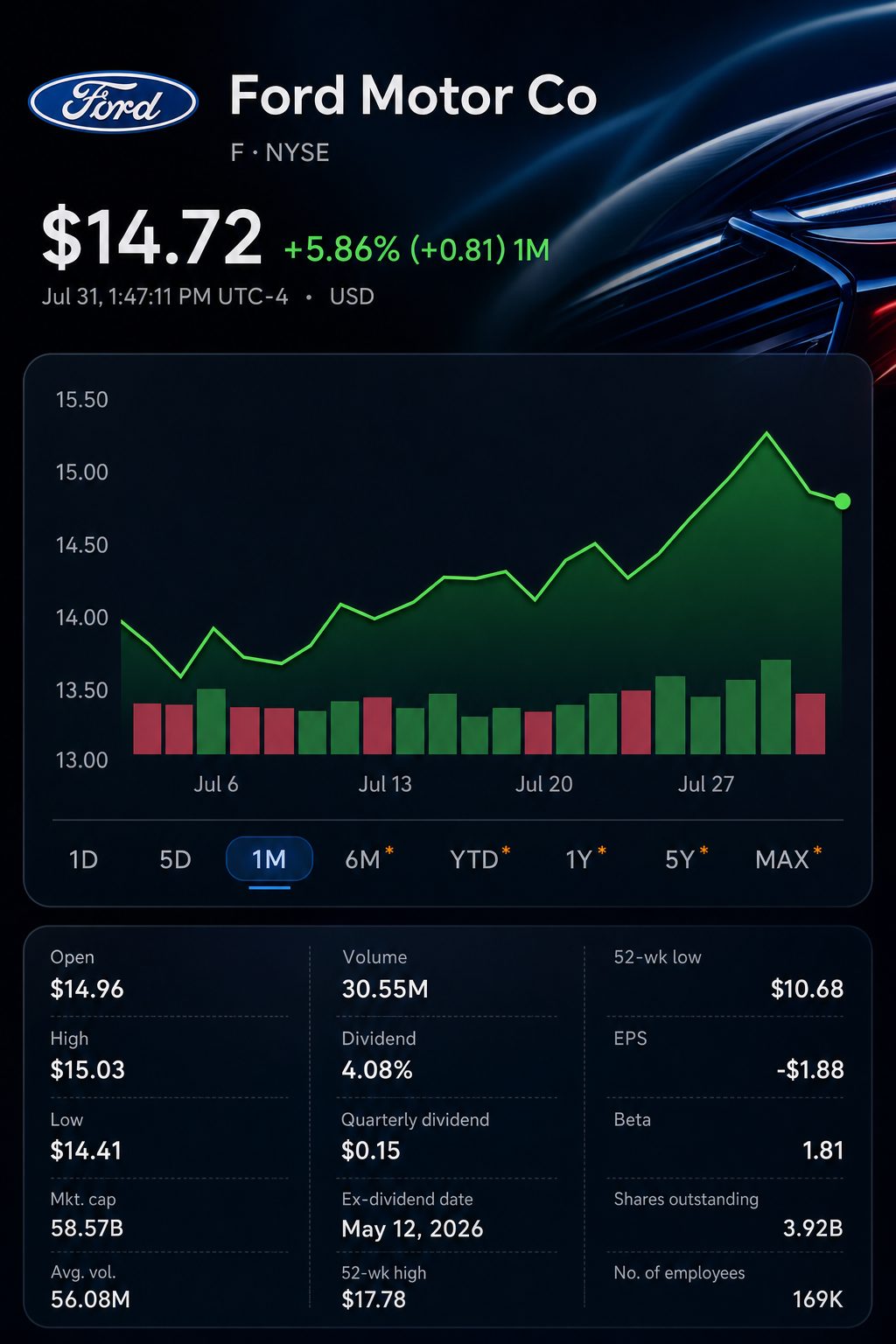
Shares of Ford declined by 1.5% to $14.63 on Friday, trading 2.2% lower than their closing price prior to Tuesday’s results. The stock’s after-hours gain of 5.4% following the earnings release has dissipated.
Shares of the nearest U.S.-listed automotive peers moved in mixed directions.
Prices represent most recent trades at approximately 1:17 p.m. EDT. Percentage changes are based on previous closing values.
The pullback prioritizes cash conversion over surpassing earnings expectations. Ford produced only $220 million in adjusted free cash flow during H1. This figure does not include operating cash flows from Ford Credit.
Derived estimate: In the second half, $5.78 billion to $6.78 billion must be delivered, representing 96.3% to 96.9% of the year’s goal. The majority of cash remains outstanding.
Profit is not as heavily weighted to the second half. Adjusted EBIT in the first half stood at $5.991 billion. The outlook points to $4.009 billion to $5.009 billion for the second half. Using the midpoint, that is roughly 25% lower than the first half.
Ford increased its forecast for full-year adjusted EBIT to a range of $10 billion-$11 billion. Adjusted free cash flow is now expected between $6 billion and $7 billion, with the range incorporating roughly $500 million from anticipated IEEPA reimbursement recovery.
Q2 results demonstrated the reason for the increased profit range. Despite lower volume, adjusted EBIT climbed.
Q2 metric
2026
2025
Change
Wholesale units
1.039 million
1.185 million
-12%
Revenue
$48.3 billion
$50.2 billion
-4%
Adjusted EBIT
$2.503 billion
$2.140 billion
+$363 million
Adjusted EBIT margin
5.2%
4.3%
+0.9 points
Adjusted EPS
$0.42
$0.37
+$0.05
Adjusted free cash flow
$2.094 billion
$2.826 billion
-$732 million
Ford disclosures; calculated numbers may show slight differences due to rounding.
Adjusted earnings per share reached 42 cents, surpassing the consensus estimate of 35 cents. The company posted a GAAP net loss of $1.33 billion following $4.18 billion in pre-tax special items. The largely non-cash charge from BlueOval SK totaled $3.6 billion.
Stronger performance from Ford Blue and Model e balanced out softness in Ford Pro.
Q2 segment
Revenue
EBIT
EBIT change from 2025
Margin
Ford Blue
$26.1 billion
$1.135 billion
up $474 million
4.4%
Ford Pro
$17.8 billion
$1.718 billion
down $600 million
9.7%
Ford Model e
$1.0 billion
-$919 million
loss reduced by $410 million
-89.6%
Second quarter performance of Ford’s automotive division.
Blue benefited from a higher proportion of trucks and off-road vehicles. “Our industrial system is getting fitter,” CFO Sherry House told reporters. Ford Blue chief Andrew Frick stated, “We expect that level of product mix and series mix to continue.” Reuters
The guidance bridge highlights the cash gap clearly.
Measure
H1 actual
Full-year guidance
Implied H2
H2 share of full year
Adjusted EBIT
$5.991 billion
$10 billion-$11 billion
$4.009 billion-$5.009 billion
40.1%-45.5%
Adjusted free cash flow
$0.220 billion
$6 billion-$7 billion
$5.780 billion-$6.780 billion
96.3%-96.9%
Figures are calculated from Ford’s published first-half results and existing outlook.
Management predicts a $1 billion profit boost from Novelis, largely in the second half. The company is also aiming for $1 billion in savings from materials and warranties. However, approximately $1 billion invested in Universal Electric Vehicle and Ford Energy balances out the anticipated benefits.
Ford’s 10-Q attributed the drop in Q2 cash flow to timing factors and increased expenditures. Additional pressure came from tax and interest outlays. Working capital added $600 million, helping to counterbalance some of that impact.
Citigroup NYSE:C analyst Michael Ward raised his rating on Ford to Buy on Wednesday. He assigned a price target of $20 following the company’s results. The analyst’s note pointed to strengthening operating momentum.
Ford reported holding $22.3 billion in cash at the end of June, with overall liquidity amounting to $43.4 billion. The company announced a regular quarterly dividend of 15 cents.
Risks: The outlook does not factor in a significant escalation in the Middle East or a substantial downturn in the U.S. economy. It projects an approximate 0.5% increase in U.S. industry pricing. Model e is projected to incur a loss of about $4 billion this year.
Earnings prospects have strengthened. Cash flow still hinges on successful execution in H2.
What is causing Ford shares to decline as the overall market moves higher today?
Ford shares were last seen at $14.63, down 1.5% around 1:11 p.m. ET. By comparison, the S&P 500, Nasdaq and Dow each gained between 0.4% and 0.5%. That left Ford lagging the major indexes by about two percentage points. Verified reports did not indicate a clear trigger for the decline. The most recent notable Ford-related topic was pressure from Chinese competition. Reuters said CEO Jim Farley predicts Chinese automakers could enter in five to ten years. Farley's statement was strategic and not directly tied to the day’s share movement. Reuters
Did Ford surpass forecasts with its second-quarter earnings?
Ford reported adjusted earnings of $0.42 per share, beating the $0.35 consensus forecast from LSEG. Adjusted EBIT climbed by $400 million to reach $2.5 billion. The margin rose 0.9 percentage point to 5.2%. Revenue dropped 4% to $48.3 billion as wholesale volumes decreased. Ford reported a GAAP net loss of $1.3 billion, weighed down by $4.2 billion in pretax special charges, mainly non-cash. While operating results surpassed expectations, headline net income remained weak. Ford Shareholder Services
What must happen in the second half for Ford to achieve its upgraded 2026 outlook?
Ford projects adjusted EBIT in the range of $10 billion to $11 billion and expects adjusted free cash flow between $6 billion and $7 billion. In the first half, EBIT came in at $6.0 billion, while free cash flow totaled just $0.2 billion. This means Ford needs to generate about $4 billion to $5 billion of EBIT in the second half. Second-half free cash flow must climb to between $5.8 billion and $6.8 billion. Ford anticipates around a $1 billion EBIT boost from Novelis, mostly in the latter half of the year. Achieving the cash flow goal presents higher execution risk compared to the profit objective. Ford Shareholder Services
Is Ford's performance in trucks and its commercial division sufficient to counterbalance softer overall vehicle sales?
U.S. second-quarter sales declined 10% to 549,200 vehicles, but the June retail share edged up by 0.2 percentage point to 12.3%. Ford Blue’s EBIT climbed $474 million to $1.14 billion, even with an 8% drop in wholesales. Segment margin rose to 4.4% from 2.6%. Ford Pro’s EBIT decreased $600 million to $1.72 billion as wholesales fell 13%. F-Series sales totalled 357,801, with off-road trims making up 23.9% of first-half sales. A favourable mix is offsetting pressure from lower volumes, though Ford Pro’s downturn continues to be significant. From The Road
Is Ford seeing progress in reducing its electric-vehicle losses?
Model e reported a quarterly loss of $919 million, $410 million less than the same period a year ago. This marked the third consecutive quarter of year-over-year EBIT gains. Still, revenue declined 56% to $1.0 billion and wholesales were down 53%. The EBIT margin dropped to negative 89.6%, compared to negative 56.4% previously. Ford maintains its forecast for around $4.0 billion in Model e losses in 2026. The roadmap includes launching an electric pickup priced at approximately $30,000 in 2027. While losses are narrowing, the underlying unit economics have yet to be demonstrated. Ford Shareholder Services
How challenging are cash-flow targets, and is the dividend fully covered?
Ford reported ending June with cash holdings of $22.3 billion and total liquidity at $43.4 billion. Adjusted free cash flow for the first half stood at just $0.2 billion. This means the company must deliver $5.8 billion to $6.8 billion in the remainder of the year to meet its full-year goal. Ford pays a quarterly dividend of $0.15, translating to an annualized $0.60. With shares at $14.63, the yield is around 4.1%. The annual dividend costs about $2.4 billion, representing 34% to 40% of projected cash flow. Management guidance indicates the dividend is covered, but most expected cash generation is weighted toward the latter half of the year. Ford Shareholder Services
Is Ford Credit increasing in strength or presenting a greater risk?
Ford Credit reported a pre-tax profit of $757 million, an increase of $112 million from the previous year. Net receivables totaled $143.2 billion, and net liquidity stood at $27.4 billion. The U.S. loss-to-receivables ratio climbed to 52 basis points compared to 48. Ford attributed this rise to more repossessions and increased loss severity. Auction values remained nearly unchanged, helping to limit near-term residual-value risk. The unit continues to provide earnings support, though credit quality indicators saw mild deterioration. SEC
What factors might threaten Ford’s improved 2026 outlook?
Ford projects U.S. industry sales between 16.0 million and 16.5 million vehicles annually. The company also expects industry net pricing to increase by about 0.5%. Ford anticipates roughly $3 billion in tariff reimbursements and offsets, though the timing for receiving these funds is unclear; $500 million in IEEPA cash is projected in the second half. Inventory has climbed 10.9% since December, totaling $16.95 billion, while warranty reserves stand at $17.57 billion, with potential additional costs of approximately $2 billion. Pressures on cash and margins could come from weaker pricing, postponed reimbursements, or higher claims. Ford Shareholder Services
Is Ford’s share price considered low, and what are analysts forecasting for the future?
Ford trades at $14.63, giving the automaker a market capitalization close to $58.3 billion. The company’s cash-flow projection of $6 billion to $7 billion translates into an equity yield between 10% and 12%. While that appears cheap, comparisons are complicated by auto industry cycles and the Ford Credit unit. MarketBeat tracks 18 analysts covering Ford, with a consensus Hold recommendation. Their average price target stands at $15.68, with estimates spanning from $11 to $20. Citigroup upgraded Ford to Buy with a $20 target, whereas BNP Paribas remained Neutral at $15. This broad range highlights considerable analyst disagreement and little consensus. Ford Shareholder Services
Iwona Majkowska is a financial markets journalist at TS2.tech, specializing in stocks, artificial intelligence and technology. A graduate of the Warsaw School of Economics, she previously worked in equity research and financial analysis before focusing on market reporting. Her daily coverage helps investors follow major developments across U.S. and global markets. Follow Iwona Majkowska on Google News.