NEW YORK, August 3, 2026, 13:21 EDT
- The stock gained roughly 1.0% to $149.10 in early trading on Monday.
- Growth in Automotive and IoT segments compensated for 60.6% of the reduction in handset revenue.
- The midpoint of fourth-quarter adjusted EPS guidance falls 8.9% short of Wall Street’s forecast.
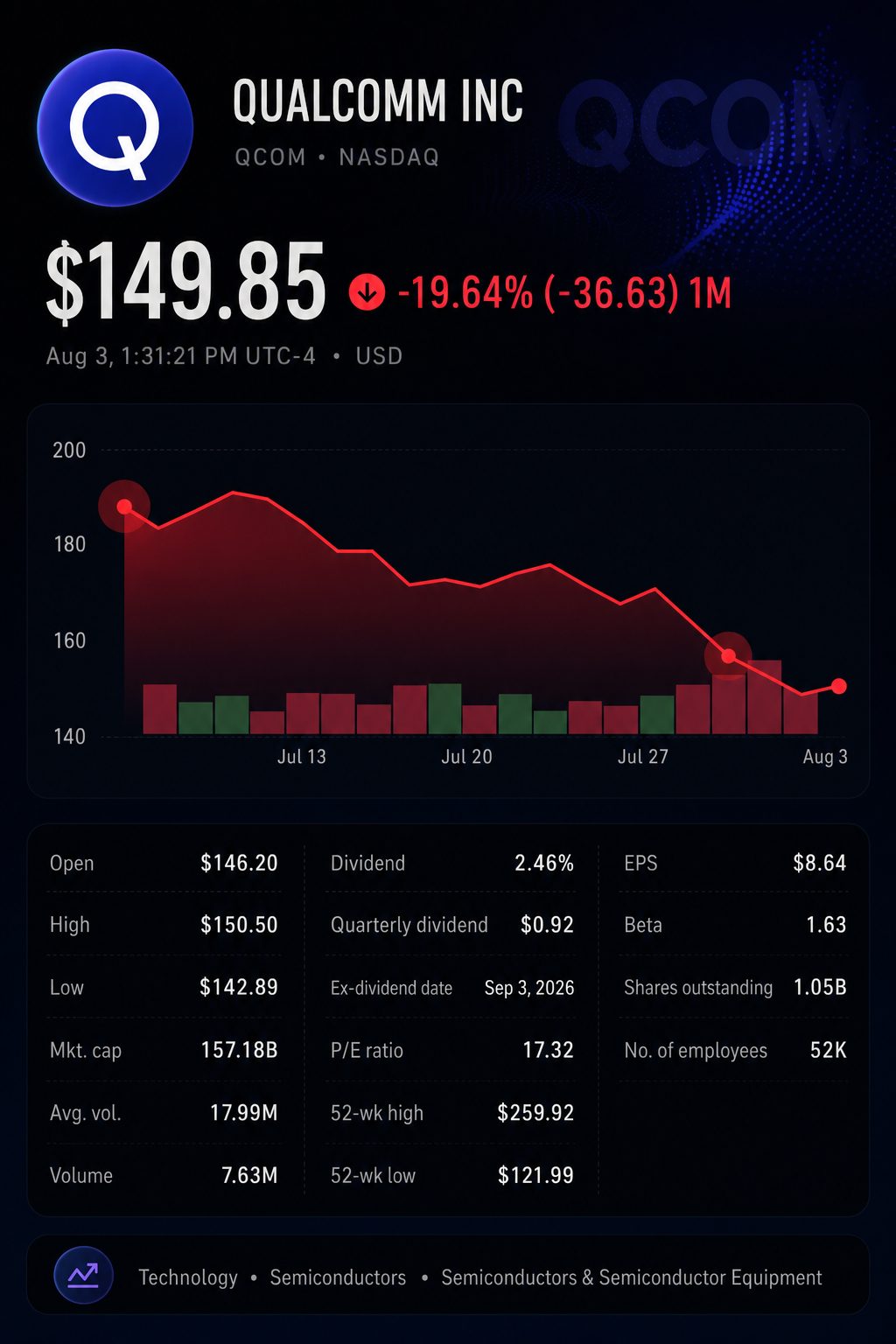
Growth in automotive and IoT offset 61% of Qualcomm’s drop in handset revenue last quarter. After falling 12.6% over five sessions, shares stabilized Monday. The stock gained 1.0% to $149.10 in early U.S. trade.
This turns diversification into a near-term earnings support, rather than just a 2029 goal. However, QCT’s pretax margin declined by four points to 26%. Efforts to protect profit are still incomplete.
Revenue from handsets dropped by $1.24 billion. Automotive revenue increased by $604 million, and IoT generated an additional $149 million. Combined, these segments offset $753 million of the decline.
| QCT revenue stream | Q3 FY2026 | Q3 FY2025 | Dollar change | Year-on-year |
|---|---|---|---|---|
| Handsets | $5.086 bln | $6.328 bln | -$1.242 bln | -20% |
| Automotive | $1.588 bln | $0.984 bln | +$0.604 bln | +61% |
| IoT | $1.830 bln | $1.681 bln | +$0.149 bln | +9% |
| Automotive plus IoT | $3.418 bln | $2.665 bln | +$0.753 bln | +28% |
The offset ratio uses Qualcomm’s disclosed segment revenue for its calculation.
Total revenue across the company declined 4% to $9.95 billion, topping the consensus forecast of $9.67 billion. Adjusted earnings dropped 20%, coming in two cents below expectations.
| Metric | Q3 FY2026 | Q3 FY2025 | Wall Street estimate | Comparison |
|---|---|---|---|---|
| Revenue | $9.947 bln | $10.365 bln | $9.67 bln | 2.9% above; 4% decrease year-on-year |
| Adjusted EPS | $2.21 | $2.77 | $2.23 | 0.9% below; 20% decline year-on-year |
| Net income | $2.002 bln | $2.666 bln | — | Down 25% year-on-year |
| QCT pretax margin | 26% | 30% | — | Dropped by 4 percentage points |
Qualcomm released the reported results. Consensus data was gathered by LSEG and Visible Alpha.
The margin question became more pronounced with the fourth-quarter outlook. The revenue midpoint comes in just above the LSEG consensus. The adjusted EPS midpoint is nearly 9% lower than consensus.
| Fiscal Q4 measure | Qualcomm outlook | Midpoint | Wall Street estimate | Midpoint gap |
|---|---|---|---|---|
| Revenue | $9.7–$10.5 bln | $10.10 bln | $10.02 bln | +0.8% |
| Adjusted EPS | $2.05–$2.25 | $2.15 | $2.36 | -8.9% |
| QCT revenue | $8.4–$9.0 bln | $8.70 bln | $8.49 bln | +2.5% |
| Handset revenue | About $5.2 bln | $5.20 bln | $5.03 bln | +3.4% |
Management gave the handset number as an approximate figure. Additional estimates were supplied by LSEG and Visible Alpha.
Demand is not the sole challenge. Chief Executive Cristiano Amon told Reuters, “It’s availability of supply.” Qualcomm is preparing to raise prices starting September 1 as it works through new customer contracts. Margin improvement is expected to come in stages. Reuters
Amon told Bloomberg Television that demand for smartphones was still robust, but the market was being constrained by increased memory costs and limited supply.
Apple NASDAQ:AAPL brings a fresh headwind in the short term. Qualcomm’s share of modems for the next iPhone is now projected to fall substantially below the earlier 20% forecast. This reduction is occurring sooner than executives anticipated.
Qualcomm has identified data centers as the next focus for expansion, aiming to achieve $5 billion in revenue from the sector in fiscal 2027 and increasing the goal to $15 billion by 2029. The company is also targeting $40 billion in overall non-handset revenue.
Bob O’Donnell, chief analyst at TECHnalysis Research, said Qualcomm is “quickly pivoting to non-handset revenues.” The data from the most recent quarter backs up this perspective, but only to a certain extent. Reuters
The income outlook improved following the decline. Monday’s price puts the annualized dividend of $3.68 at a yield close to 2.47%. Qualcomm distributed $2.3 billion to shareholders last quarter via dividends and buybacks.
The yield provides support but does not drive gains. A revaluation requires higher prices to rebuild QCT margins. Growth outside of handsets is also necessary to offset Apple’s pullback.
Risks: Memory and production expenses could remain high. Pushback from customers may postpone pricing actions. Margins on initial data-center projects might also be slimmer.
The next challenge is straightforward. Growth in auto, IoT and data-center sectors needs to offset the outstanding 39% decline in handsets. This has to be achieved without incurring a further four-point margin reduction.
Related articles: NASDAQ:AAPL