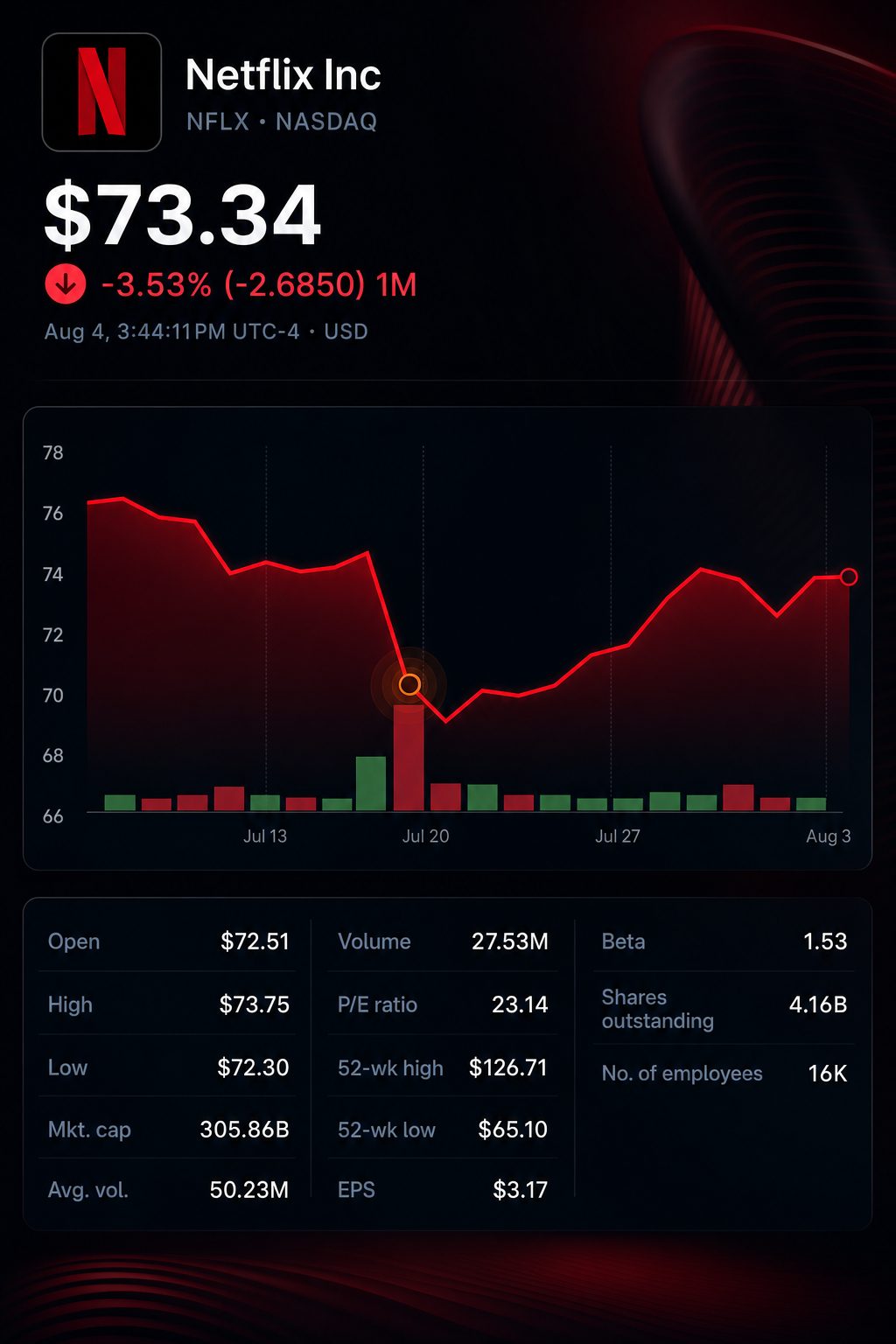
NEW YORK, August 4, 2026, 15:09 EDT — U.S. markets open.
- Netflix traded at $73.13, down 0.3%, while the S&P 500 gained about 2%.
- The Culture Edit launched Monday across six markets and every subscription tier.
- Advertising could provide up to one-quarter of Netflix’s forecast 2026 revenue growth.
Netflix shares slipped Tuesday while a broad U.S. rally lifted most large-cap peers. The gap puts its newest engagement experiment under a sharper valuation test.
The Culture Edit launched Monday across six English-speaking markets. It serves lifestyle videos lasting less than 20 minutes on every subscription tier.
The catalogue mixes licensed archives with newly produced series. In investor terms, it tests whether daytime sessions can create valuable advertising inventory.
The market comparison shows Netflix’s weaker session and continuing valuation premium:
| Company | Price | Day move | Market value | Trailing P/E |
|---|---|---|---|---|
| Netflix, Inc. NASDAQ:NFLX | $73.13 | -0.3% | $311.7 billion | 22.4x |
| Alphabet Inc. NASDAQ:GOOGL | $379.43 | +1.6% | $4.64 trillion | 19.1x |
| Walt Disney Co. NYSE:DIS | $98.37 | +0.2% | $174.3 billion | 15.7x |
| Comcast Corp. NASDAQ:CMCSA | $24.76 | +0.8% | $87.8 billion | 8.0x |
Market data were current near 15:00 EDT.
Netflix’s earnings multiple exceeds Alphabet’s by about 18%. It stands roughly 43% above Disney’s multiple. Yet Netflix remains 42% below its 52-week high.
Advertising remains small within Netflix’s revenue mix. Its contribution to incremental growth is far more important.
| Metric | 2025 actual | 2026 company forecast | Implied change |
|---|---|---|---|
| Total revenue | $45.18 billion | $51.0-$51.4 billion | $5.82-$6.22 billion |
| Advertising revenue | More than $1.5 billion | About $3.0 billion | Roughly double |
| Advertising share of revenue | More than 3.3% | About 5.9% at midpoint | About 2.6 points |
| Advertising share of total growth | — | Up to about 25% | Based on 2025 floor |
The 2026 figures are company forecasts. Calculations use the $51.2 billion revenue midpoint.
Using $1.5 billion as the 2025 floor, additional advertising could supply up to one-quarter of forecast revenue growth. That makes engagement outside Netflix’s core slate financially meaningful.
Management has already seen signs of incremental usage. Co-Chief Executive Ted Sarandos said podcast viewing was “definitely incremental” and skewed toward daytime and mobile.
Short lifestyle videos extend that same test. They can be opened quickly and do not require a full episode commitment.
Eater said hundreds of its videos would join Netflix while remaining on existing platforms. That shows at least some supply is non-exclusive, favoring catalogue breadth over differentiation.
The broader revenue trend raises the execution bar:
| Quarter | Revenue | Year-on-year growth | Operating margin |
|---|---|---|---|
| Q2 2025 | $11.08 billion | 15.9% | 34.1% |
| Q1 2026 | $12.25 billion | 16.2% | 32.3% |
| Q2 2026 | $12.56 billion | 13.4% | 33.4% |
| Q3 2026 company forecast | $12.86 billion | 11.7% | 33.2% |
The Q3 forecast implies sequential revenue growth of only 2.4%. Year-on-year growth would slow by 1.7 percentage points from Q2. Margins should remain broadly steady.
Investors will receive less supporting audience data. Netflix plans to publish its detailed viewing report annually, rather than twice yearly, starting in 2027.
Consensus data compiled by FactSet NYSE:FDS put Q3 earnings at $0.82 per share. That estimate stood at $0.84 one month earlier. The median price target is $93, about 27% above Tuesday’s price.
Capital returns offer some support. Netflix repurchased $4.7 billion of shares during Q2 and retained $27.1 billion of authorization. The remaining authority equals about 8.7% of its current market value.
Risks remain. Advertiser demand, fill rates and ad-tier adoption could miss management’s assumptions. Licensed short videos may add viewing without enough retention or pricing benefit. Netflix also warns that its limited advertising history makes revenue harder to forecast.
The next test is concrete. Netflix must reach its $12.86 billion Q3 revenue forecast while keeping margins above 33%. The Culture Edit matters only if those extra sessions eventually appear in the numbers.
Related articles: NASDAQ:NFLX