NEW YORK, August 5, 2026, 12:07 EDT — U.S. markets open
AT&T Inc. NYSE:T slipped 2.0% to $22.91 by late Wednesday morning following Space Exploration Technologies Corp. NASDAQ:SPCX detailing a terrestrial Starlink mobile network. U.S. markets stayed open.
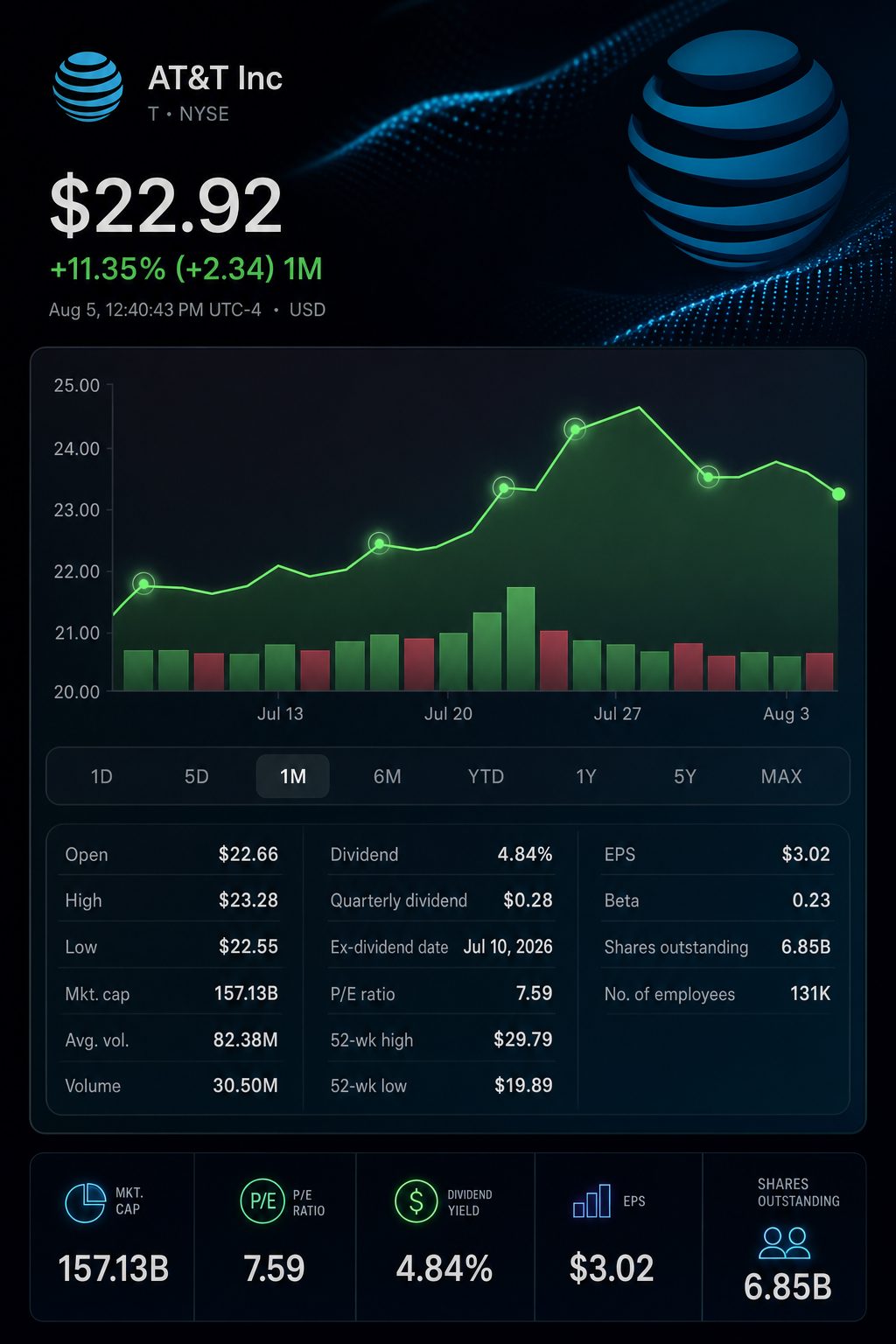
The action wiped around $3.3 billion off AT&T’s market capitalisation. This represents about 18% of the company’s minimum free-cash-flow forecast for 2026. AT&T has not revised this projection.
Verizon Communications Inc. NYSE:VZ slipped 2.5%. T-Mobile US Inc. NASDAQ:TMUS dropped 2.2%. The combined equity value lost by the three carriers was estimated at $12.4 billion.
| Stock | Price | Day change | Market value | Preliminary value erased |
|---|---|---|---|---|
| AT&T | $22.91 | -2.0% | $159.1 billion | $3.3 billion |
| Verizon | $45.72 | -2.5% | $190.7 billion | $4.8 billion |
| T-Mobile | $173.23 | -2.2% | $187.5 billion | $4.3 billion |
Values were noted at approximately 11:51 a.m. EDT. Fluctuations represent initial estimates based on up-to-date market capitalization and observed price shifts.
SpaceX President Gwynne Shotwell stated that Starlink will evolve into “a true mobile service.” She predicts securing “quite a few” customers from the current three leading providers. SpaceX has not revealed details about the cost of the terrestrial network. Reuters
AT&T and SpaceX each acquired licenses from EchoStar Corp. NASDAQ:ECHO. AT&T finalized its deal, valued at approximately $23 billion, on July 28. SpaceX completed two transactions, amounting to $19.6 billion.
| Spectrum comparison | AT&T | SpaceX and Starlink |
|---|---|---|
| EchoStar spectrum acquired | Around 50 MHz across the nation | 65 MHz |
| Purchase value | Approximately $23 billion | $19.6 billion |
| Spectrum detail | 30 MHz in the 3.45 GHz band; 20 MHz in the 600 MHz band | Includes terrestrial rights |
| Current position | Operates national mobile and fiber infrastructure | Satellite service; planning a terrestrial buildout |
| Transaction status | Completed July 28 | Secured via two agreements |
Spectrum bands, license conditions, and geographic rights vary. MHz totals alone do not represent economic value directly.
The spectrum comparison illustrates why the market is concerned, while also highlighting the execution challenges facing SpaceX. Acquiring spectrum does not automatically result in cell site deployment, retail networks, or comprehensive terrestrial coverage across the country.
Craig Moffett at MoffettNathanson described launching a rival consumer service within five years as “extraordinarily challenging” unless there is a deal to lease an existing network. David Barden from New Street Research noted that 65 MHz would not easily match what carriers have built over thirty years. Reuters
AT&T faces this challenge as it sees gains in customer metrics. In the second quarter, the company reported 432,000 net adds for postpaid phone subscribers. The postpaid phone churn rate stood at 0.86%, with advanced-internet net additions totaling 646,000.
The most recent quarterly figures also indicate that each incumbent continues to possess strong cash-generating abilities.
| Carrier | Q2 reported net-add metric | Relevant service revenue growth | Q2 free cash flow | 2026 free-cash-flow outlook |
|---|---|---|---|---|
| AT&T | 432,000 postpaid phones; 646,000 advanced-internet connections | Advanced Connectivity: +5.1% | $4.7 billion | At least $18 billion |
| Verizon | 184,000 postpaid phones; 348,000 broadband connections | Mobility and broadband: +2.8% | $6.4 billion | 9%–10% growth |
| T-Mobile | 277,000 postpaid accounts | Total service revenue: +8.9% | $4.8 billion adjusted | $18.4–$18.8 billion adjusted |
Definitions for subscribers and revenue vary across carriers. Free cash flow is based on non-GAAP metrics as determined by the company.
AT&T’s approach of bundling services serves as a further safeguard. Approximately 42.5% of homes with advanced AT&T internet also purchase AT&T wireless, a convergence ratio the company says may be updated. Its fiber infrastructure covers 38.6 million sites for consumers and businesses.
Cash returns are still key for investors. Chief Executive John Stankey stated, “We are accelerating the pace of our planned share repurchases this year to approximately $10 billion.” AT&T gave back $4.1 billion to shareholders in the second quarter, with $2.2 billion from stock buybacks. AT&T Newsroom
AT&T’s $1.11 annual dividend translated to a 4.8% yield at Wednesday’s price. The company’s minimum 2026 free-cash-flow goal represents an equity yield of 11.3%. These numbers do not include potential buybacks.
Analyst views are still mostly positive, though not without dissent. At present, there are 16 Buy or Overweight recommendations, 11 Hold ratings, and a single Sell.
| Analyst recommendation | Current | One month ago | Change |
|---|---|---|---|
| Buy | 14 | 13 | +1 |
| Overweight | 2 | 3 | -1 |
| Hold | 11 | 12 | -1 |
| Underweight | 0 | 0 | — |
| Sell | 1 | 0 | +1 |
| Consensus | Overweight | Overweight | — |
The mean target stands at $28.65, while the midpoint is $28.50. These figures suggest potential gains of approximately 25.1% and 24.4%, respectively, compared to Wednesday’s closing price.
Wolfe Research raised its rating on AT&T to Outperform on July 23, assigning a price target of $29. Analyst Peter Supino noted that SpaceX would require several years to bridge the gap in terrestrial networks and spectrum.
Risks: SpaceX may accelerate its schedule via a buyout or by securing a network-leasing deal. Aggressive competition on price could impact AT&T’s service revenue expansion and cash flow. AT&T reported net debt of $126.4 billion as of June 30.
At present, the decline is due primarily to concerns over long-term competitive threats rather than a revised 2026 outlook. AT&T has confirmed its previous projections. SpaceX has not disclosed a budget for ground network development. The difference remains the main issue for investors.
Related articles: NYSE:T