
NEW YORK, August 9, 2026, 11:13 EDT — U.S. cash markets have ended trading.
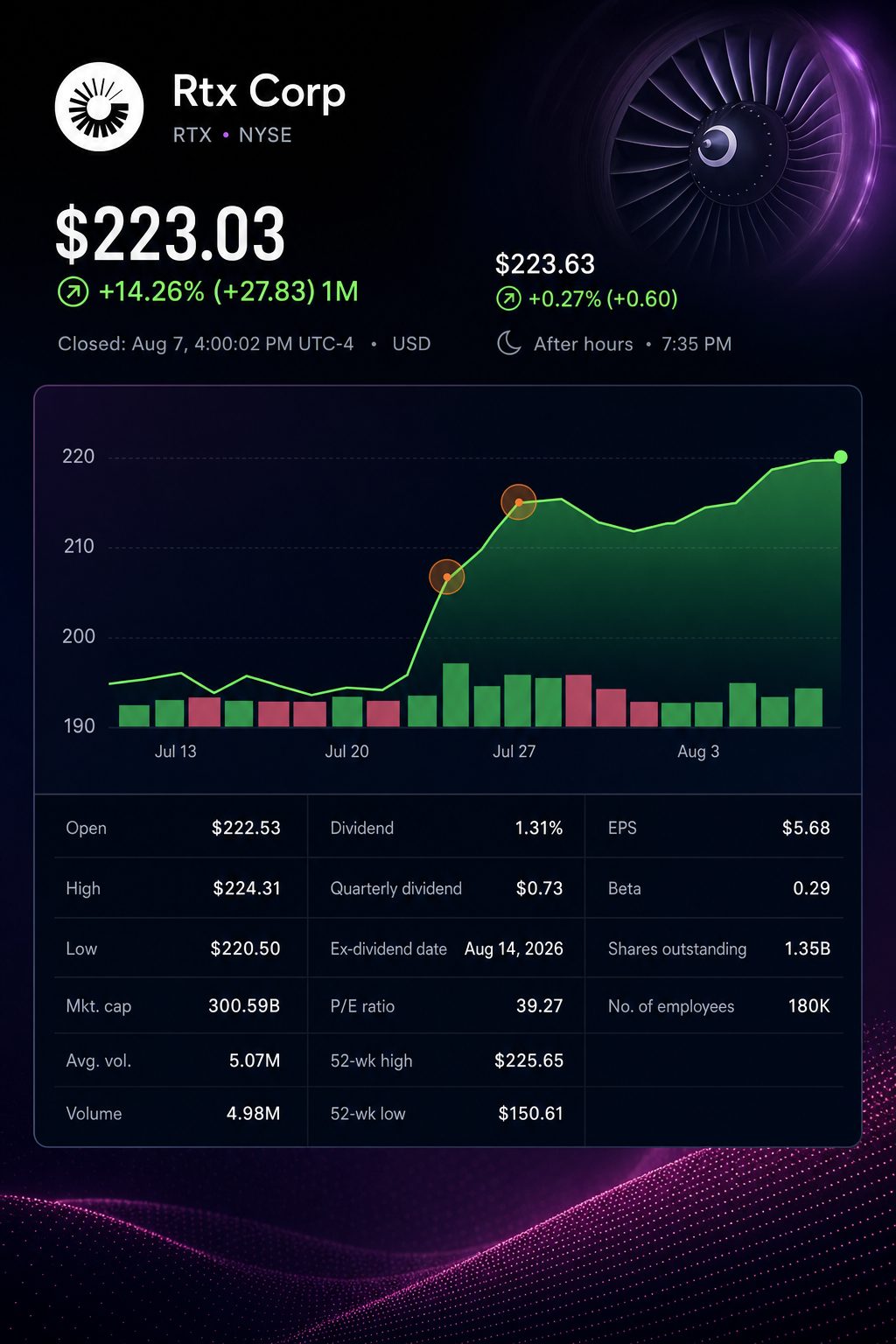
Shares of RTX Corporation NYSE:RTX will open Monday, August 10, trading 1.2% away from their 52-week peak. The stock ended Friday at $223.03, placing it just 2.5% under the consensus price target from 21 analysts surveyed by MarketBeat.
Cash is more difficult to assess. Based on Friday’s market closing prices and midpoint figures from company guidance, RTX provides a 2.9% free-cash-flow yield for 2026. Lockheed Martin NYSE:LMT delivers 5.2%, and Northrop Grumman NYSE:NOC posts 4.1%.
| Company | Market value | Backlog | Backlog/2026 sales | 2026 FCF midpoint | FCF yield |
|---|---|---|---|---|---|
| RTX Corporation NYSE:RTX | $300.59 bln | $289.0 bln | 3.0x | $8.63 bln | 2.9% |
| Lockheed Martin NYSE:LMT | $135.69 bln | $230.4 bln | 2.9x | $7.10 bln | 5.2% |
| Northrop Grumman NYSE:NOC | $81.39 bln | $104.7 bln | 2.4x | $3.30 bln | 4.1% |
Backlog ratios and yields use guidance midpoints and market capitalizations as of August 7. Free-cash-flow metrics are defined differently by each company.
This disparity shapes the investment perspective. RTX holds the largest backlog compared to sales among its peer group, but provides the lowest short-term cash return. As a result, share performance depends on smooth capacity growth rather than simply securing additional orders.
RTX rose 3.6% last week, mirroring the S&P 500’s climb. The wider market gained ground as July payrolls fell unexpectedly, sending Treasury yields down.
| Security | August 7 close | Weekly move |
|---|---|---|
| RTX Corporation NYSE:RTX | $223.03 | up 3.6% |
| Lockheed Martin NYSE:LMT | $587.95 | up 0.9% |
| Northrop Grumman NYSE:NOC | $571.58 | up 5.4% |
| General Dynamics NYSE:GD | $392.05 | up 2.3% |
| S&P 500 | 7,757.64 | up 3.6% |
Company returns use July 31 closing prices as the benchmark.
Nonetheless, RTX shares have risen 14.4% since July 22, the last trading day prior to its second-quarter results. The stock gained after the company raised its guidance and reported a 22% increase in backlog.
A fresh demand indicator appeared on Friday. According to Reuters, Patriot missile stocks remain stretched thin in the United States, as well as in Europe and Gulf countries. CSIS provided an estimate — not an official figure — showing U.S. supplies of interceptors below 1,000 units. RTX’s Raytheon division manufactures Patriot platforms and PAC-2 GEM-T missiles, while the PAC-3 line is produced by Lockheed.
Production is still the key variable. A new U.S. plan aims to scale up RTX’s Tomahawk manufacturing from approximately 60 units per year to 1,000. That would make output almost 17 times higher.
Second-quarter earnings reflected initial signs of operating leverage. Revenue increased 14% to $24.7 billion. Adjusted earnings per share rose 21% to $1.89, and free cash flow totaled $2.9 billion. “Demand remains robust, and our backlog is up 22 percent year over year,” CEO Chris Calio said. RTX
The expansion was widespread, with Raytheon seeing gains from weapons demand and Pratt & Whitney boosted by growth in commercial aftermarket and military activity.
| RTX segment | Q2 sales | Year-on-year growth | Adjusted margin |
|---|---|---|---|
| Collins Aerospace | $8.21 bln | up 8% | 16.7% |
| Pratt & Whitney | $8.89 bln | increased 16% | 8.3% |
| Raytheon | $8.27 bln | rose 18% | 12.6% |
Collins recorded 13% organic sales growth; the table displays reported growth figures.
Raytheon secured approximately $10 billion in international bookings during the first half, with $7 billion coming from Europe, CFO Neil Mitchill said to Reuters. JPMorgan Chase NYSE:JPM analyst Seth Seifman said Raytheon was responsible for about two-thirds of the rise in annual profit guidance, while Collins contributed around one-quarter.
Analysts maintain a positive outlook, though price targets are grouped close to the current share price. According to MarketBeat, there is one strong-buy recommendation, 14 buy ratings, five holds, and a single sell. The average price target stands at $228.59.
| Date | Research firm and analyst | Recommendation | Target | Move from $223.03 |
|---|---|---|---|---|
| Aug. 3 | Sanford C. Bernstein — Douglas Harned | Market Perform | $232 raised from $213 | +4.0% |
| July 27 | TD Cowen — Gautam Khanna | Buy | $240 up from $225 | +7.6% |
| July 24 | Royal Bank of Canada NYSE:RY — Ken Herbert | Outperform | $250 increased from $230 | +12.1% |
| July 24 | Morgan Stanley NYSE:MS — Kristine Liwag | Overweight | $240 | +7.6% |
| July 24 | UBS Group NYSE:UBS — Gavin Parsons | Neutral | $215 lifted from $198 | −3.6% |
MarketBeat combined ratings and price targets. Implied price movements are based on Friday’s closing figure.
Focus turns to interest rates and inflation in the week ahead. July’s consumer price report is due on Wednesday, August 12, followed by producer price figures on Thursday, both set for release at 08:30 EDT. RTX’s $0.73 dividend has a record date of Friday, August 14, and will be paid on September 3.
Risks: Cash conversion may be hindered by factory delays, shortages of critical minerals, and potential program charges. Further costs could arise from Pratt & Whitney’s GTF inspection program. Weaker defense spending or reduced demand in the airline aftermarket would negatively impact both major growth drivers.
RTX holds the orders. Priced at $223.03, investors seek swift and efficient fulfillment. Further gains rely on cash flow rather than setting another backlog milestone.
Related articles: NYSE:RTX