
NEW YORK, August 9, 2026, 1:05 p.m. EDT — U.S. stock markets finished the session.
- Last week, the S&P 500 advanced 3.58%. The Nasdaq climbed 5.19%, and the Dow increased 2.96%.
- Nonfarm payrolls decreased by 23,000 in July. Chances of a rate hike in September slipped to 44%, down from 67% the previous week.
- Consumer price index data for July is due Wednesday, with producer prices set for release Thursday and retail sales figures coming Friday.
Wall Street ended its best week since April at a new high. Softer hiring numbers helped ease concerns over interest rate increases, while robust corporate earnings helped limit worries about a possible recession.
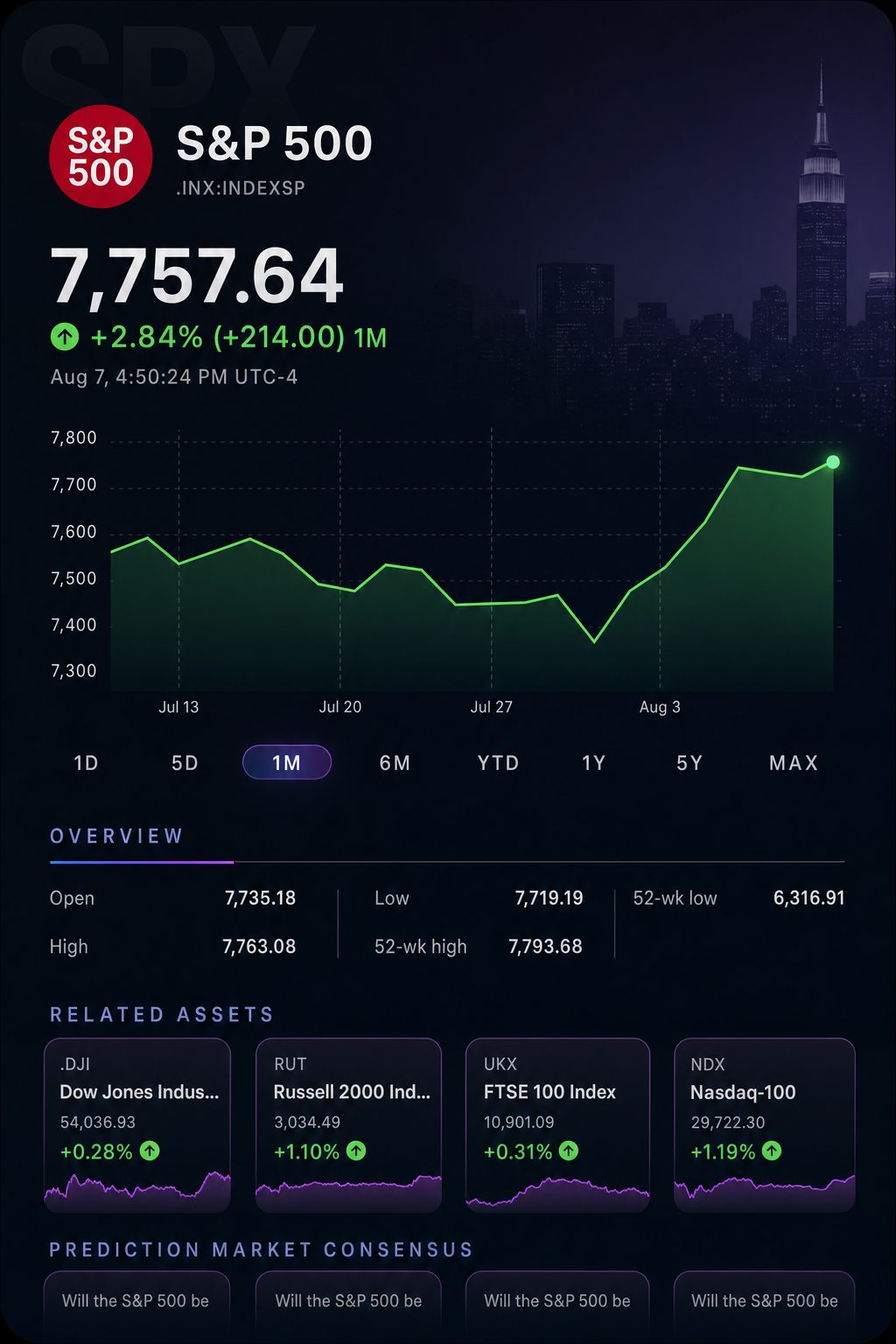
The key takeaway for investors lies in the combination, rather than the historical outcome. Odds of a September rate increase dropped by 23 percentage points. At the same time, the earnings-beat rate stayed 17.1 points over its long-term norm. Tom Siomades at AE Wealth Management commented, “earnings have been stellar.” Reuters
The market’s response to soft employment figures on Friday was driven by that combination. Investors benefited from a reduced expected discount rate while maintaining their profit foundation.
Closing performance of major indexes on Friday
| Index | Friday close | Friday | Week | 2026 year to date |
|---|---|---|---|---|
| S&P 500 | 7,757.64 | up 0.62% | up 3.58% | up 13.3% |
| Nasdaq Composite | 26,690.62 | up 1.30% | up 5.19% | up 14.8% |
| Dow Jones Industrial Average | 54,036.93 | up 0.28% | up 2.96% | up 12.4% |
| Russell 2000 | 3,034.49 | up 1.1% | up 3.5% | up 22.3% |
Last week, the Nasdaq outperformed the Dow by 2.23 percentage points. The majority of the policy-driven gains were concentrated in rate-sensitive growth stocks. Small cap stocks also advanced by 3.5%, indicating the rally had some breadth.
The employment data released on Friday delivered the decisive trigger. Payrolls declined by 23,000, missing forecasts of an 80,000 gain. The unemployment rate edged down to 4.1%, in part due to a shrinking labor force.
The rally’s dual foundations
| Signal | Latest reading | Comparison | Difference |
|---|---|---|---|
| July nonfarm payrolls | -23,000 | +80,000 forecast | -103,000 |
| September Fed hike probability | 44% | 67% one week earlier | -23 percentage points |
| S&P 500 earnings-beat rate | 85.1% of 436 reports | 68% average since 1994 | +17.1 points |
| S&P 500 forward P/E, Tuesday | 20.4 times | 22.2 times at 2025 year-end | -8.1% |
| Second-quarter adjusted earnings growth | +31.1% year over year | Peak since 2021 | — |
As a result, valuation appears less extended than the index’s position indicates. As of Tuesday, the forward multiple was roughly 8% under where it stood at the end of last year. Much of the market’s rise has been offset by strong earnings growth.
The situation is still fragile. Inflation now plays the key role in determining if slower job growth will hold back the Federal Reserve. A higher-than-expected reading would swiftly revive anticipation of rate increases.
Data outlook for the week: consensus forecasts, provisional until published
| Date and time, ET | Release | Consensus estimate | Previous |
|---|---|---|---|
| Tuesday, 10:00 a.m. | Existing home sales | 4.01 million | 4.09 million |
| Wednesday, 8:30 a.m. | CPI, month-on-month | +0.1% | -0.4% |
| Wednesday, 8:30 a.m. | CPI, year-on-year | +3.4% | +3.5% |
| Wednesday, 8:30 a.m. | Core CPI, month-on-month | +0.3% | 0.0% |
| Wednesday, 8:30 a.m. | Core CPI, year-on-year | +2.5% | +2.6% |
| Thursday, 8:30 a.m. | Producer price index, month-over-month | +0.2% | -0.3% |
| Thursday, 8:30 a.m. | Core producer prices | +0.3% | +0.1% |
| Friday, 8:30 a.m. | Retail sales | +0.1% | +0.2% |
| Friday, 8:30 a.m. | Retail sales ex-autos | +0.2% | -0.2% |
| Friday, 10:00 a.m. | Preliminary consumer sentiment | 54.5 | 54.2 |
Wednesday presents the clearest test. A Reuters poll forecasts headline inflation at 3.4% and core inflation at 2.5%. On Friday, the 10-year Treasury yield hovered around 4.64%, making tech valuations vulnerable to any upside surprise.
Friday’s retail sales data will challenge the remaining key support. Sluggish consumer spending may add to signals of a cooling job market. This could put corporate earnings projections at risk. Conversely, robust sales alongside persistent inflation would likely push yields upward.
Upcoming company results are set to scrutinize the AI investment chain. The Philadelphia semiconductor index is still higher by more than 70% this year, but remains over 15% under its peak from late June, highlighting how rapidly expectations may shift.
Key analyst recommendations before earnings — individual views, not consensus
| Company | Analyst and firm | Rating | Target | Main premise |
|---|---|---|---|---|
| CoreWeave NASDAQ:CRWV | Param Singh and Jake Heimowitz, Oppenheimer Holdings (NYSE:OPY) | Outperform | $150 over 12–18 months | Analysts believe fears around capacity delays are overstated |
| Cisco Systems NASDAQ:CSCO | David Vogt, UBS Group NYSE:UBS | Buy | $132 over 12 months | Anticipated rise in AI networking and infrastructure need |
| Applied Materials NASDAQ:AMAT | Brian Chin and Daniela Talio, Stifel Financial NYSE:SF | Buy | $650 over 12 months | Robust spending projected in DRAM, advanced logic and packaging |
Key tech earnings: consensus or initial company forecasts; all times in ET
| Company | Reporting time | Revenue view | Profit or margin view | Status |
|---|---|---|---|---|
| CoreWeave | Tuesday, 5:00 p.m. | $2.56 billion, up 110.7% | Per-share loss of $1.42 | Consensus |
| Super Micro Computer NASDAQ:SMCI | Tuesday, 5:00 p.m. | Expected at lower end of $11.0–$12.5 billion range | Gross margins of 15%–17% | Company preliminary, unaudited |
| Cisco Systems | Wednesday, after close | $16.83 billion, an increase of 14.7% | $1.17 per share, up 18.2% | Consensus |
| Applied Materials | Thursday, after close | $9.01 billion, up 23.4% | $3.39 per share, a rise of 36.7% | Consensus |
The earnings benchmarks stay high. Cisco and Applied Materials are projected to post double-digit gains in both revenue and earnings. CoreWeave needs to demonstrate that capacity expansion is keeping pace and that delays are being brought under control.
Super Micro offers a distinct picture. Preliminary revenue comes in close to the low end of its forecast, but projected margins are nearly double the previously indicated range. Final figures could still be revised.
Risks: A higher-than-expected CPI, increased oil market swings or climbing Treasury yields have the potential to pressure growth-stock valuations. On the other hand, disappointing retail sales might refocus investors on possible earnings cuts. Company outlooks are also contributing to volatility.
Wall Street starts Monday supported by two factors but facing a key challenge. Robust earnings may balance weaker job growth as long as inflation does not push the Fed to act. Whether this trade-off continues will be revealed on Wednesday.
Related articles: US Economy