
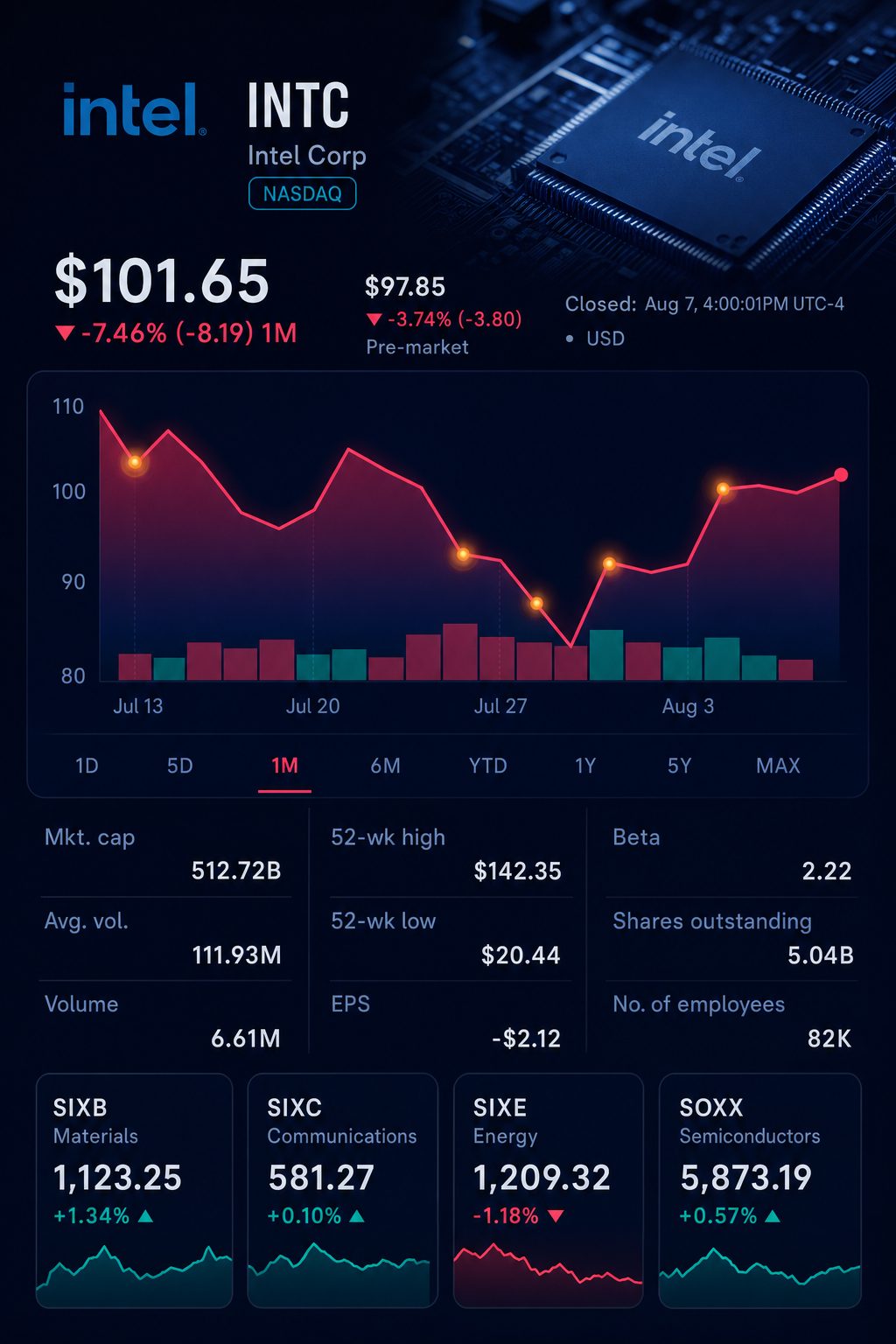
SANTA CLARA, California, August 10, 2026, 09:02 EDT — Premarket trading continued for U.S. cash equities after Intel revealed its $15 billion stock offering at 07:45 EDT.
- Intel announced an underwritten common stock offering valued at $15 billion.
- Underwriters have the option to purchase an additional $2.25 billion over the next 30 days.
- Assuming a $100 price, the base offering would increase the share count by 150 million.
- Intel stock dropped over 3% ahead of Monday’s market open.
Intel Corporation NASDAQ:INTC on Monday announced a $15 billion share offering. Shares were down over 3% in pre-market trading. The company’s stock price has increased by more than 100% this year.
The timing transforms a strong rally into a boost for manufacturing capital. In July, Intel increased its capital-expenditure forecast for 2026 from $18 billion to over $20 billion. The base offering represents roughly 75% of that $20 billion figure.
Current shareholders will incur a tangible dilution. Intel reported 5.044 billion shares in circulation as of July 17. Assuming a $100 offer price, the deal would lift share count by about 3.0%. The final offer price is yet to be determined. Intel could also exercise a $2.25 billion underwriter option.
| Offering scenario | Gross proceeds | Illustrative new shares at $100 | Share-count increase | Ownership dilution |
|---|---|---|---|---|
| Initial deal | $15.00 billion | 150.0 million | 3.0% | 2.9% |
| Including full 30-day option | $17.25 billion | 172.5 million | 3.4% | 3.3% |
The calculation highlights the main trade-off for the central investor. Issuing at a lower price means more shares are needed, while a higher price requires fewer shares. Net proceeds will be less than the total amount due to discounts and fees.
Intel stated that the funds could be used for capital spending and working capital requirements. The company also aims to maintain its investment-grade rating. Underwriters have the option to purchase an additional $2.25 billion at the offering price.
The balance sheet offers perspective. On June 27, Intel reported $12.874 billion in cash and $16.853 billion in short-term investments. Total debt stood at $48.549 billion. A base sale would represent roughly half of the combined value of its cash and short-term investments.
Management attributes the rise in spending to growing demand. CEO Lip-Bu Tan stated, “AI is driving unprecedented demand for compute.” CFO Dave Zinsner noted that Intel was “meaningfully increasing our investments in equipment, clean room space, and substrates.” Intel second-quarter results
The most recent quarter reinforces that argument. Revenue grew 25% to $16.1 billion. Data Center and AI revenue surged 59% to reach $6.3 billion. Foundry revenue advanced 31% to $5.8 billion, factoring in internal sales.
Intel’s published results offer the clearest basis for year-on-year operating comparison. The GAAP loss reflected a $12.5 billion mark-to-market charge related to U.S. government escrowed shares. Core margins nonetheless rose significantly.
| Metric | Q2 2026 | Q2 2025 | Change |
|---|---|---|---|
| Revenue | $16.1 billion | $12.9 billion | +25% |
| GAAP gross margin | 40.4% | 27.5% | +12.9 points |
| GAAP operating margin | 11.1% | -24.7% | +35.8 points |
| Non-GAAP diluted EPS | $0.42 | -$0.10 | Returned to profit |
Investment prospects hinge on more than demand. Intel needs to turn its expenditures into competitive manufacturing capacity and secure deals as an external foundry. Taiwan Semiconductor Manufacturing Co. NYSE:TSM continues to dominate in contract chip manufacturing. Intel is aiming for large-scale 14A production in 2028.
The sale is still contingent on market conditions. J.P. Morgan, Goldman Sachs, Morgan Stanley and Citigroup have been appointed as joint book-runners. Share issuance and near-term dilution will be clarified after final pricing.
Wall Street’s outlook stays measured even as Intel shows improvement. TipRanks lists 33 analyst ratings, with a consensus of Hold. The average price target for the next 12 months stands at $119.11, ranging from $80 to $200.
| Recommendation | Analysts | Share of tracked ratings |
|---|---|---|
| Buy | 7 | 21.2% |
| Hold | 24 | 72.7% |
| Sell | 2 | 6.1% |
The division is significant. While the majority of analysts recognize increased demand, they stop short of supporting the valuation. The offer requires investors to back growth ahead of Intel demonstrating consistent foundry profitability.
Risks: The sale may be priced under the latest market value. Production setbacks, soft demand abroad or unexpected costs might reduce returns. Opting for a smaller transaction would maintain a larger stake but result in reduced funds for expansion.
The upcoming catalyst is specific: Intel’s definitive offer price, the number of shares to be issued, and the total net proceeds. At nearly $100, the main transaction would increase the share count by about 3%.
Related articles: NASDAQ:INTC