
NEW YORK, August 19, 2026, 10:02 EDT
- TLT rose 1.56% as the 30-year Treasury yield retreated from a 19-year high.
- Treasury will raise long-end buybacks from $2 billion to at least $4 billion per operation.
- The added $2 billion is modest beside TLT’s 14.83-year duration risk.
The iShares 20+ Year Treasury Bond ETF NASDAQ:TLT jumped 1.56% to $82.94 on Wednesday morning after the U.S. Treasury doubled planned buybacks of long-dated debt. The announcement pulled the 30-year yield down to 5.187%, after it touched 5.337% on Tuesday. That was its highest level since 2007.
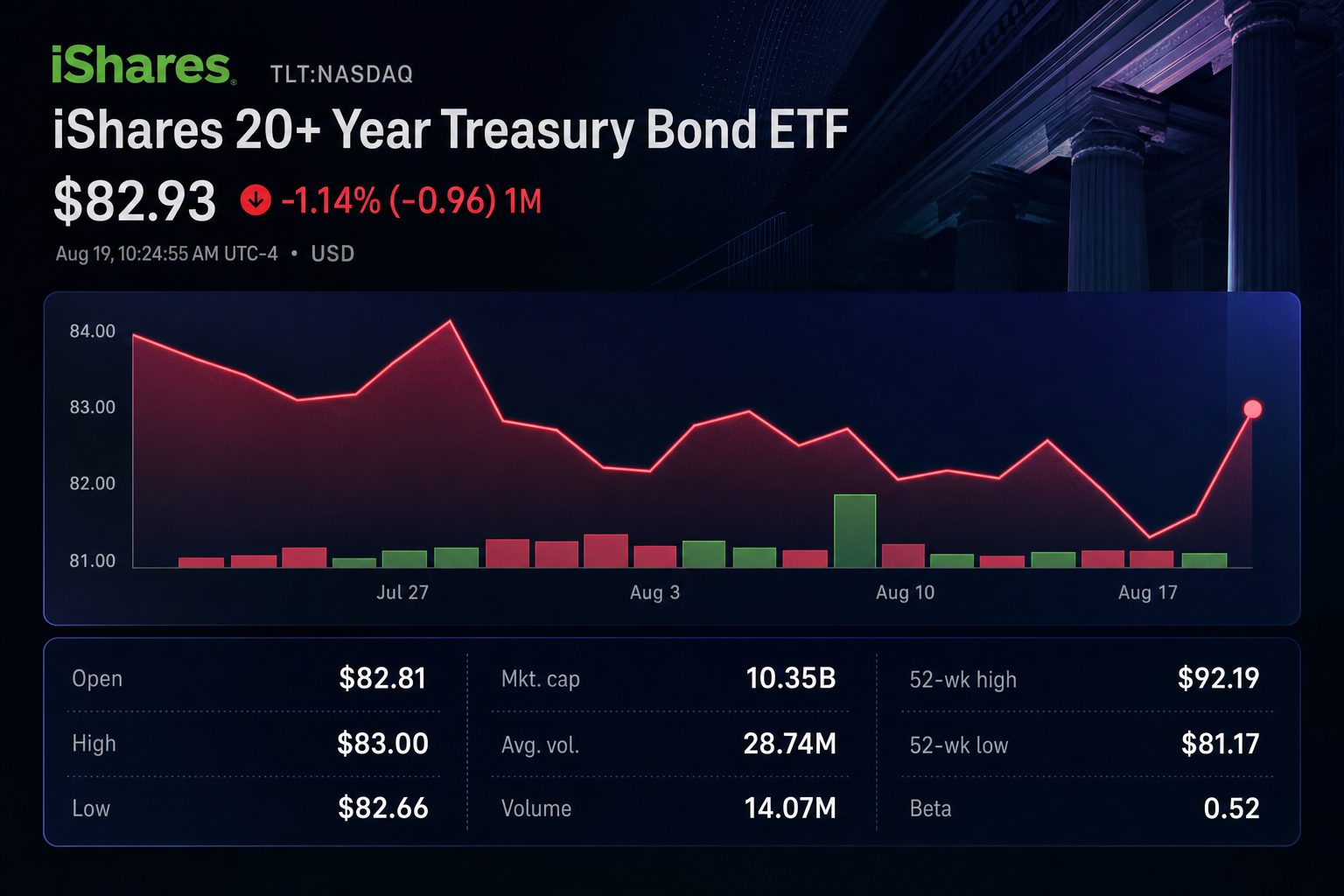
The rally shows why duration still matters more than buyback size. TLT carried 14.83 years of effective duration on August 18. A simple duration estimate maps the 15-basis-point yield reversal to roughly a 2.2% price gain, before convexity and curve effects. The observed move was smaller, but directionally close.
| Listed Treasury proxy | Effective duration | Intraday move at 10:02 EDT |
|---|---|---|
| iShares 20+ Year Treasury Bond ETF NASDAQ:TLT | 14.83 years | +1.56% |
| iShares 7-10 Year Treasury Bond ETF (NASDAQ:IEF) | 6.84 years | +0.44% |
| iShares 1-3 Year Treasury Bond ETF (NASDAQ:SHY) | 1.81 years | +0.01% |
The duration ladder strengthens that reading. TLT gained more than three times IEF’s percentage move, while SHY barely changed. The market rewarded exposure to the part of the curve Treasury directly targeted.
| Buyback measure | Before | New plan | Investor reading |
|---|---|---|---|
| Maximum per long-end operation | $2 billion | At least $4 billion | Liquidity support doubles |
| Eligible maturity sectors | 10-20 and 20-30 years | Unchanged | Directly overlaps TLT’s long-duration exposure |
| Effective window | Existing schedule | September 9-November 4 | Temporary quarter-end support |
| August 18 offers versus purchases | Nearly $20 billion offered | $2 billion bought | About 10 times coverage |
The program is designed to improve trading in older, off-the-run securities. It does not retire debt permanently or reduce planned issuance. Treasury said the increase reflects strong sponsorship and a large volume of high-quality offers.
Scale remains the constraint. The extra $2 billion per operation equals about 4.3% of TLT’s $46.1 billion in net assets. It is far smaller against the overall Treasury market. Tuesday’s operation also left roughly 90% of submitted bonds unbought.
| TLT metric | Latest value | Why it matters |
|---|---|---|
| Net assets | $46.09 billion | Large, liquid listed proxy |
| Effective duration | 14.83 years | High sensitivity to yield changes |
| Weighted average maturity | 25.70 years | Concentrated at the long end |
| Average yield to maturity | 5.33% | Income cushion before fees |
| 30-day SEC yield | 5.21% | Standardized current income measure |
| Expense ratio | 0.15% | Annual fund cost |
| YTD NAV total return | -3.90% | Rally has not erased 2026 losses |
Income now offers a larger cushion. Yet TLT’s 5.21% SEC yield cannot absorb a sharp renewed rise in long rates. A 25-basis-point increase would imply about a 3.7% duration loss before income and convexity.
Jeremy Stretch, CIBC’s head of G10 foreign-exchange strategy, said the long-end selloff risked spilling into other asset classes. Treasury’s adjustment showed it was prepared to limit market pressure, he said. Rene Albrecht, a senior analyst at DZ Bank, linked the action to the pain created by long yields above 5%.
| Analyst | Verified view | Investor recommendation implied by the view |
|---|---|---|
| Jeremy Stretch, CIBC | Treasury is acting to limit long-end pressure and cross-asset spillovers. | Treat the rally as policy-supported relief, not proof that inflation and debt risks have cleared. |
| Rene Albrecht, DZ Bank | Yields above 5% raise costs for government and private borrowers. | Watch the 5% area as a policy-sensitivity zone, while keeping duration exposure sized for volatility. |
The central investor question is whether buybacks improve liquidity without being mistaken for yield control. The new plan begins September 9. Operations are already scheduled for the 10-20 year sector on September 10 and the 20-30 year sector on September 24.
Risks: Inflation, oil prices, fiscal deficits and heavy bond issuance can push long yields higher again. A renewed 30-year move toward Tuesday’s peak would reverse much of TLT’s rally. Faster growth or a hawkish Federal Reserve would add pressure.
Treasury will publish an updated calendar later. It will reassess buyback sizes at the November 4 quarterly refunding. Until then, TLT remains a high-conviction duration trade rather than a low-volatility income holding.
Related articles: Stock Market







Buyback relief meets 14.83 years of duration
Live market snapshot: August 19, 2026, 10:02 EDT · U.S. market open
August 19, 2026, 10:02 EDT
Previous close: $81.66
Down from Tuesday's 5.337% peak
Fund data as of August 17, 2026
Duration drove the reaction
Buyback scale
The extra $2 billion equals roughly 4.3% of TLT's assets, but only a small share of the Treasury market.
Fund profile
| Metric | Value |
|---|---|
| Net assets | $46.09B |
| Average yield to maturity | 5.33% |
| Weighted average maturity | 25.70 years |
| Expense ratio | 0.15% |
| YTD NAV total return | −3.90% |
Fund metrics dated August 17–18, 2026, depending on item.
Scenario sensitivity
*First-order duration estimate using 14.83 years. It excludes income, convexity, curve shifts, tracking difference and trading effects.
TLT's 1.56% gain was more than triple IEF's move. The long end, not the front end, absorbed the policy signal.
Upcoming checkpoints
| September 9 | New sizing begins |
| September 10 | 10–20Y operation |
| September 24 | 20–30Y operation |
| November 4 | Quarterly refunding review |