
BEAVERTON, Oregon, August 19, 2026, 14:20 EDT
- Nike traded at $40.96 at 13:59 EDT, up 2.26% after closing at a 12-year low on Monday.
- Wall Street’s average target implies 23.4% upside, but the target range spans $40 to $75.
- Fiscal 2026 wholesale sales rose 4% currency-neutral while Nike Direct fell 8%.
Nike Inc. NYSE:NKE rebounded 2.26% to $40.96 on Wednesday afternoon, two sessions after its lowest close since 2014. The bounce recovered only a fraction of the long decline. Shares remain about 49% below their 52-week high.
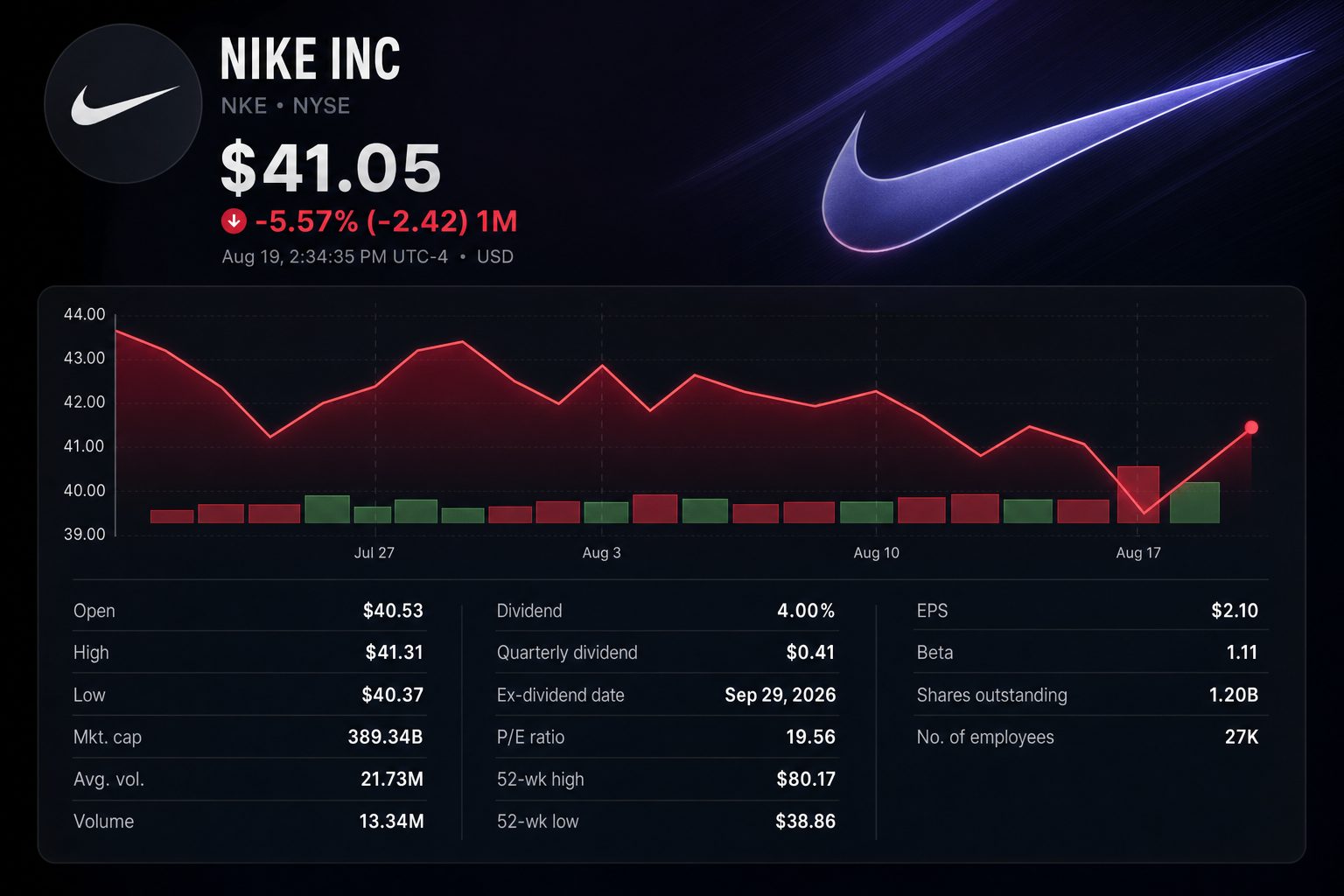
The investor question is no longer whether Nike looks cheap. It is whether earnings can stabilize before the remaining valuation support disappears. The current price sits just 2.4% above the Street’s lowest target.
| Market snapshot | Reading | Investor signal |
|---|---|---|
| Price | $40.96 | Up 2.26% intraday |
| Day range | $40.37-$41.30 | Still near the bearish target |
| 52-week range | $38.86-$80.16 | Near the bottom 5% of range |
| Volume at 13:59 EDT | 12.74 million | 59% of average full-day volume |
| Average analyst target | $50.55 | 23.4% above price |
Trading activity makes the recovery less convincing. Roughly 69% of the regular session had elapsed, but volume was only 59% of the usual full-day total. The rally lacked a clear surge in participation.
The deeper pressure sits in Nike’s channel mix. Fiscal 2026 revenue was $46.4 billion, flat as reported and down 2% currency-neutral. Wholesale rose while Direct contracted sharply.
| Fiscal 2026 operating test | Result | Year-on-year / currency-neutral |
|---|---|---|
| Total revenue | $46.4 billion | -2% |
| Wholesale revenue | $27.5 billion | +4% |
| Nike Direct revenue | $17.7 billion | -8% |
| Nike Brand Digital | $8.6 billion | -12% |
| Greater China revenue | $5.85 billion | -13% |
| Gross margin | 42.9% | +20 basis points reported |
That split matters. Wholesale can rebuild shelf space quickly, but weaker Direct sales reduce Nike’s control over pricing and customer data. Digital sales fell 12%, mainly because traffic declined.
Chief Executive Elliott Hill said Nike had made “important structural improvements” during the year. He also acknowledged a challenging revenue environment. The next proof point is consistent full-price demand, not another distribution shift. Nike’s results statement
Competition raises the bar. adidas AG (ETR:ADS) reported 14% currency-neutral second-quarter growth and 25% Direct-to-Consumer growth. Its gross margin reached 52.5%. Nike’s latest quarter was distorted by a $986 million tariff recovery, so the headline 49.2% margin is not a clean run rate.
| Analyst / firm | Latest action | Rating | Target |
|---|---|---|---|
| Piral Dadhania, Royal Bank of Canada NYSE:RY | Maintained, Aug. 19 | Hold | Not listed |
| Matthew Boss, J.P. Morgan NYSE:JPM | Downgraded, Aug. 4 | Sell | $40 |
| Aneesha Sherman, Bernstein | Maintained, July 29 | Buy | $68 |
| Ike Boruchow, Wells Fargo NYSE:WFC | Maintained, July 24 | Hold | $40 |
| Consensus, 25 analysts | 9 Buy / 14 Hold / 2 Sell | Hold-leaning | $50.55 average |
J.P. Morgan analyst Matthew Boss sees a longer earnings reset. His fiscal 2028 estimate of $1.72 sits about 20% below consensus, while the $40 target values Nike near 21 times calendar 2028 earnings. That leaves little room for another delay.
The bullish case rests on measurable change. North American revenue grew 5% currency-neutral last year. Running and performance products have also improved. Yet Greater China fell 13%, and inventories ended flat at $7.5 billion despite softer Direct demand.
Risks: Faster product sell-through or successful new launches could make today’s price overly pessimistic. The downside is another earnings reset, prolonged China weakness, heavier discounting or tariff pressure.
For investors, $40 is the near-term line. A durable bottom needs stronger Direct traffic, better China sales and margin gains excluding refunds. Until those arrive, the wide target range is evidence of uncertainty, not hidden consensus.
Related articles: NYSE:NKE

Nike: the $40 bottom test
Regular U.S. session open
Nike has recovered from Monday's 12-year closing low, but price alone does not settle the turnaround debate. Wholesale is growing while Direct and China shrink. The stock needs evidence that product demand—not channel loading or one-off refunds—can rebuild earnings.