
NEW YORK, August 26, 2026, 03:07 EDT – Moderna’s stock rose 14.4% as a cancer-vaccine repricing move lifted the company’s market capitalization by $8 billion.
- Moderna finished Tuesday at $158.83, a gain of 14.36%, following an upgrade by Wolfe Research.
- The $19.94 rise increased quoted equity value by around $8.0 billion.
- Comprehensive Phase 3 efficacy results and overall survival statistics are still awaited.
Moderna Inc. (NASDAQ:MRNA) surged 14.36% on Tuesday to close at $158.83 after Wolfe Research raised its rating on the stock to Peer Perform from Underperform. The $19.94 increase boosted Moderna’s quoted equity value by approximately $8.0 billion.
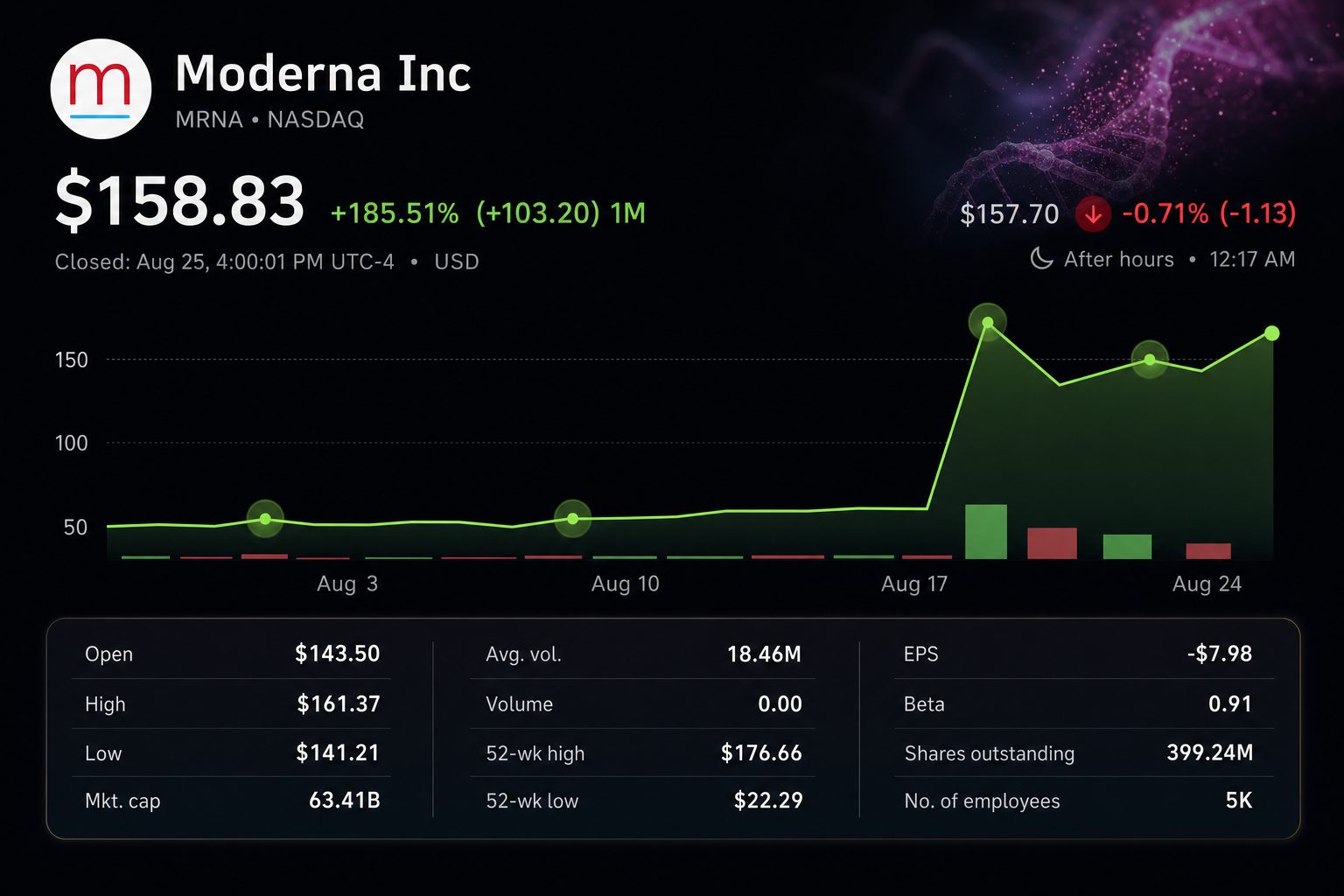
Moderna’s market capitalization reached about $63.4 billion following the move, far surpassing its second-quarter revenue of $145 million. The valuation reflects investor expectations for an oncology platform, rather than present vaccine sales.
No additional clinical data was released on Tuesday. Wolfe described the melanoma result as a significant de-risking milestone for personalized therapy. However, the firm cautioned that profitability may not be achieved before 2030.
The upgrade came after Moderna achieved Phase 3 results in partnership with Merck & Co. (NYSE:MRK). Their intismeran-Keytruda therapy reached two melanoma goals on August 19. The study included 1,137 patients who had undergone surgical removal of tumors.
The combination led to gains in recurrence-free and distant-metastasis-free survival. The companies, though, did not disclose hazard ratios or absolute event rates. Overall-survival monitoring is ongoing.
Intismeran is created based on the unique tumor sequence of each patient. It is capable of encoding up to 34 individual tumor mutations. Patients are treated with as many as nine tailored doses, administered in combination with Keytruda.
Moderna finished trading at $62.96 prior to the readout. On Tuesday, shares were up 152.3%. The increase amounts to roughly $38.3 billion in added equity value. However, the stock remained 8.9% lower than its closing price on August 19.
| Investor measure | Latest reading | Signal |
|---|---|---|
| Tuesday close | $158.83; +14.36% | $8.0 billion one-session market cap jump |
| Trading volume | 49.05 million shares | 3.7 times the three-month daily average |
| Wolfe Research | Peer Perform; no target | Rating revised on August 25 |
| Barclays | Equal Weight; $125 target | Target is 21.3% under Tuesday’s finish |
| S&P Global consensus | Hold; $99.82 average target | Target stands 37.2% below Tuesday’s closing price |
Analyst views are mixed following the trial. Barclays increased its price target to $125 from $48. JPMorgan upped its target to $77 while maintaining an Underweight rating. The consensus among 23 analysts remains Hold.
Debate is intensifying amid balance-sheet pressure. Moderna reported a $782 million loss for the second quarter. Sequentially, cash and investments declined by $600 million to $6.9 billion. In July, the company made a $950 million litigation payment.
Management anticipates ending the year with cash between $4.7 billion and $5.2 billion. The company also projects research expenses of $2.9 billion in 2026. Progress in oncology will need to ultimately counterbalance the operating cash burn.
The individualised manufacturing process introduces an additional implementation hurdle. Producing each therapy involves sequencing, algorithmic design, and patient-tailored manufacturing. Adoption may be limited if there are delays or elevated per-unit expenses.
Risks: Comprehensive Phase 3 results might limit the perceived advantage. Overall survival benefit has yet to be established. Regulators could ask for additional analyses. Outcomes in different tumor types could vary.
The complete trial presentation will provide the next key evidence. The companies intend to hold regulatory discussions as well. Intismeran is being evaluated in nine clinical studies spanning multiple tumor types.
Tuesday’s rally reflected more than just enthusiasm for melanoma. Investors highlighted Moderna as a cancer-platform opportunity. The ultimate sustainability of that premium rests on forthcoming efficacy details.
Related articles: NASDAQ:MRNA






![UK Stock Market Today 26/08/2026 [UPDATE: 09:01 BST] [Miners Offset Oil Majors as Brent Slides Below $86]](https://ts2.tech/wp-content/uploads/2026/08/UK-market-dashboard-2026-08-26-0901-480x384.jpg "UK Stock Market Today 26/08/2026 [UPDATE: 09:01 BST] [Miners Offset Oil Majors as Brent Slides Below $86]")