
LONDON, August 3, 2026, 12:08 BST
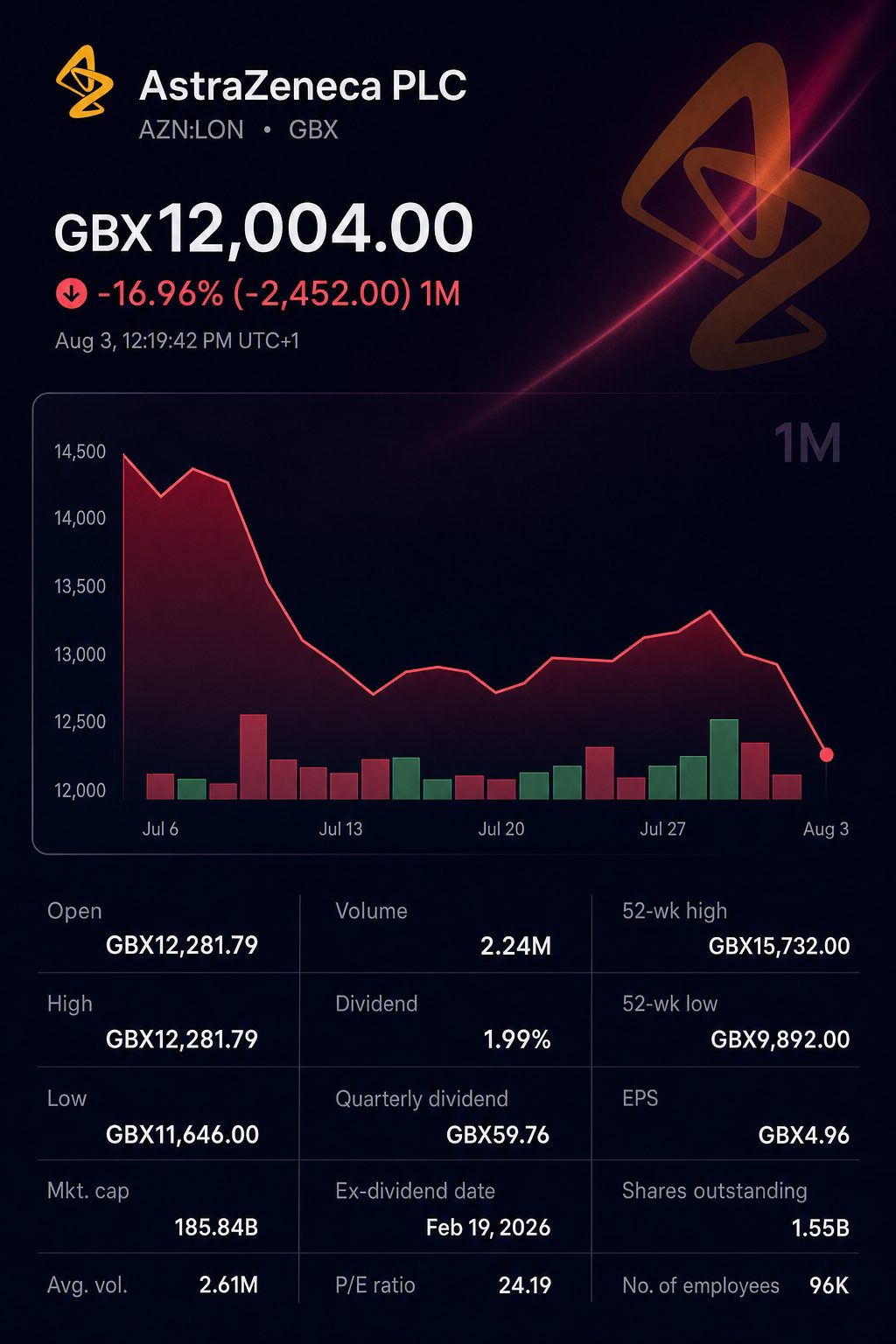
- AstraZeneca traded close to 11,994 pence at 11:58 BST, down 5.03% as London markets remained open.
- Bristol Myers Squibb Company NYSE:BMY gained 6.03%, reaching $69.25 prior to the start of the U.S. cash trading session.
- Initial estimates of market value indicate a total loss nearing $5.2 billion.
AstraZeneca shares dropped roughly 5% on Monday following news of early-stage merger discussions. Bristol Myers gained approximately 6% ahead of the New York cash session.
The divided response sends the strongest signal to investors. Bristol could secure a premium, while AstraZeneca seems to face higher strategic costs.
Based on Friday’s market prices, AstraZeneca saw a decrease of approximately $13.3 billion in value. Bristol added roughly $8.0 billion. The initial overall net loss stood at $5.2 billion, or 1.3%.
| Market reaction | AstraZeneca | Bristol Myers | Combined |
|---|---|---|---|
| Price at snapshot | 11,994p midpoint | $69.25 premarket | — |
| Share change | -5.03% | +6.03% | — |
| Market cap as of Friday | $264.11bn | $133.41bn | $397.52bn |
| Implied post-move value | $250.8bn | $141.5bn | $392.3bn |
| Initial value shift | -$13.3bn | +$8.0bn | -$5.2bn |
The calculation uses percentage changes based on Friday’s market capitalizations in dollars. It omits intraday fluctuations in currencies and utilizes a Bristol quote from extended trading hours.
The gap indicates investors anticipate costs in addition to the target premium, which could involve financing, integration and governance risk for AstraZeneca.
A person familiar with the situation said the talks were at an early stage. The present status of the discussions is unknown. AstraZeneca declined to comment. Bristol Myers did not reply.
Lucy Coutts, investment director at JM Finn and holder of AstraZeneca shares, viewed the results as mixed. “On balance, BMS shareholders would be the winners,” she said. Reuters
Investors expressed caution despite robust performances from both companies. AstraZeneca’s cancer unit maintained momentum, while Bristol recently lifted its yearly forecast.
| Latest operating measure | AstraZeneca | Bristol Myers |
|---|---|---|
| Second-quarter revenue | $15.384bn | $12.973bn |
| Revenue growth | +5% CER; +6% actual | +5% ex-FX; +6% actual |
| Adjusted quarterly EPS | $2.63 core; +18% CER | $2.04 non-GAAP; +40% |
| Main growth engine | H1 oncology: $14.1bn, +15% CER | Q2 Growth Portfolio: $7.56bn, +15% |
| 2026 revenue guidance | Mid-to-high single-digit CER rise | $49bn-$50bn |
| 2026 adjusted EPS guidance | Low-double-digit CER increase | $6.75-$7.00 |
AstraZeneca discloses core results and growth at constant exchange rates. Bristol publishes non-GAAP results and excludes currency fluctuations from its growth figures.
AstraZeneca is still targeting $80 billion in revenue by 2030, CEO Pascal Soriot said. He pointed to “more than twenty high-value readouts” expected over the next 18 months. The strong pipeline makes pursuing a megadeal less likely. BioSpace
The United States presents the strongest strategic case. AstraZeneca is aiming for approximately $40 billion in 2030 revenue from the country. Bristol reported $9.0 billion in second-quarter U.S. sales, accounting for about 69% of its overall total.
However, there is significant crossover. Oncology is the core focus for each company, with their checkpoint treatments in direct competition.
| Strategic factor | AstraZeneca | Bristol Myers | Investor implication |
|---|---|---|---|
| U.S. position | Aims for 50% of $80bn revenue in 2030 from the U.S. | The U.S. accounted for about 69% of Q2 revenue | Rapid expansion, but at a high cost |
| Oncology exposure | $14.1bn; oncology comprised 46% of H1 sales | Over 40% of H1 revenue stems from oncology | Significant concentration and product overlap |
| Checkpoint medicine | Imfinzi | Opdivo | Head-to-head rivalry |
| Pipeline and patents | Over 20 clinical readouts due in the next 18 months | Opdivo and Eliquis may lose patent protection by 2028 | Risk of dilution, potential for fixes |
The operating comparisons are derived from company statements and public market data. Analysis of investor implications represents interpretive conclusions.
Antitrust attorney Andre Barlow noted that extensive overlap might necessitate “meaningful divestitures.” These types of remedies could take away assets that support the rationale for the deal. Reuters
Bristol faces continued legacy declines. Opdivo revenue declined by 3% in the latest quarter. Revlimid plunged 49%, even as various newer medicines recorded quicker sales growth.
Risks are apparent. Negotiations could conclude without reaching an agreement. If financing plans or premium levels fall short, a formal bid might add pressure on AstraZeneca. Antitrust solutions could undermine the rationale for the deal.
The next clear indication will arrive at 14:30 BST as New York’s market opens. Bristol’s action during the cash session will challenge the gains made outside regular hours. The $5.2 billion discrepancy in value stands as the main reference until further details are disclosed.